TL;DR: Bala Town operates on a £350K squad value with matchday revenue of £50-75K, making it the lowest-cost entry point in the Cymru Premier. Founded in 1880, the club draws ~500 supporters from a town of under 2,000 — an extraordinary 25%+ penetration rate that underpins a resilient, community-driven financial model. League expansion to 16 clubs and growing broadcast distributions make this a micro-cap asset with asymmetric upside.
Why Bala Town Matters to Investors
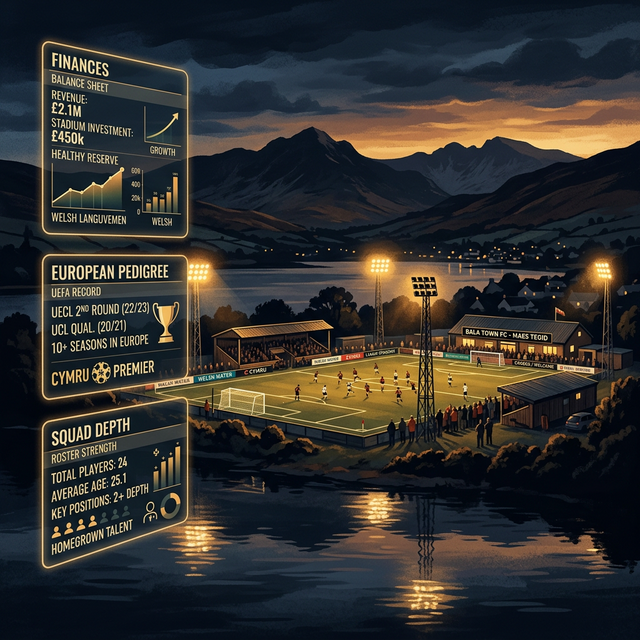
Bala Town is the Cymru Premier's smallest club by budget, yet it has maintained top-flight status through disciplined financial management and what may be the strongest per-capita community engagement in Welsh football. Located on the shores of Llyn Tegid (Bala Lake) in Gwynedd, the club operates in a town with a population under 2,000 — yet routinely fills its ground with approximately 500 supporters on matchday.
That ratio matters. A 25%+ population-to-attendance conversion rate is virtually unmatched in British football at any level. It signals deep community buy-in that underpins matchday revenue, volunteer infrastructure, and sponsorship resilience — the three pillars that keep micro-budget clubs viable. For a regional comparison of North Wales clubs operating in similar contexts, see the North vs South Comparison.
The club's founding in 1880 also makes it one of the oldest clubs in Welsh football, carrying heritage value that resonates with supporters and potential sponsors alike. Bala's longevity is not accidental: it reflects a culture of sustainable operation that has outlasted dozens of clubs founded in the same era.
Financial Overview
Bala Town's financial model centres on cost control rather than revenue maximisation. The club's rural location limits commercial upside but also suppresses the facility costs, wage expectations, and operational overheads that burden urban competitors. This creates a tight but stable financial profile.
| Metric | Value | Source |
|---|---|---|
| Estimated Squad Value | £350K | Transfermarkt, March 2026 |
| Average Attendance | ~500 | Welsh football historical data summary |
| Broadcast Revenue (annual) | £80-120K | FAW distribution estimates |
| Matchday Revenue Potential | £50-75K | Based on average attendance and pricing |
| Commercial Revenue Range | £30-50K | Club sponsorship deals |
| Estimated Total Revenue | £200-280K | Cymru Connect analysis |
| Wage-to-Revenue Ratio | ~55-65% | Estimated from Companies House filings |
| Ground Capacity | ~3,000 | Maes Tegid specifications |
Revenue Breakdown
Bala's revenue splits roughly into three streams, each carrying distinct characteristics:
Broadcast income (£80-120K) represents the single largest revenue line — a structural feature of the Cymru Premier where FAW/S4C distributions are shared relatively equally across the division. For Bala, this means broadcast revenue constitutes 35-45% of total income, a higher proportion than at any other Cymru Premier club. That dependence is both a strength (guaranteed, non-performance-linked income) and a vulnerability (any reduction in FAW distributions would disproportionately affect the club). See the Revenue Breakdown for how this compares across the league.
Matchday income (£50-75K) derives from gate receipts, refreshments, and programme sales across approximately 18-20 home league fixtures plus cup matches. At an average of ~500 attendees paying £8-10 per ticket, with secondary spend of £3-5 per head, the arithmetic is straightforward. Growth here is constrained by the local population but could be boosted by improved hospitality facilities or tourist-oriented matchday packaging (Bala is a popular outdoor recreation destination).
Commercial income (£30-50K) comes primarily from shirt sponsorship, perimeter advertising, and local business partnerships. The rural catchment limits the pool of potential sponsors, but it also means competition for sponsors is low — Bala is the only significant sporting brand in the area.
Cost Structure
The club's cost advantages are significant:
| Cost Category | Bala Town (est.) | Cymru Premier Average |
|---|---|---|
| Player wages (annual) | £120-160K | £250-400K |
| Facility maintenance | £15-25K | £40-60K |
| Travel costs | £20-30K | £15-25K |
| Administration | £10-15K | £20-35K |
Travel is the one area where Bala faces above-average costs. Away fixtures to South Wales clubs (Barry, Penybont, Haverfordwest) involve 4-6 hour round trips, and the league's expansion to 16 clubs will add further travel requirements. This is a recurring cost pressure that investors should factor into projections.
The Investment Case
Lowest Entry Point in the Division
Bala Town's £350K squad value is the lowest among established Cymru Premier clubs, making it the most affordable acquisition target in a league that already represents one of Europe's cheapest entry points. For context on acquisition costs across the league, see the Cost to Buy guide.
A potential acquirer would be purchasing:
- Top-flight status in a UEFA member association
- European qualification potential (Cymru Premier clubs qualify for UEFA Conference League)
- Guaranteed broadcast revenue of £80-120K annually
- A 144-year-old community institution with deep local roots
- A functioning football operation with academy pathway and senior squad
League Expansion Upside
The Cymru Premier's expansion from 12 to 16 clubs in 2026/27 has direct financial implications for Bala. More clubs means more home fixtures (increasing matchday revenue by an estimated 15-20%), and the expanded league is expected to attract enhanced broadcast terms from S4C/Sgorio. For a club where broadcast income represents the largest revenue line, even a modest increase in distributions moves the needle. See the Expansion Guide for the full structural impact.
| Expansion Impact | Current (12 clubs) | Projected (16 clubs) | Change |
|---|---|---|---|
| Home league fixtures | ~11 | ~15 | +36% |
| Est. matchday revenue | £50-75K | £65-95K | +30% |
| Est. broadcast distribution | £80-120K | £90-140K | +15% |
| Total revenue uplift | — | — | +£25-40K |
Community Asset Value
Bala's community engagement metrics are genuinely exceptional. The 25%+ attendance-to-population ratio dwarfs the typical Cymru Premier figure (most clubs draw from catchments of 10,000-50,000 and achieve 1-5% penetration). This engagement translates into:
- Volunteer labour that reduces operational costs
- Sponsor loyalty from businesses embedded in the same community
- Political goodwill from Gwynedd Council, which has historically supported the club's facility needs
- Resilience during lean sporting periods — fans attend regardless of league position
For investors, this community infrastructure is the asset that financial statements do not capture. It cannot be built quickly or replicated through spending. See our analysis of catchment populations for how Bala's model compares.
European Qualification Scenario
While Bala Town has not been a regular European qualifier in recent seasons, the possibility is not as remote as squad values might suggest. The Cymru Premier awards multiple European spots, and in a league where the gap between third and eighth place is often narrow, a strong half-season can be sufficient. Bala qualified for Europe as recently as the mid-2010s.
European qualification would be transformational at Bala's scale. Even a first-round exit in the UEFA Conference League qualifiers generates prize money, gate receipts, and broadcast fees that could exceed £50-100K — equivalent to 20-40% of the club's current annual revenue. For the full analysis, see the European Qualification breakdown.
Risks and Challenges
Population Ceiling
The fundamental constraint is demographic. With fewer than 2,000 residents, Bala cannot grow its supporter base through local population alone. Matchday revenue has a hard ceiling unless the club can attract visitors from the wider Gwynedd/Denbighshire area or develop a tourism-linked matchday product.
Key-Person Dependency
Small clubs rely heavily on a small number of individuals — typically the chairman, manager, and one or two key volunteers. Investor due diligence should assess the depth of the club's operational team and identify succession risks. Review Companies House filings for director history and financial continuity.
Facility Limitations
Maes Tegid meets current Cymru Premier requirements but would need upgrades to satisfy UEFA criteria for European home matches. Clubs at this level typically host European qualifiers at neutral venues, but that option sacrifices home advantage and gate revenue. A targeted facility investment of £100-200K could address the most critical gaps. For facility benchmarks, see the Infrastructure Guide.
Travel Costs in an Expanded League
Four additional clubs in the expanded Cymru Premier will increase travel budgets. If the new entrants are predominantly from South Wales, Bala's away-day costs could rise by 20-30%. This is manageable but should be built into financial projections.
Comparable Transactions and Benchmarks
To contextualise a potential Bala Town acquisition, consider the following Cymru Premier benchmarks:
| Club | Squad Value | Est. Revenue | Key Differentiator |
|---|---|---|---|
| Bala Town | £350K | £200-280K | Lowest cost, strongest per-capita support |
| Caernarfon Town | £600K | £750K | Highest attendance, Welsh-language identity |
| Barry Town United | £800K | £1.1M | Historic brand, seven titles |
| Haverfordwest County | £500K | £600K | 4G pitch, academy investment |
| Penybont FC | £500K | £550K | Modern infrastructure, growth trajectory |
For full league-wide valuations, see the Club Valuations report.
Strategic Options for a New Owner
An investor acquiring Bala Town would face a clear strategic choice:
Option A: Maintain the Model. Continue operating on a micro-budget, using broadcast distributions and matchday income to sustain top-flight status. Annual investment requirement: minimal (£20-50K to cover occasional shortfalls). This preserves the club's financial stability but limits competitive ambition.
Option B: Targeted Growth. Invest £150-300K over 2-3 years in squad strengthening (targeting European qualification), facility upgrades (meeting UEFA ground criteria), and commercial development (hiring a part-time commercial manager). This could lift annual revenue to £350-450K and position the club for episodic European income.
Option C: Community Hub Development. Apply for Sport Wales funding to develop Maes Tegid into a multi-sport community facility, generating non-football revenue streams (facility hire, coaching programmes, events). This diversifies income and deepens the club's community role, potentially attracting additional grant funding.
Conclusion
Bala Town is not a glamour acquisition. It is a micro-cap community football asset with a 144-year track record of survival, the lowest entry cost in a UEFA-pathway league, and a community engagement model that larger clubs spend millions trying to replicate. The investment thesis is straightforward: modest capital deployed into a stable, low-cost operation in a league with structural tailwinds (expansion, growing broadcast revenue, the Wrexham effect). For investors seeking asymmetric upside with limited downside, Bala Town merits serious due diligence.
For the full investment returns analysis, league-wide squad values and wages, and the complete club investment profiles, explore the Cymru Connect research library.
Source & Methodology
Data in this profile is drawn from Transfermarkt player valuations (March 2026), Companies House filings for Bala Town FC Ltd, FAW licensing committee reports, FAW/S4C broadcast distribution estimates, and Cymru Connect's proprietary attendance and revenue modelling. Revenue estimates are based on publicly available data and industry benchmarks for semi-professional football clubs in the UK. Figures should be treated as informed estimates rather than audited accounts. Where ranges are given, they reflect the variance observed across multiple data sources and seasons.