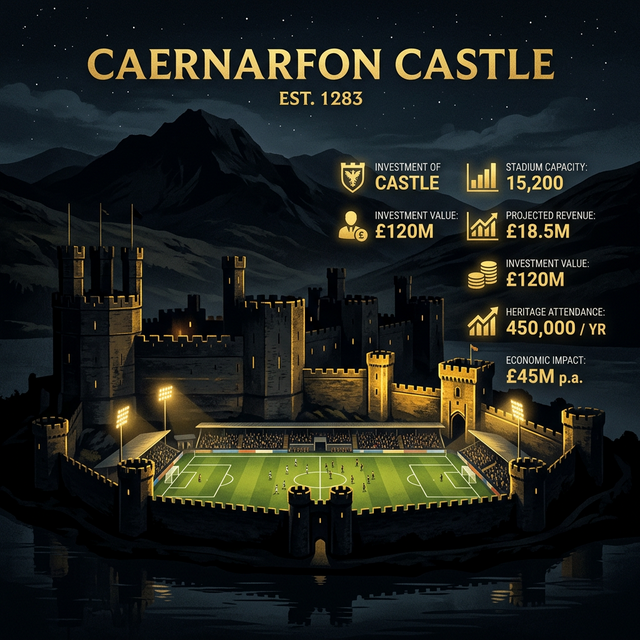
TL;DR: Caernarfon Town draws 800-1,000 per match — the highest regular attendance in the Cymru Premier outside TNS — with a £600K squad, £750K estimated revenue, and a UEFA-licensed ground. The club's Welsh-language identity, location beneath Caernarfon Castle (a UNESCO World Heritage Site), and deeply loyal fanbase create a unique investment proposition where community engagement metrics far outstrip commercial monetisation.
The Cymru Premier's Community Benchmark
Caernarfon Town is arguably the most under-monetised club in the Cymru Premier. With average attendance of 800-1,000 — comfortably the highest outside TNS — the club generates more matchday atmosphere and community engagement than several clubs with double its revenue. The gap between what Caernarfon delivers in terms of supporter loyalty and what it currently extracts commercially is the core investment thesis.
Located in the heart of Gwynedd, beneath the walls of Caernarfon Castle, the club occupies a position of deep cultural significance within Welsh-speaking North Wales. The Cofis (as supporters are known) are not casual football fans — they are custodians of a community institution that has operated since 1876, making it one of the oldest clubs in Welsh football. For a regional comparison with other North Wales clubs, see the North vs South Comparison.
Four academy players in the senior squad reflect a commitment to developing local, Welsh-speaking talent — a distinctive approach that reinforces the club's cultural identity while keeping wage costs manageable. For league-wide investment context, see the Club Investment Profiles.
Financial Overview
Caernarfon's estimated £750K revenue places it in the middle tier of the Cymru Premier, but this figure understates the club's potential. The revenue-per-attendee ratio is among the lowest in the league, indicating significant room for commercial growth.
| Metric | Value | Source |
|---|---|---|
| Estimated Squad Value | £600K | Transfermarkt estimates, March 2026 |
| Average Attendance | 800-1,000 | Cymru Premier attendance data, 2025/26 |
| Estimated Annual Revenue | £750K | Cymru Connect internal analysis |
| Broadcast Revenue | £80-120K | FAW distribution estimates |
| Matchday Revenue | £100-140K | Based on attendance and pricing |
| Commercial Revenue | £80-120K | Sponsorship and partnership estimates |
| Academy Players in Squad | 4 | FAW academy reports, 2026 |
| UEFA Licensing Status | Met | FAW licensing committee, 2026 |
| Ground Capacity (The Oval) | ~3,000 | Ground specifications |
| Town Population | ~10,000 | ONS Census data |
Revenue Breakdown and Benchmarking
| Revenue Stream | Caernarfon (est.) | Cymru Premier Average | Gap |
|---|---|---|---|
| Matchday | £100-140K | £60-80K | +60-75% |
| Broadcast | £80-120K | £80-120K | At par |
| Commercial | £80-120K | £100-150K | -20-25% |
| Other (grants, etc.) | £50-80K | £40-60K | +25% |
| Total | £750K | £500-600K | +25-50% |
The standout figure is matchday revenue. Caernarfon's 800-1,000 average attendance generates £100-140K annually — approximately double the league average. This is the club's structural advantage: a supporter base that turns up regardless of league position, creating a revenue floor that smaller clubs cannot match.
The commercial line, however, is where the underperformance is most stark. A club with Caernarfon's attendance and cultural profile should be generating significantly more from sponsorship, hospitality, and merchandise. The commercial revenue-per-attendee is roughly half what comparable clubs achieve. See the Revenue Breakdown for league-wide benchmarks.
Revenue Per Attendee Analysis
| Metric | Caernarfon | League Average | Top Performer (TNS) |
|---|---|---|---|
| Revenue per attendee | £750-940 | £1,000-1,200 | £3,200+ |
| Commercial rev. per attendee | £80-150 | £200-300 | £800+ |
| Matchday rev. per attendee | £125-175 | £120-160 | £200+ |
This analysis reveals that Caernarfon's matchday monetisation is actually competitive — the deficit lies almost entirely in commercial revenue. An investor who can professionalise the commercial operation without alienating the supporter base has a clear path to £200-300K in additional annual income.
The Attendance Phenomenon
Population Context
Caernarfon's attendance figures are extraordinary when measured against the local population:
| Comparison | Population | Avg. Attendance | Penetration Rate |
|---|---|---|---|
| Caernarfon Town | ~10,000 | 820 | 8.2% |
| Cymru Premier avg. | ~20-50K | 400-600 | 1-3% |
| Bala Town | ~2,000 | ~500 | 25%+ |
| English League Two avg. | ~80-200K | 5,000-7,000 | 3-5% |
An 8.2% penetration rate from the immediate catchment is remarkable for any football club. When the wider Gwynedd catchment (population ~120,000) is considered, Caernarfon draws from a substantial Welsh-speaking community across the region. Supporters travel from Bangor, Pwllheli, Porthmadog, and the Llyn Peninsula, reflecting the club's status as the flagship football institution of Welsh-speaking North Wales.
For detailed catchment analysis across the league, see the Population and Catchment report and the Attendance Trends analysis.
What Drives the Attendance
Several factors combine to produce Caernarfon's attendance premium:
Cultural identity: The club is deeply embedded in Welsh-language culture. Match announcements, signage, and social media are primarily in Welsh. This creates an emotional connection that transcends football — attending matches is an act of cultural participation.
Limited competition: There is no professional football club within 30 miles. Caernarfon fills a void in the sporting landscape of North-West Wales that no other institution occupies.
Historic continuity: Founded in 1876, the club has operated for 150 years. Multi-generational family support is common — grandparents, parents, and children attending together.
The Oval's atmosphere: The ground's compact layout creates an intense matchday atmosphere that rewards attendance. The experience of watching football beneath Caernarfon Castle is genuinely distinctive.
Community infrastructure: A strong volunteer network, active supporters' groups, and integration with local schools and youth teams sustain engagement beyond matchday.
The Oval: Facility Assessment
The Oval is one of the most characterful grounds in the Cymru Premier, located within sight of Caernarfon Castle and the Menai Strait. More importantly for investors, it holds UEFA licensing — meaning the club can host European qualifying matches without needing to relocate to a neutral venue.
| Facility Feature | Current Status | Assessment |
|---|---|---|
| Pitch surface | Natural grass | Adequate; 4G potential |
| Capacity | ~3,000 | Sufficient for current demand |
| Seating | Partial (~800 seats) | Meets FAW minimum |
| Floodlights | Compliant | Adequate for current needs |
| UEFA licensing | Met | Key competitive advantage |
| Hospitality facilities | Basic | Significant upgrade potential |
| Training facilities | Limited on-site | Development opportunity |
| Accessibility | Basic compliance | Improvement needed |
UEFA Licensing: The Hidden Asset
The Oval's UEFA licensing status is a significant competitive advantage. Most Cymru Premier clubs that qualify for European competition must host matches at neutral venues (often the Cardiff City Stadium or Parc y Scarlets), which means:
- Sacrificing home advantage
- Losing a portion of gate revenue to the host venue
- Reduced atmosphere and supporter experience
Caernarfon can host European matches at home. For a club with 800-1,000 regular attendees, a European match could draw 2,000-2,500 — generating £30-50K in a single matchday from gate receipts alone, before broadcast fees and prize money. This operational advantage is worth quantifying in any valuation. See the European Qualification analysis and UEFA Stadium Requirements for detail.
Facility Investment Opportunities
The Oval's primary limitations are in hospitality and commercial infrastructure rather than playing standards. Targeted investments could include:
| Investment | Est. Cost | Annual Revenue Impact | Payback Period |
|---|---|---|---|
| Hospitality/clubhouse upgrade | £150-250K | £30-50K | 4-6 years |
| 4G training pitch (adjacent) | £300-500K | £25-40K (hire income) | 8-12 years |
| Improved catering facilities | £30-50K | £15-25K | 2-3 years |
| Digital infrastructure (Wi-Fi, screens) | £20-30K | £10-15K | 2-3 years |
For broader facility benchmarks, see the Infrastructure Guide and the Artificial Pitch Investment analysis.
Squad and Player Development
Current Squad Profile
Caernarfon's £600K squad value reflects a blend of experienced semi-professional players and academy products. The squad's Welsh-speaking core is both a cultural asset and a practical advantage in a region where Welsh is the everyday language.
| Squad Metric | Value | League Context |
|---|---|---|
| Squad value | £600K | Mid-table (league avg. £500-600K) |
| Academy players in first team | 4 | Above average |
| Welsh-language speakers | ~60-70% | Highest in league |
| Average player age | ~26 | At league average |
The Welsh-Language Talent Pipeline
Caernarfon's focus on Welsh-speaking players is not merely a cultural preference — it is a recruitment strategy. The club has strong relationships with schools and youth teams across Gwynedd and Anglesey, identifying talent that larger clubs (operating in English) may overlook. This pipeline produces players who are culturally aligned with the club and community, reducing the integration challenges and wage demands that come with external recruitment.
The academy model is more modest than Cardiff Met's university-based approach but serves a similar purpose: reducing reliance on the transfer market while developing players who embody the club's identity. See the Best Academy Clubs and Talent Pipeline analyses for comparisons.
Competitive Positioning
League Standing
Caernarfon competes in the mid-to-upper tier of the Cymru Premier, with European qualification a realistic ambition in strong seasons:
| Tier | Clubs | Squad Value Range |
|---|---|---|
| 1 | TNS | £2.5M |
| 2 | Connah's Quay, Barry Town | £800K-1.5M |
| 3 | Caernarfon, Penybont, Newtown | £500-700K |
| 4 | Bala, Cefn Druids | £300-400K |
The gap between Caernarfon's current squad value (£600K) and the European qualification threshold (typically requiring top-three, achieved by clubs at £800K-1.5M) represents the investment required to make European competition a regular rather than aspirational target. An additional £200-400K in squad investment, combined with the home-ground European advantage, could transform Caernarfon's competitive and financial profile.
For full squad value comparisons, see the Squad Values and Wages analysis.
The Expansion Opportunity
The Cymru Premier's expansion to 16 clubs in 2026/27 benefits Caernarfon in several ways:
- Additional home fixtures (4 extra, generating £25-35K in matchday revenue)
- Enhanced broadcast distributions from a larger, more commercially attractive league
- Increased European pathway slots (more qualifying positions)
- Greater fixture variety keeping supporter interest sustained
See the Expansion Guide for the full structural analysis.
The Investment Case
Thesis
Caernarfon Town's investment case rests on a simple observation: the club generates community engagement metrics (attendance, volunteer participation, cultural significance) that far exceed its commercial output. The gap between engagement and monetisation is the opportunity.
What an Investor Buys
| Asset | Value Driver |
|---|---|
| 800-1,000 weekly attendees | Highest non-TNS matchday audience in the league |
| UEFA-licensed home ground | European match hosting capability |
| Welsh-language cultural brand | Unique positioning, deep community loyalty |
| 150-year operating history | Heritage equity, multi-generational support |
| North Wales monopoly position | No competing professional football within 30 miles |
| Academy pipeline | Welsh-speaking talent development |
Investment Scenarios
Scenario 1: Commercial Professionalisation (£50-100K) Hire a dedicated commercial manager, implement structured sponsorship sales, launch a premium membership scheme, and develop matchday hospitality. Expected revenue uplift: £100-200K annually within 18 months. This is the highest-ROI first move.
Scenario 2: Facility Enhancement (£200-400K) Upgrade hospitality facilities, install improved catering infrastructure, add a 4G training pitch. Expected revenue uplift: £50-80K annually from facility hire, events, and enhanced matchday spend. See the Community Sports Hub funding guide for grant opportunities that could offset 30-50% of costs.
Scenario 3: Competitive Push (£200-400K annual squad budget increase) Increase the squad budget to £400-500K annually (from the current ~£180-250K), targeting consistent European qualification. A top-three finish unlocks Conference League qualifying revenue (£50-200K+) plus the unique advantage of hosting at The Oval.
For return projections, see the Investment Returns Analysis.
Risks and Mitigants
| Risk | Severity | Mitigant |
|---|---|---|
| Population ceiling | Medium | Wider Gwynedd catchment (120K) untapped |
| Key-person dependency | Medium | Professionalise governance structure |
| Cultural sensitivity | High | Welsh-language, community-first approach essential |
| Travel costs (expansion) | Low | Modest impact on overall budget |
| Ground tenure | Varies | Verify lease terms during due diligence |
| Competitive gap to TNS | Medium | European qualification does not require title challenge |
The cultural sensitivity risk deserves emphasis. Caernarfon's identity is rooted in Welsh language and community. An investor who is perceived as threatening either — through anglicisation, commercialisation at the expense of community access, or disregard for the Welsh-language character of the club — will face severe resistance. The most successful approach would be to invest through rather than despite the club's cultural identity, using it as a commercial differentiator rather than treating it as a constraint.
Comparable Valuations
| Club | Squad Value | Revenue | Key Comparison |
|---|---|---|---|
| Caernarfon Town | £600K | £750K | Subject club |
| Barry Town United | £800K | £1.1M | Historic brand, lower attendance |
| Bala Town | £350K | £200-280K | Smaller, lower cost |
| Haverfordwest County | £500K | £600K | 4G pitch, academy focus |
| Penybont FC | £500K | £550K | Modern, growth-stage |
Conclusion
Caernarfon Town offers something rare in football investment: a club where the community asset is already built. The 800-1,000 supporters who attend every week, the Welsh-language cultural identity, the UNESCO World Heritage setting, and the UEFA-licensed ground create a foundation that money cannot buy. What money can buy is the commercial infrastructure to monetise that foundation properly — sponsorship sales, hospitality, digital engagement, and targeted squad investment.
For investors willing to work within and respect Caernarfon's cultural framework, the upside is significant. The club's attendance already supports a £1-1.5M revenue operation; the current £750K figure simply reflects commercial underdevelopment. Closing that gap is the opportunity.
For further analysis, see the Club Valuations, Sponsorship Guide, and the full Due Diligence Guide.
Source & Methodology
Data in this profile is drawn from Transfermarkt player valuations (March 2026), FAW licensing committee reports, FAW/S4C broadcast distribution estimates, ONS Census data for population figures, and Cymru Connect's proprietary attendance and revenue modelling. Attendance figures are based on available Cymru Premier data and club-reported averages. Revenue estimates are informed by Companies House filings where available, cross-referenced with industry benchmarks for semi-professional UK football clubs. The Oval's UEFA licensing status is confirmed via FAW licensing documentation. All figures should be treated as informed estimates.