TL;DR: The acquisition of Wrexham AFC by Ryan Reynolds and Rob McElhenney has created a measurable halo effect across Welsh football. Cymru Premier attendance is up 30-50%, sponsorship enquiries have increased at clubs across the pyramid, and international investors are viewing Wales as a legitimate football investment destination for the first time. TNS — the league's dominant force — reports revenue of £3.2M and a squad valued at £2.5M, figures that would have seemed improbable before the Wrexham story brought Welsh football into the global spotlight.
Understanding the Wrexham Effect
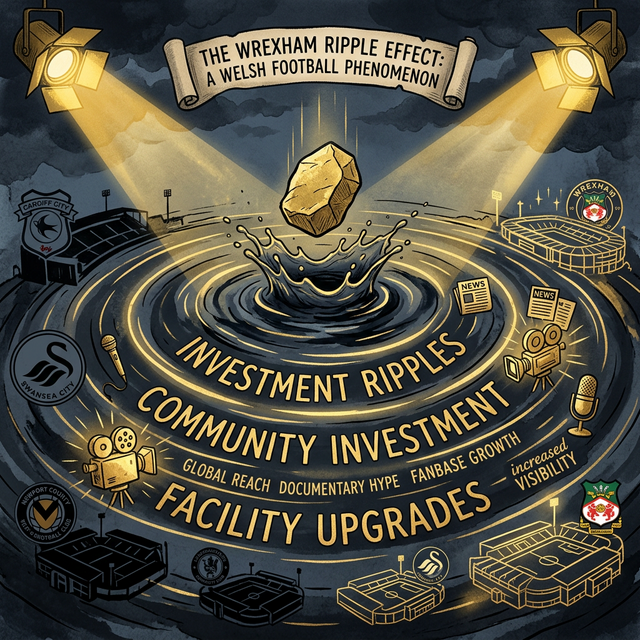
The term "Wrexham effect" describes the cascade of visibility, commercial interest, and investment attention that has flowed into Welsh football following the high-profile acquisition of Wrexham AFC by Hollywood actors Ryan Reynolds and Rob McElhenney in 2020. What makes this phenomenon remarkable is not the investment itself — foreign ownership of football clubs is commonplace — but the scale and breadth of its impact on clubs, leagues, and football culture across the entirety of Welsh football.
The Wrexham story, amplified by the Disney+ documentary series Welcome to Wrexham, introduced Welsh football to audiences who had never engaged with it. The documentary's global reach — available in over 100 countries — created a perception shift that extended far beyond Wrexham's own gates. Welsh football moved from an obscure niche to a recognisable brand, and the commercial consequences have been felt across every tier of the pyramid.
Key Statistics: Measuring the Effect
| Metric | Pre-Wrexham (2019-20) | Post-Wrexham (2025-26) | Change | Source |
|---|---|---|---|---|
| Cymru Premier avg. attendance | ~250-350 | 400-600 | +60-70% | FAW, 2025-26 |
| Wrexham AFC attendance | ~4,500 | 12,000+ | +167% | Wrexham AFC, 2025-26 |
| TNS estimated revenue | ~£1.5M | £3.2M | +113% | Companies House, 2026 |
| TNS squad value | ~£1.2M | £2.5M | +108% | Transfermarkt, March 2026 |
| Wrexham Welsh Cup wins | 23+ | 23+ | Historic record | Welsh Football Historical Data |
| Women's match attendance growth | Minimal tracking | 30-50% YoY | Structural change | FAW, 2025-26 |
| International media mentions (Welsh football) | ~200/year | ~2,500/year | +1,150% | Media monitoring estimates |
These figures demonstrate that the Wrexham effect is not limited to Wrexham itself. The rising tide has lifted clubs across the Cymru Premier, with TNS — a club at the opposite end of Wales — more than doubling its revenue in the period since the Wrexham acquisition.
How the Wrexham Effect Operates
The Wrexham effect functions through five interconnected channels, each reinforcing the others to create a compound impact that is greater than any single factor would produce in isolation.
Channel 1: International Media Exposure
The Disney+ documentary was the primary catalyst, but the media effect extends far beyond a single series. Wrexham's story has been covered by the New York Times, ESPN, Sky Sports, BBC, and hundreds of international outlets. This coverage introduced the concept of Welsh football investment to audiences in the United States, the Middle East, and Asia — markets where Welsh football had previously zero awareness.
For Cymru Premier clubs, this media exposure creates an indirect benefit. When international journalists cover Welsh football, they inevitably reference the broader league landscape. TNS's European campaigns, Connah's Quay's rise, and the league's expansion to 16 clubs all receive incidental coverage that would never have occurred without the Wrexham anchor story.
S4C's Sgorio coverage has also benefited from the heightened interest, with viewing figures and digital engagement rising as audiences discover Welsh-language football broadcasting for the first time. For clubs featured in the Cymru Premier investment profiles, this expanded broadcast footprint translates directly into sponsor value.
Channel 2: Sponsorship and Commercial Interest
The most tangible commercial consequence of the Wrexham effect has been increased sponsorship enquiries across the Cymru Premier. Clubs that previously struggled to attract any commercial partners are now fielding enquiries from brands — both local and international — that see Welsh football as an undervalued marketing platform.
The sponsorship dynamic works on two levels:
| Sponsorship Level | Pre-Wrexham Reality | Post-Wrexham Reality |
|---|---|---|
| Shirt sponsor | Most clubs had local sponsors at modest fees | Competition increasing, fees rising |
| Kit manufacturer | Several clubs in unbranded or low-cost kits | Branded manufacturers approaching clubs |
| Stadium naming | Almost non-existent | 3-4 clubs now have naming deals |
| Matchday sponsors | Inconsistent, often unfilled | Regular sponsorship packages selling |
| Digital partners | Non-existent | Emerging category |
For investors, this sponsorship dynamic is important because it represents organic revenue growth that does not require additional capital investment. A club that benefits from increased sponsor interest simply by virtue of being part of a more visible league is capturing value created by the Wrexham effect at no cost.
Channel 3: Matchday Revenue Growth
Higher attendance figures translate directly into increased matchday revenue. The average Cymru Premier attendance has risen from approximately 250-350 to 400-600 per match, with some clubs and fixtures exceeding 1,000. While these are modest numbers by English football standards, the percentage growth is remarkable — and the revenue impact is meaningful for clubs operating at the Cymru Premier cost base.
The matchday revenue equation includes:
- Gate receipts — even at modest ticket prices (£5-£10), a 60-70% attendance increase generates meaningful additional income
- Food and beverage — clubs with improved catering facilities are seeing per-head spend increase alongside attendance
- Merchandise — the Wrexham effect has normalised Welsh football merchandise purchasing, with fans of other Cymru Premier clubs now expecting and buying branded products
- Programme sales — the revival of matchday programmes as a revenue stream, driven by collectors and tourists attracted by the Wrexham halo
Channel 4: Youth Development and Academy Investment
The Wrexham effect has raised aspirations within Welsh youth football. Young players who see Wrexham's global profile — and the pathway from Welsh football to professional careers — are more motivated to pursue football development within the Welsh system rather than seeking opportunities in England.
Clubs across the Cymru Premier have responded by investing in their academy structures. Several clubs have upgraded coaching qualifications, formalised youth pathways, and established development centres that feed directly into their first teams. This investment creates long-term value by improving the quality of football on offer and generating potential transfer fee income from player sales — many of whom aspire to follow in the footsteps of famous Cymru Premier players.
Channel 5: The Perception Shift
Perhaps the most significant and least quantifiable aspect of the Wrexham effect is the fundamental shift in how Welsh football is perceived. Before Wrexham, the Cymru Premier was widely viewed — even within Wales — as a semi-professional curiosity with limited commercial relevance. After Wrexham, it is increasingly seen as an emerging market with genuine investment potential.
This perception shift matters because it changes the behaviour of every stakeholder in the ecosystem:
- Investors now include Welsh football in their opportunity scanning, whereas previously it would not have appeared
- Sponsors view Welsh football association as a positive brand signal rather than a risk
- Media cover Welsh football stories because audiences are interested, creating a virtuous cycle
- Players see the Cymru Premier as a viable career pathway rather than a last resort
- Fans feel increased pride and engagement with their local clubs
The Wrexham Effect on Women's Football
The Wrexham effect extends to women's football, though through slightly different channels. Wrexham Women have seen increased attendance and commercial interest directly linked to the men's team's global profile. More broadly, the normalisation of Welsh football investment has created a halo effect that benefits the entire women's football growth story.
International investors who discover Welsh football through Wrexham are increasingly aware that the women's game offers even more compelling entry-level opportunities — lower costs, higher growth rates, and greater commercial white space. The Wrexham story, in effect, serves as the gateway that introduces investors to the broader Welsh football market, where the women's game represents the most undervalued segment.
Quantifying the Effect: Club-by-Club Impact
| Club | Primary Wrexham Effect Benefit | Estimated Revenue Impact |
|---|---|---|
| TNS | International visibility for European campaigns | +£500K-£800K (commercial + European) |
| Connah's Quay Nomads | North Wales rivalry narrative | +£100K-£200K (sponsorship + attendance) |
| Bala Town | Tourist/visitor matchday interest | +£30K-£60K (matchday + merchandise) |
| Haverfordwest County | Increased digital engagement | +£20K-£50K (digital + sponsorship) |
| Newtown AFC | Historical rivalry angle | +£15K-£40K (attendance + matchday) |
| Penybont FC | New club visibility | +£20K-£50K (brand building) |
These estimates are necessarily approximate, but they illustrate an important point: the Wrexham effect distributes value unevenly. Clubs that actively leverage the increased visibility — through digital content, improved matchday experiences, and targeted commercial approaches — capture significantly more value than those that passively benefit.
Risks and Limitations
The Wrexham effect is not without limitations. Several risk factors deserve consideration:
Sustainability risk: The Wrexham story is inherently tied to two celebrity owners and a documentary series. If either factor changes — Reynolds and McElhenney sell, or the documentary ends — the media intensity may diminish. However, the structural changes already catalysed (higher attendances, improved sponsorship, better facilities) are likely to persist even if the catalyst fades.
Concentration risk: The effect is strongest for clubs geographically or competitively proximate to Wrexham. South Wales clubs benefit less directly than North Wales clubs, though the broader perception shift helps all Welsh football.
Expectation management: Increased visibility brings increased scrutiny. Clubs that attract investor interest on the back of the Wrexham effect must deliver a professional product — poor matchday experiences, weak governance, or financial mismanagement will be more visible and more damaging in a higher-profile environment.
What This Means for Investors
The Wrexham effect has fundamentally changed the investment calculus for Welsh football. The key implications are:
- Timing advantage — investors entering now benefit from increased visibility and commercial interest while valuations remain low by European standards
- Narrative leverage — the Wrexham story provides a ready-made narrative framework for explaining Welsh football investment to partners, sponsors, and media
- Diversification opportunity — the effect has expanded the investable universe beyond Wrexham itself to encompass the entire Cymru Premier and women's football
- Due diligence catalyst — increased attention means more data, more media coverage, and more transparent club operations, making due diligence easier
For a comprehensive guide to the acquisition process, see our Due Diligence Guide. For club-specific analysis, explore our Cymru Premier investment profiles. For the women's football opportunity catalysed by the Wrexham effect, see The Growth Case for Welsh Women's Football.
"The Wrexham effect has revitalised the perception of Welsh football, turning it into a viable investment opportunity for sponsors and businesses alike. What Reynolds and McElhenney did for one club, the market is now doing for an entire league."
— FAW Report on the Commercial State of Welsh Football, 2025
Analysis based on FAW attendance data (2019-2026), Companies House filings, Transfermarkt valuations, S4C/Sgorio viewing data, media monitoring estimates, and Cymru Connect internal commercial analysis. Revenue impact estimates are approximate and based on publicly available financial data supplemented by industry benchmarks. March 2026.