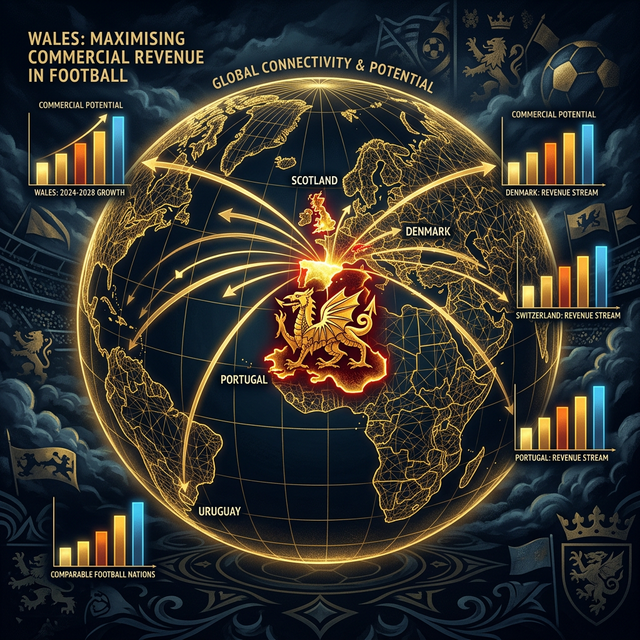

TL;DR: Cymru Premier clubs with dedicated commercial managers see a 15-20% revenue increase, yet fewer than half the league employs one. For a club generating £300-500K in annual revenue, that uplift translates to £45-100K — comfortably covering the cost of the hire. This guide covers the role definition, hiring process, compensation structures, and performance metrics for commercial managers at semi-professional level, with data from across the Cymru Premier and comparable UK leagues.
The Commercial Gap in Semi-Professional Football
Semi-professional football in Wales — and across the UK — suffers from a consistent structural weakness: commercial underdevelopment. Clubs generate a fraction of the sponsorship, hospitality, and merchandise revenue that their audience reach and community presence would justify. The primary reason is simple: nobody is dedicated to the task.
At most Cymru Premier clubs, commercial activity is handled by the chairman, secretary, or a committee volunteer alongside their other responsibilities. Sponsorship deals are renewed (or not) reactively. Hospitality is offered informally. Merchandise is ordered in bulk and sold from a trestle table. Digital revenue channels are unexplored. The result is a commercial operation that captures perhaps 30-40% of the available revenue.
The FAW's own 2025 report quantifies the impact: clubs that hire a dedicated commercial manager see an average 15-20% increase in total revenue, primarily through improved sponsorship acquisition, structured hospitality packages, and community partnerships. For clubs where total revenue ranges from £200K to over £1M, that percentage translates to material sums.
For context on revenue structures across the Cymru Premier, see the Revenue Breakdown and the Sponsorship Guide.
The Business Case
Revenue Impact Data
| Club Revenue Tier | Typical Revenue | 15-20% Uplift | Commercial Manager Cost | Net Gain |
|---|---|---|---|---|
| Tier 1 (TNS-level) | £3.2M | £480-640K | £35-50K | £430-590K |
| Tier 2 (£800K-1.5M) | £1M | £150-200K | £30-40K | £110-160K |
| Tier 3 (£400-800K) | £600K | £90-120K | £25-35K | £55-85K |
| Tier 4 (below £400K) | £250K | £37-50K | £15-25K (part-time) | £12-25K |
Even at the smallest clubs, the return on investment is positive. At Tier 2 and above, the hire pays for itself several times over. The question is not whether to hire a commercial manager — it is how to do it well.
Key Statistics
| Metric | Value | Source |
|---|---|---|
| Revenue increase with commercial manager | 15-20% | FAW report, 2025 |
| Cymru Premier clubs with dedicated commercial staff | <50% | Cymru Connect research, 2026 |
| Sponsorship revenue range (semi-pro) | £30K-£500K+ | Companies House filings, 2026 |
| Average Cymru Premier attendance | 400-600 | Welsh Football Historical Data, 2026 |
| Broadcast revenue per club | £80-120K | FAW financial statements, 2025 |
| Average commercial revenue per attendee | £150-300 | Cymru Connect analysis |
| Best-in-class commercial rev. per attendee | £500-800 | TNS benchmark |
Defining the Role
What a Semi-Pro Commercial Manager Actually Does
The role at semi-professional level is fundamentally different from its professional equivalent. At a Premier League club, the commercial director manages a team of 10-20 specialists across sponsorship, hospitality, licensing, and digital. At a Cymru Premier club, one person does everything commercial — and often marketing, events, and community relations as well.
This reality shapes the job description:
| Responsibility Area | Activities | Time Allocation |
|---|---|---|
| Sponsorship | Prospecting, pitching, contracting, servicing | 30-35% |
| Matchday commercial | Hospitality, programme sales, catering oversight | 15-20% |
| Marketing & communications | Social media, email, website, PR | 15-20% |
| Community engagement | Schools liaison, events, outreach programmes | 10-15% |
| Merchandise | Design, procurement, sales (online and matchday) | 5-10% |
| Events & hospitality | Non-matchday events, facility hire coordination | 5-10% |
| Administration | Reporting, budgeting, board updates | 5-10% |
Core KPIs
A well-structured role includes measurable performance targets:
| KPI | Baseline | Target (Year 1) | Target (Year 2) |
|---|---|---|---|
| Total commercial revenue | £X | +15% | +25-30% |
| Number of active sponsors | Y | +30% | +50% |
| Average sponsorship value | £Z | +10% | +20% |
| Matchday hospitality revenue | £A | +25% | +40% |
| Social media following | B | +20% | +40% |
| Merchandise revenue | £C | +30% | +50% |
| Non-matchday events revenue | £D | +50% | +100% |
For benchmarks on what sponsors pay at this level, see the Sponsorship Costs guide and the Shirt Sponsorship analysis.
The Hiring Process
Where to Find Candidates
The most common mistake is hiring a pure sales profile. At semi-professional level, the commercial manager also handles marketing, event coordination, and community relations. The ideal candidate combines commercial instinct with operational versatility and genuine enthusiasm for community football.
| Candidate Source | Strengths | Limitations |
|---|---|---|
| Local business development | Existing network, commercial skills | May lack football knowledge |
| Sports marketing agencies | Industry knowledge, contacts | May expect larger budgets |
| Football club staff (lateral) | Football understanding, networks | May bring larger-club expectations |
| University sports management | Energy, modern skills, lower cost | Limited experience |
| Community development sector | Community relationships, grant knowledge | May lack commercial drive |
| Existing volunteers (internal) | Club knowledge, passion | May lack professional skills |
The Interview Process
Structure interviews around three competency areas:
Commercial competency: Ask candidates to prepare a mock sponsorship pitch for the club. This reveals their ability to articulate value propositions, understand the local market, and present professionally.
Operational competency: Present a scenario: "You have 48 hours to organise a matchday hospitality package for 20 guests. Walk me through the process." This tests practical problem-solving and organisational skills.
Cultural fit: Semi-professional football clubs are volunteer-heavy organisations with strong community identities. A candidate who talks about "monetising the fanbase" rather than "growing revenue while strengthening community ties" may struggle to earn trust.
Compensation Structures
| Employment Model | Annual Cost | Best Suited To |
|---|---|---|
| Full-time salaried | £25-45K | Clubs with £500K+ revenue |
| Part-time salaried (3 days) | £15-25K | Clubs with £250-500K revenue |
| Base + commission | £15-25K + 10-15% of new revenue | Growth-stage clubs |
| Freelance/consultancy | £500-1,000/month | Clubs under £250K revenue |
| Volunteer + expenses | £0-5K | Entry-level (not recommended long-term) |
The base + commission model is particularly effective at semi-professional level. It aligns incentives (the commercial manager earns more when the club earns more), keeps fixed costs manageable, and attracts candidates with genuine commercial confidence. A typical structure: £18-22K base salary plus 10-15% commission on new sponsorship revenue above a defined baseline.
What to Sell: The Sponsorship Inventory
Before hiring a commercial manager, the club should audit its sponsorship inventory — the assets available for sale. Many clubs underestimate what they have to offer.
Physical Assets
| Asset | Typical Annual Value | Notes |
|---|---|---|
| Shirt front sponsor | £5-25K | Primary commercial asset |
| Shirt sleeve sponsor | £2-8K | Growing in value |
| Shorts sponsor | £1-5K | Often overlooked |
| Perimeter boards (per board) | £500-2K | 10-20 available positions |
| Programme advertising (per page) | £200-500 | Per issue, 15-20 issues/season |
| Matchday ball sponsor | £1-3K | Per match or seasonal |
| Man of the match sponsor | £500-2K | Per match or seasonal |
| Mascot/walkout sponsor | £1-3K | Family-oriented, high visibility |
Digital Assets
| Asset | Typical Annual Value | Notes |
|---|---|---|
| Website banner advertising | £1-5K | Per position, per season |
| Social media sponsored posts | £500-3K | Per campaign |
| Email newsletter sponsorship | £500-2K | If database >1,000 subscribers |
| Match highlights sponsor | £2-5K | Growing value with video content |
| Player interview sponsor | £1-3K | Content-linked |
Experience Assets
| Asset | Typical Annual Value | Notes |
|---|---|---|
| Matchday hospitality table | £1-3K | Per match (6-10 guests) |
| Season hospitality package | £5-15K | Premium offering |
| Pitch-side experience | £500-1K | Per match (family packages) |
| Player appearance | £200-500 | Per event (club arranged) |
| Ground hire (non-matchday) | £5-15K | Annual revenue from facility hire |
For a complete framework, see the Sponsorship Inventory Audit Template and the Sponsor Categories analysis.
Building the Commercial Operation
Month 1-3: Foundation
- Audit current revenue: Document every existing sponsorship deal, its value, renewal date, and sponsor satisfaction
- Build the prospecting list: Identify 50-100 local businesses within the club's catchment that are not currently sponsors
- Create the pitch deck: A professional presentation covering the club's audience, reach, community impact, and sponsorship options. Include data from the Sponsorship ROI analysis
- Quick wins: Renew lapsing sponsorships at improved rates, fill obvious gaps in perimeter boards and programme advertising
Month 4-6: Growth
- Launch outbound sales: Contact the prospecting list systematically — aim for 5-10 meetings per week
- Develop hospitality: Create structured matchday hospitality packages (see Matchday Revenue for benchmarks)
- Activate digital channels: Launch or professionalise social media, build an email database, explore online merchandise sales
- Community partnerships: Approach schools, local authorities, and community groups for participation-linked partnerships
Month 7-12: Scaling
- Introduce tiered sponsorship: Create Gold/Silver/Bronze packages that allow businesses of different sizes to participate
- Non-matchday revenue: Develop facility hire, corporate events, and community programmes that generate income outside the season
- Regional expansion: Extend prospecting beyond the immediate catchment to regional and national brands
- Annual reporting: Present the board with a full-year commercial report showing revenue growth, sponsor retention, and pipeline for year two
Common Pitfalls
Hiring Mistakes
The corporate sales executive: Someone who has spent their career selling to large enterprises will struggle with the relationship-driven, low-value, high-volume nature of semi-pro sponsorship. The commercial manager needs to be comfortable pitching a £500 perimeter board deal with the same professionalism as a £15K shirt sponsorship.
The football romantic: Passion for the club is valuable, but the role demands commercial discipline. A volunteer who loves the club but has never closed a sponsorship deal will need significant support and training.
The part-timer who is actually a volunteer: If the club cannot afford a proper salary, a consultancy arrangement (fixed monthly retainer plus commission) is preferable to a vaguely-defined "part-time" role that drifts into unpaid overtime and eventual burnout.
Operational Mistakes
No CRM or tracking: Without a system to track sponsorship prospects, deals, and renewals, revenue will leak. Even a simple spreadsheet is better than nothing, but dedicated CRM tools (many are free for small organisations) are preferable.
Ignoring digital: Semi-pro clubs often undervalue their digital audience. A club with 5,000 social media followers and 1,000 email subscribers has a commercial asset that many local businesses would pay to access. The Digital Presence Rankings show the current landscape.
Over-promising to sponsors: The temptation to over-sell the club's reach or matchday experience to close a deal creates short-term revenue at the cost of long-term relationships. Under-promise and over-deliver.
Case Studies from the Cymru Premier
High-Performance Commercial Operations
TNS (The New Saints): With £3.2M in revenue, TNS operates the most sophisticated commercial operation in the Cymru Premier. A dedicated commercial team manages sponsorship portfolios, hospitality packages, and digital revenue streams. TNS's commercial revenue per attendee is approximately £500-800 — the benchmark for the league. See the TNS Investment Profile for detail.
Connah's Quay Nomads: Leveraging the North-East Wales business community and cross-border ties to Chester and Merseyside, Connah's Quay has built a commercial operation that punches above its attendance weight.
Emerging Commercial Operations
Haverfordwest County: The club's £500K 4G pitch investment (2024) created new commercial opportunities — facility hire, coaching programmes, community events — that have diversified revenue beyond traditional sponsorship.
Penybont FC: As a relatively new entrant to the Cymru Premier, Penybont's modern approach to branding and digital engagement has attracted sponsors who value contemporary presentation.
The Underperformers
Clubs like Bala Town and Caernarfon Town have strong community engagement but significantly underdeveloped commercial operations. Caernarfon's case is particularly striking: 800-1,000 average attendance (the highest outside TNS) but commercial revenue per attendee is among the lowest in the league. A dedicated commercial hire at Caernarfon could deliver the highest absolute revenue gain in the division.
Measuring Success
Year-One Benchmarks
A well-hired commercial manager at a mid-tier Cymru Premier club (£400-700K revenue) should be targeting:
| Metric | Realistic Year-1 Target |
|---|---|
| Revenue increase | 15-20% (£60-140K) |
| New sponsors signed | 8-15 |
| Sponsor retention rate | 80%+ |
| Matchday hospitality revenue | +25% |
| Social media growth | +20% |
| Non-matchday revenue | +30% |
| ROI on hire | 2-4x salary |
If the commercial manager is not delivering at least 2x their salary in new revenue by month 12, something is wrong — either the hire, the support, or the expectations.
Funding the Hire
For clubs uncertain about the financial commitment, several options can de-risk the initial hire:
- Commission-only trial period (3 months): The candidate earns only commission on new revenue, proving their capability before a salaried commitment
- Sport Wales grants: Some development grants cover commercial and administrative staffing costs
- FAW development funding: The FAW occasionally supports commercial development at member clubs
- Shared services: Two or more clubs in the same region could share a commercial manager, splitting costs while benefiting from cross-selling opportunities
Conclusion
The commercial manager is the single highest-ROI hire available to most Cymru Premier clubs. The data is unambiguous: a 15-20% revenue increase for a £25-45K salary is a return that any business would accept. The clubs that have made this hire — TNS, Connah's Quay — have materially outperformed their peers commercially. The clubs that have not — including several with strong attendance and brand equity — are leaving money on the table.
For clubs ready to make the hire, start with the Sponsorship Inventory Audit Template to understand what you have to sell. For broader commercial context, see the Sponsorship Guide, the Sponsorship Costs analysis, and the Local Business Sponsorship ROI data.
Source & Methodology
Revenue impact data is drawn from the FAW's 2025 Commercial Development Report, which surveyed commercial outcomes across Cymru Premier and Cymru North/South clubs. Compensation benchmarks are informed by Cymru Connect's analysis of job postings, club accounts, and industry norms for semi-professional UK football. Sponsorship inventory valuations are based on deals observed across the Cymru Premier and comparable English non-league clubs. All figures should be treated as informed estimates; actual outcomes will vary by club, location, and hire quality.