TL;DR: Only 8 of 12 Cymru Premier clubs currently hold UEFA licences, with infrastructure deficits and financial documentation the most common failure points. Meeting UEFA standards unlocks European competition revenue worth £200K–£500K per season, while the league's 2027 expansion to 16 teams will force four additional clubs to confront these requirements.
The Licensing Landscape in Welsh Football
UEFA club licensing is the gatekeeping mechanism that determines which Welsh clubs can participate in European competition. It covers far more than stadium specifications — encompassing financial controls, governance structures, youth development programmes, and administrative standards — but infrastructure requirements are where most Cymru Premier clubs fall short. Of the current 12 top-flight clubs, only 8 hold full UEFA licences, leaving 3 in a pending status and 1 classified as at-risk.
For investors, licensing compliance is a critical due diligence factor. A club without a UEFA licence cannot access European prize money even if it finishes at the top of the Cymru Premier, effectively capping its revenue potential. Conversely, a club that secures a licence immediately unlocks a revenue stream worth £200K–£500K per European campaign. For the full financial picture, see our Investment Returns Analysis.
Current Licensing Status
| Club | UEFA Licence Status | Primary Gap (if applicable) |
|---|---|---|
| The New Saints | Full licence | — |
| Connah's Quay Nomads | Full licence | — |
| Bala Town | Full licence | — |
| Penybont | Full licence | — |
| Haverfordwest County | Full licence | — |
| Caernarfon Town | Full licence | — |
| Newtown AFC | Full licence | — |
| Aberystwyth Town | Full licence | — |
| Barry Town United | Pending | Financial documentation |
| Flint Town United | Pending | Stadium capacity |
| Cardiff Met | Pending | Stadium ownership/lease |
| Airbus UK Broughton | At risk | Multiple criteria |
The distinction between "pending" and "at risk" is significant. Pending clubs have identified gaps and submitted remediation plans to the FAW licensing committee. At-risk clubs face multiple deficiencies without a clear pathway to resolution within the current licensing cycle.
UEFA Licensing Criteria: The Five Pillars
UEFA's licensing framework is organised into five categories, each with mandatory and recommended requirements. Welsh clubs must satisfy all mandatory criteria to receive a licence.
Sporting Criteria
| Requirement | Mandatory | Details |
|---|---|---|
| First-team head coach qualification | Yes | Minimum UEFA A Licence |
| Youth development programme | Yes | Structured academy with age-group teams |
| Youth team coach qualifications | Yes | Minimum UEFA B Licence for youth coaches |
| Medical staff | Yes | Qualified physiotherapist at all matches |
| Anti-doping education | Yes | Annual compliance training |
The sporting criteria are generally the least problematic for Cymru Premier clubs. Most have qualified coaching staff and basic youth programmes. The challenge lies in scaling these programmes to meet the spirit of the regulations — not just the letter. Clubs with strong academy output, like Cardiff Met (45% of first-team minutes from graduates) and Haverfordwest (22%), are well ahead of their peers. See our Academy Best Clubs analysis for the full picture.
Infrastructure Criteria
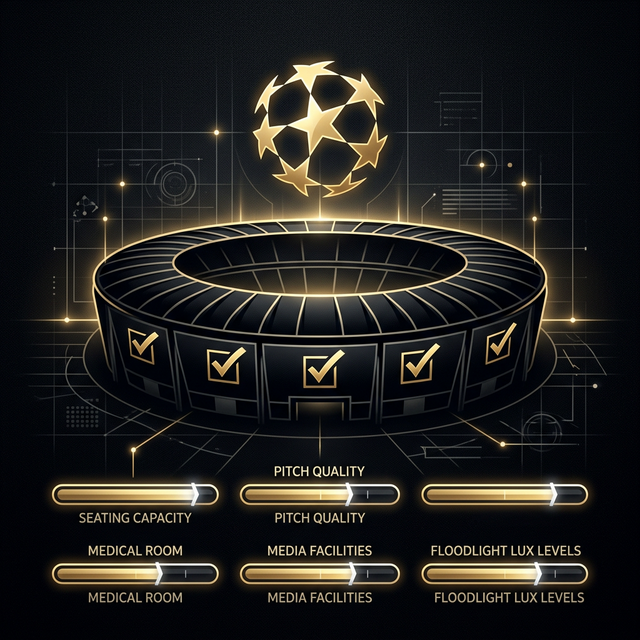
This is where most Welsh clubs struggle. UEFA infrastructure requirements are tiered, with higher standards for clubs progressing deeper into European competition.
| Requirement | Category 1 (Domestic) | Category 2 (European Group Stage) |
|---|---|---|
| Minimum seated capacity | 1,000 | 3,000 |
| Floodlighting (lux) | 500 lux | 1,200 lux |
| Dressing rooms | Home and away, minimum standards | Expanded to include referee, fourth official |
| Media facilities | Basic press area | Full press room, broadcast compound, mixed zone |
| Medical room | Treatment room accessible from pitch | Fully equipped with ambulance access |
| Pitch surface | Natural or FIFA-certified artificial | Natural or FIFA Quality Pro certified |
| Electronic scoreboard | Recommended | Mandatory |
| VIP/hospitality area | Recommended | Mandatory |
For Cymru Premier clubs, the critical threshold is Category 1 — the minimum needed for early European qualifying rounds. Most clubs that hold licences meet Category 1 but would need significant investment to reach Category 2. Given that Welsh clubs rarely progress beyond the second qualifying round, this is not an immediate concern, but it caps the potential upside from a deep European run.
The prevalence of artificial pitches in the Cymru Premier (8 of 12 clubs, or 67%) adds a specific complication. UEFA requires artificial surfaces used in European matches to hold FIFA Quality Pro certification, which involves annual testing and costs approximately £15,000–£25,000 per cycle. For more on artificial pitch investment, see our 3G/4G Pitch Guide.
Financial Criteria
| Requirement | Details |
|---|---|
| Audited annual accounts | Must be submitted to the FAW licensing committee |
| No overdue payables | All player wages, transfer fees, and tax obligations current |
| Going concern assessment | Independent auditor must confirm viability |
| Future financial information | Budget projections for the licensing period |
| Break-even assessment | Not currently applied to Welsh clubs (UEFA exemption for smaller associations) |
Financial criteria are the second most common failure point after infrastructure. Several Cymru Premier clubs operate with limited administrative staff, and the cost of a full external audit (£5,000–£15,000) is material relative to their budgets. The FAW has provided guidance and template financial reporting frameworks, but compliance remains inconsistent.
For investors, the financial licensing criteria serve a dual purpose: they are a barrier to entry that protects the value of a licence once obtained, and they provide a framework for financial discipline that can improve club governance. See our Companies House Filings guide for how to access and interpret these records.
Administrative Criteria
Administrative requirements cover club governance, staffing, and operational procedures. Key mandatory elements include:
- A designated general secretary or club administrator
- An identifiable legal entity (most Cymru Premier clubs are registered as limited companies)
- Compliance with national association statutes
- A written club development plan
Legal Criteria
Legal criteria ensure clubs operate within UEFA's regulatory framework. Requirements include compliance with transfer regulations, adherence to player contract standards, and participation in national dispute resolution mechanisms. These are rarely a barrier for Cymru Premier clubs, though clubs with complex ownership structures should ensure transparency.
The Cost of Compliance
Meeting UEFA licensing requirements involves both capital expenditure (stadium improvements, floodlighting) and ongoing operational costs (audits, certification, staffing). The following table estimates typical costs for a Cymru Premier club moving from non-compliant to fully licensed.
| Investment Area | Estimated Cost | Frequency |
|---|---|---|
| Stadium capacity expansion to 1,000 seats | £100K–£300K | One-off |
| Floodlighting to UEFA standard | £150K–£400K | One-off (maintenance ongoing) |
| Dressing room and medical facility upgrades | £50K–£150K | One-off |
| Media facilities | £20K–£50K | One-off |
| FIFA Quality Pro pitch certification | £15K–£25K | Annual |
| External audit | £5K–£15K | Annual |
| Additional administrative staffing | £25K–£40K | Annual |
| Total first-year cost | £365K–£980K | — |
These figures are significant relative to the average Cymru Premier club revenue of approximately £850K. However, the return on investment is clear: European qualification brings £200K–£500K in a single season, meaning the infrastructure investment can pay for itself within 2–4 years of European participation. For a deeper look at infrastructure ROI, see our Stadium Development ROI analysis.
The 2027 Expansion Factor
The Cymru Premier's expansion from 12 to 16 teams in the 2026/27 season introduces four new clubs to the top flight — each of which will need to meet or approach licensing standards. This creates both urgency and opportunity:
- For promoted clubs: The licensing gap is a significant barrier. Clubs in the second tier typically lack the infrastructure and financial documentation needed for a UEFA licence. Investors who identify promotion candidates early can fund the necessary upgrades in advance.
- For existing clubs: The expansion dilutes the proportion of licensed clubs, potentially creating a two-tier dynamic within the Cymru Premier itself. Clubs that already hold licences gain a structural advantage.
For more on the expansion and its investment implications, see our 2027 Expansion Guide.
Licensing and the FAW's Role
The Football Association of Wales administers UEFA licensing on behalf of UEFA, with a dedicated licensing committee that reviews applications annually. The FAW has been proactive in supporting clubs through the process, offering:
- Template financial reporting frameworks
- Facility improvement grants (limited, typically £10K–£30K)
- Advisory visits from ground grading inspectors
- Phased compliance timelines for clubs with clear development plans
The FAW's approach is broadly supportive rather than punitive — the association recognises that Welsh clubs operate on tight budgets and that rigid enforcement could reduce the number of clubs eligible for European competition. However, the standards are non-negotiable, and clubs that fail to meet them are excluded regardless of their league position.
For a broader view of FAW licensing requirements beyond the UEFA framework, see our FAW Licensing Requirements guide. The Ground Grading Guide covers the domestic standards that apply to all tiers of the Welsh pyramid.
What Investors Should Look For
When evaluating a Cymru Premier club's licensing position, investors should assess:
- Current licence status: Does the club hold a full UEFA licence, or is it pending/at risk?
- Infrastructure gap analysis: What specific improvements are needed, and what will they cost?
- Timeline to compliance: Can the club achieve a licence within one or two licensing cycles?
- Revenue unlock: What is the realistic European revenue potential once licensed?
- Competing priorities: Does the club need to spend on squad, youth development, or other areas before infrastructure?
The clubs that offer the strongest investment cases are often those that are close to licensing compliance but have not yet crossed the threshold — the marginal cost of achieving a licence is low relative to the revenue it unlocks. Our Club Benchmarking analysis helps identify these opportunities.
Source and Methodology
Licensing status data is sourced from the FAW licensing committee's published decisions (2025/26 cycle). Infrastructure requirements are drawn from the UEFA Club Licensing and Financial Fair Play Regulations (2024 edition). Cost estimates are based on Cymru Connect's analysis of recent stadium development projects in Wales and comparable UK semi-professional leagues. Revenue estimates for European competition are based on UEFA's published prize money distributions and Cymru Connect's proprietary modelling. All figures are in GBP and should be treated as indicative rather than definitive.