TL;DR: The Cymru Premier's expansion from 12 to 16 clubs for 2026/27 is the most significant structural change in Welsh football in a decade. With matchday revenues projected to grow by 20%, four new sets of unactivated sponsorship inventory entering the market, and broadcast income set to rise on the back of additional fixtures, the expansion creates compelling entry points for investors across every tier of the pyramid.
Why Expansion Changes the Investment Landscape
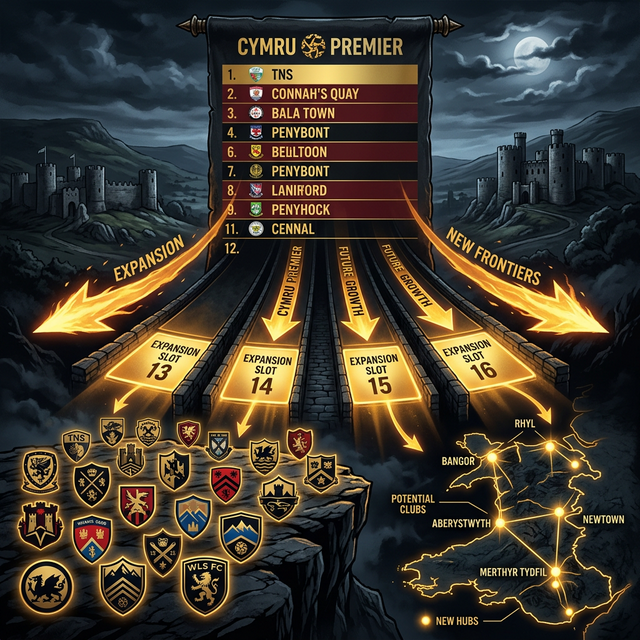
The Football Association of Wales confirmed the expansion of the Cymru Premier from 12 to 16 teams for the 2026/27 season, with two clubs promoted from Cymru North and two from Cymru South. This is not simply an administrative restructuring. It fundamentally alters the economics of the league by increasing the number of fixtures, broadening the geographic footprint, and deepening the competitive pyramid.
For investors who have been tracking Welsh football's quiet transformation — driven in part by the Wrexham effect and growing international interest in undervalued European leagues — this expansion represents a structural catalyst. More fixtures mean more broadcast inventory for S4C/Sgorio, more matchday revenue opportunities, and a larger base of clubs competing for European qualification. Our comprehensive Expansion 2027 Guide covers the timeline and contender clubs in detail.
The Numbers Behind Expansion
Understanding the financial impact requires examining the key metrics that drive club economics in Welsh football.
| Metric | Current (12-Club) | Projected (16-Club) | Change |
|---|---|---|---|
| Total League Fixtures per Season | 132 | 240 | +82% |
| Broadcast Revenue per Club | £80-120K | £95-140K | +15-20% |
| Average Matchday Revenue per Club | £30-60K | £40-75K | +20-25% |
| Total Sponsorship Inventory (League) | 12 shirt sponsors | 16 shirt sponsors | +33% |
| UEFA Coefficient Building Matches | 132 | 240 | +82% |
| Average Attendance | 400-600 | 440-660 (est.) | +10-15% |
The fixture increase is the single most impactful change. Moving from 132 to 240 league matches per season creates 108 additional broadcast and matchday events — each one generating revenue across multiple streams simultaneously.
Broadcast Revenue: The S4C/Sgorio Multiplier
The Cymru Premier's domestic broadcast deal with S4C/Sgorio currently delivers £80-120K per club annually. With 82% more fixtures available for selection, the value of the next broadcast negotiation cycle is expected to increase materially.
Welsh-language broadcasting carries a unique strategic advantage: S4C has a public service mandate to cover Welsh sport, creating a floor under broadcast revenue that does not exist in comparable leagues. This structural guarantee means broadcast income is more predictable and less cyclical than in market-driven broadcast environments. For a detailed analysis of the current deal, see our S4C/Sgorio Broadcast Sponsorship report.
The additional fixtures also create more content inventory for digital distribution. Clubs that invest in their own streaming capabilities — a trend accelerating across lower-league football globally — can monetise matches that are not selected for television coverage.
Sponsorship: Four New Sets of Unactivated Inventory
Perhaps the most immediately actionable opportunity lies in sponsorship. Four new Cymru Premier clubs means four new sets of entirely unactivated commercial inventory:
- Shirt sponsorship deals ranging from £30K to £100K for newly promoted clubs
- Stadium naming rights that have never been offered at the Premier level
- Matchday hospitality packages at venues entering the top flight for the first time
- Training kit and sleeve sponsorship — categories that most promoted clubs have never monetised
For brands, the "founding sponsor" window is particularly valuable. Being the first major commercial partner of a newly promoted club creates disproportionate brand association and fan loyalty. These deals typically lock in at below-market rates and appreciate significantly as the club establishes itself in the top flight. Our Sponsorship Costs 2026 analysis provides current pricing benchmarks, while the Sponsorship Inventory Audit Template outlines how clubs can prepare for commercial activation.
Matchday Revenue: More Derbies, More Demand
A 16-team league creates more local derbies — fixtures that consistently generate the highest attendances and matchday spending in Welsh football. The current average attendance of 400-600 across the Cymru Premier leaves significant room for growth, particularly when new clubs bring their own supporter bases and local rivalries into the mix.
| Revenue Stream | Current Average | Post-Expansion Estimate |
|---|---|---|
| Gate Receipts | £15-30K/season | £20-40K/season |
| Hospitality | £5-10K/season | £8-15K/season |
| Food & Beverage | £8-15K/season | £10-20K/season |
| Programme/Merchandise | £3-8K/season | £5-12K/season |
| Total Matchday | £31-63K | £43-87K |
The Wrexham effect has already demonstrated how increased visibility can drive attendance growth of 30-50%. While most Cymru Premier clubs will not replicate Wrexham's trajectory, the expansion will bring more media attention to Welsh football as a whole, creating a rising-tide effect across all clubs.
Infrastructure Requirements and Capital Expenditure
Expansion is not without capital requirements. Promoted clubs must meet FAW ground grading standards, which mandate minimum levels of seating capacity, floodlighting, changing facilities, and media infrastructure. Our Ground Grading Requirements guide details these standards.
Current infrastructure across the existing 12 clubs provides useful context:
| Club | Stadium | Capacity | Pitch Type | UEFA Licence |
|---|---|---|---|---|
| TNS | Park Hall | 2,034 | Artificial | Yes |
| Connah's Quay | Deeside Stadium | 2,500 | Artificial | Yes |
| Penybont | SDM Glass Stadium | 2,500 | Artificial | Yes |
| Caernarfon | The Oval | 3,000 | Artificial | Yes |
| Barry Town | Jenner Park | 3,000 | Natural | Yes |
| Haverfordwest | Ogi Bridge Meadow | 3,000 | 4G | Yes |
| Bala Town | Maes Tegid | 3,000 | Artificial | Yes |
| Cardiff Met | Cyncoed Campus | 2,000 | Artificial | Yes |
With 67% of current clubs using artificial pitches and 8 of 12 holding UEFA licences, the league has already established a high baseline for infrastructure standards. Promoted clubs that have invested in 3G/4G pitch technology will find the transition significantly smoother.
The European Dimension
A deeper league strengthens Wales's UEFA coefficient, which determines how many European qualification spots the country receives and at which stage Welsh clubs enter continental competition. More competitive depth means more meaningful domestic matches that better prepare clubs for European campaigns.
TNS's consistent Champions League qualifying presence already generates £50-200K in European prize money per campaign — revenue that would not exist without the domestic league platform. As the league expands, the pathway to European qualification becomes more competitive, which in turn produces better-prepared clubs for continental competition. Our European Qualification analysis examines this dynamic in detail.
Investment Entry Points by Category
The expansion creates distinct opportunities depending on investor type and appetite:
For Club Acquisition
Contender clubs in Cymru North and South represent the lowest entry cost into Welsh top-flight football. Acquisition costs for clubs at this level typically range from £100K to £500K — a fraction of what comparable access would cost in the English pyramid. See our Cost to Buy a Welsh Football Club guide for detailed pricing.
For Sponsorship Partners
The founding sponsor opportunity with newly promoted clubs offers 3-5 year deals at rates that will likely appreciate 50-100% as clubs establish themselves. Current shirt sponsorship benchmarks provide the baseline.
For Infrastructure Investors
Stadium and facility development — including floodlight installations, pitch upgrades, and hospitality facilities — offers a tangible asset-backed investment with clear valuation metrics.
For Community Investment
Clubs combining expansion with community hub funding can access Sport Wales and local authority grants that significantly reduce the capital required for facility development.
Risk Factors
No investment case is complete without acknowledging the risks. The expansion could dilute competitive quality in the short term if promoted clubs lack the financial resources to compete effectively. Attendance growth projections assume continued momentum from the Wrexham effect, which may plateau. And the broadcast revenue uplift depends on the outcome of the next S4C/Sgorio negotiation cycle, which is not guaranteed.
For investors conducting due diligence, our Buying a Welsh Football Club guide provides a comprehensive framework for evaluating these risks against the opportunity.
Conclusion
The Cymru Premier's expansion to 16 teams is a structural catalyst that improves the investment case across every metric — more fixtures, more broadcast inventory, more sponsorship opportunities, and a broader competitive base. The window for early-mover advantage is narrow: clubs preparing for promotion are making infrastructure and commercial decisions now that will determine their trajectory for years to come.
Analysis based on FAW official announcements, Companies House filings, and Cymru Connect internal modelling. Revenue projections are estimates based on comparable league expansions and current growth trends. Data as of March 2026.