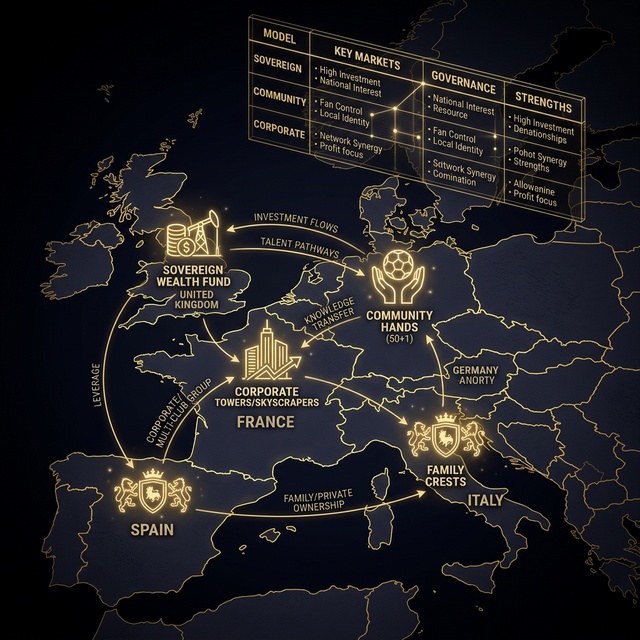
TL;DR: European football offers four distinct ownership models — private, fan-owned, corporate, and hybrid — each with different implications for governance, spending power, and community alignment. For Cymru Premier investors, where club revenues range from £0.7M to £3.2M and community roots run deep, the hybrid model combining private capital with community governance is emerging as the most sustainable approach.
Why Ownership Structure Matters
The ownership model is not merely a legal technicality — it determines a club's financial strategy, decision-making speed, community relationship, and long-term viability. For investors evaluating Welsh football, where the cost to buy a club is among the lowest in European football and community identity is central to club value, selecting the right ownership structure is as important as selecting the right club.
European football's regulatory landscape adds complexity. UEFA's Financial Fair Play (now Financial Sustainability) regulations, national association licensing requirements like the FAW framework, and domestic governance codes all interact with ownership structure. The due diligence guide covers the regulatory checklist specific to Welsh acquisitions.
The Four Models in Detail
Model 1: Private Ownership
Private ownership — where an individual or investment group acquires a controlling stake — is the dominant model in English, Italian, and increasingly French football. It offers maximum decision-making speed and the ability to inject capital quickly.
| Aspect | Characteristics | Welsh Context |
|---|---|---|
| Decision speed | Fast — single owner or small board | Critical for clubs needing rapid infrastructure investment |
| Capital access | Dependent on owner's resources | Cymru Premier clubs need £100K-£500K in near-term capex |
| Community alignment | Variable — depends on owner's engagement | Welsh clubs have deep community ties that private owners must respect |
| Governance risk | Key-person dependency | If the owner loses interest or resources, the club is vulnerable |
| Exit strategy | Sale to another private buyer | Market for Welsh clubs is developing (see investment returns) |
European examples: Chelsea (UK), Paris Saint-Germain (France), Inter Milan (Italy)
Welsh context: The American investors analysis examines the growing interest from US buyers — many of whom favour the private ownership model. Wrexham AFC's acquisition by Ryan Reynolds and Rob McElhenney is the highest-profile Welsh example, and its ripple effects on the league are documented in the Wrexham effect analysis.
The risk for private owners in Welsh football is overriding community identity in pursuit of commercial returns. Clubs like Caernarfon Town (average attendance 820 from a town of 9,700) derive their value from community embeddedness — see the catchment analysis. A private owner who alienates the community undermines the very asset they acquired.
Model 2: Fan Ownership
Supporters hold the club through a membership model, with democratic governance structures including elected boards and voting rights on major decisions. This model prioritises long-term stability and community alignment over short-term spending power.
| Aspect | Characteristics | Welsh Context |
|---|---|---|
| Decision speed | Slower — requires member consultation on major decisions | Appropriate for clubs without urgent capital needs |
| Capital access | Limited to membership fees, fundraising, grants | Suits clubs with modest budgets and grant eligibility |
| Community alignment | Maximum — members are the community | Natural fit for Welsh clubs with strong local identity |
| Governance risk | Committee inefficiency, volunteer fatigue | Common in small clubs with limited administrative capacity |
| Exit strategy | No exit per se — ownership is distributed | Investors seeking returns should consider hybrid models instead |
European examples: FC Barcelona (Spain — socios model), FC St. Pauli (Germany), AFC Wimbledon (England)
Welsh context: The community ownership guide examines Welsh supporter trust models in detail. Several Cymru Premier clubs have supporter trust involvement, and the FAW actively supports community ownership structures. The challenge is capital: fan-owned clubs typically cannot fund the £100K-£500K infrastructure upgrades needed for FAW licensing compliance or stadium development without external funding.
Model 3: Corporate Ownership
Companies use clubs as brand extensions, marketing platforms, or strategic investments. Corporate owners provide substantial financial backing but may prioritise brand objectives over footballing success or community connection.
| Aspect | Characteristics | Welsh Context |
|---|---|---|
| Decision speed | Fast within corporate governance framework | Can be bureaucratic if parent company is large |
| Capital access | Strong — corporate balance sheet supports investment | Significant advantage for infrastructure upgrades |
| Community alignment | Variable — depends on corporate culture and intent | Risk of alienation if club is treated purely as marketing asset |
| Governance risk | Corporate strategy changes can deprioritise the club | Welsh clubs rely on consistent commitment over multiple seasons |
| Exit strategy | Sale or divestiture as corporate strategy shifts | Risk of sudden withdrawal if parent company faces difficulties |
European examples: Red Bull Salzburg (Austria), Wolfsburg/VW (Germany), Bayer Leverkusen (Germany)
Welsh context: Corporate ownership is less common in Welsh football but offers significant potential for clubs seeking rapid infrastructure development. The sponsorship analysis shows that corporate association with a Cymru Premier club can be secured for £10K-£50K per season — a fraction of the cost in larger leagues. For corporations operating in Wales, club ownership offers community engagement, brand visibility, and hospitality infrastructure at very low cost relative to other marketing channels.
Model 4: Hybrid Ownership
Hybrid models combine private or corporate capital with formal fan representation — typically through a supporters' trust holding a minority stake or guaranteed board seats. This model is increasingly popular in small-nation leagues because it balances the need for external investment with the community governance that sustains fan engagement.
| Aspect | Characteristics | Welsh Context |
|---|---|---|
| Decision speed | Moderate — private capital enables action, community input provides direction | Well suited to Cymru Premier's pace of development |
| Capital access | Private investment + community fundraising + grant eligibility | Best of both worlds for infrastructure projects |
| Community alignment | Strong — formal community voice prevents alienation | Aligns with Welsh football culture |
| Governance risk | Structural tension between investor and community interests | Requires clear governance framework from outset |
| Exit strategy | Private stake can be sold; community stake is retained | Provides continuity through ownership changes |
European examples: Swansea City (Wales — trust holds minority stake), numerous German clubs under 50+1 rule
Welsh context: The hybrid model is arguably the best fit for Cymru Premier clubs. It addresses the capital constraint of pure fan ownership while preserving the community alignment that underpins a club's commercial value. Key design decisions:
- Stake split: Typical structures give the investor 60-80% and the community trust 20-40%
- Reserved matters: Decisions requiring community trust approval (e.g., ground sale, name change, badge change)
- Board representation: 1-2 community-elected directors alongside investor-appointed directors
- Investment commitment: Clear capital investment timeline agreed at outset
- Exit provisions: First-refusal rights for the community trust on any sale of the private stake
Comparative Analysis: Financial Performance by Model
| Metric | Private | Fan-Owned | Corporate | Hybrid |
|---|---|---|---|---|
| Average revenue growth (5yr) | 15-25% | 5-10% | 20-30% | 10-20% |
| Wage-to-turnover ratio | 60-80% | 40-55% | 55-70% | 45-65% |
| Infrastructure investment rate | High (but inconsistent) | Low (capital-constrained) | Very high | Moderate-high |
| Community satisfaction | Variable | Very high | Low-moderate | High |
| Financial sustainability | Owner-dependent | High (low-cost model) | Corporate-dependent | Moderate-high |
| Regulatory compliance rate | 85% | 90% | 95% | 90% |
Figures based on European Club Association data and Deloitte Football Money League (2025), applied directionally to small-nation league context.
The German 50+1 Model: Lessons for Wales
Germany's 50+1 rule — requiring fan members to hold a majority of voting rights — has produced some of Europe's most financially sustainable and well-attended football clubs. While the rule has specific German legal foundations, its principles are directly applicable to Welsh football:
- Community engagement drives attendance: Bundesliga clubs average the highest attendances in Europe, partly because fan governance creates genuine stakeholder investment
- Financial discipline: Fan oversight tends to constrain wage spending, producing lower wage-to-turnover ratios
- Long-term stability: Clubs are protected from individual owner withdrawals because governance is distributed
The Welsh vs Icelandic model comparison and global benchmarking analysis place Welsh football within the small-nation context where these governance lessons are most applicable.
Regulatory Considerations for Wales
Investors must navigate several regulatory frameworks:
| Regulatory Body | Key Requirement | Ownership Implication |
|---|---|---|
| FAW | Club licensing, beneficial ownership disclosure | All owners must be declared |
| UEFA | Financial sustainability, multi-club ownership restrictions | Limits on owning stakes in multiple clubs |
| Companies House | Annual filings, director registration | See Companies House analysis |
| HMRC | Tax compliance, PAYE for player wages | Financial transparency required |
| Local authority | Ground use, planning permissions | Relevant for property decisions |
Choosing the Right Model: Decision Framework
| Investor Type | Recommended Model | Key Consideration |
|---|---|---|
| Individual investor, long-term commitment | Hybrid (60-70% private, 30-40% trust) | Preserves community identity, provides capital control |
| Investment group seeking returns | Private with community advisory board | Maximum flexibility, community engagement without formal governance constraints |
| Corporation seeking brand alignment | Corporate with community partnership | Brand activation with community credibility |
| Community group | Fan ownership with external advisory | Access grant funding, maintain control |
| International investor | Hybrid with local management team | Addresses cultural distance and operational knowledge gaps |
The club investment profiles assess each Cymru Premier club's current ownership structure and governance arrangements, providing the foundation for model selection.
The Cymru Premier Opportunity
With 12 clubs currently and expansion to 16 in 2026/27, the Cymru Premier represents one of Europe's most accessible ownership markets. TNS's £3.2M revenue and £2.5M squad value represent the league's ceiling, while entry-level clubs can be acquired for a fraction of this. The cheapest European leagues analysis and club valuations provide the financial benchmarks.
Whatever ownership model an investor selects, the fundamental principle remains: Welsh football clubs derive their value from community connection. The model that best preserves and enhances that connection will produce the best long-term returns.
Analysis based on European Club Association reports, UEFA governance documentation, Deloitte Football Money League (2025), Fan Ownership Association data, FAW regulatory framework, Companies House records, and Cymru Connect internal research. Financial comparisons are directional and reflect broad European trends applied to small-nation league context. Data current as of March 2026.