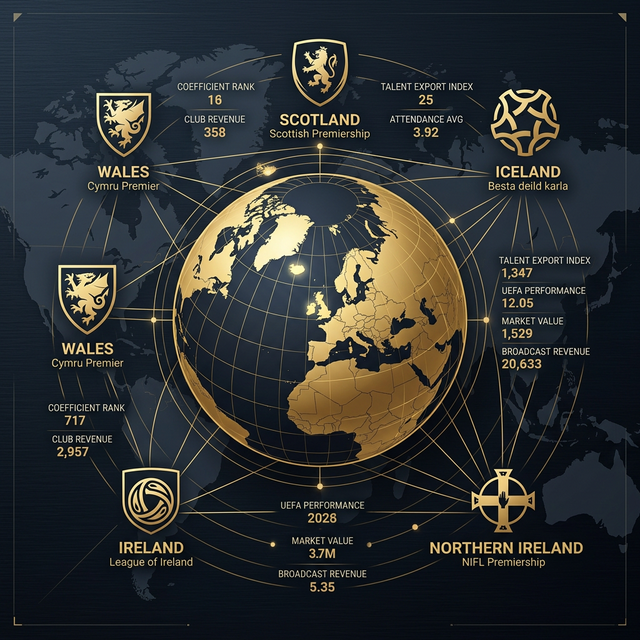
TL;DR: The Cymru Premier offers the lowest club acquisition costs (£200K-£2M) of any European league with direct UEFA competition access. Average attendance of 400-600 and club revenues of £400K-£3.2M place it below English League One/Two financially, but the cost-to-European-revenue ratio is the most favourable on the continent. Benchmarked against the League of Ireland, Icelandic Urvalsdeild, Northern Irish Premiership, and Nordic second tiers, Welsh football's combination of low entry cost, UEFA pathway, English-language market access, and the Wrexham-driven visibility surge creates a distinctive investment proposition.
Why Benchmarking Matters for Investors
Investors evaluating Welsh football clubs do not make decisions in a vacuum. They compare opportunities across leagues, countries, and risk profiles. A £500K acquisition in the Cymru Premier competes for capital with a €2M investment in the League of Ireland, a Nordic second-tier club, or an English non-league side. Understanding how the Cymru Premier benchmarks against these alternatives — on revenue, cost, risk, and European upside — is essential for informed capital allocation.
This report compares the Cymru Premier against five peer leagues using standardised financial and operational metrics. For the broader commercial potential analysis, see our commercial benchmarking report. For a focused comparison with Wales's closest peer, see Cymru Premier vs League of Ireland.
The Benchmarking Framework
Our comparison uses seven standardised metrics that capture the investment characteristics of each league:
| Metric | What It Measures | Why It Matters |
|---|---|---|
| Average attendance | Fan base depth | Matchday revenue ceiling |
| Average club revenue | Financial scale | Operating sustainability |
| Club acquisition cost range | Entry barrier | Capital required to participate |
| European competition slots | Revenue upside | Access to UEFA prize money |
| Player transfer values | Squad investment cost | Player development potential |
| Broadcast deal value | Revenue stability | Guaranteed income floor |
| Infrastructure standards | Facility quality | Capital expenditure requirements |
League-by-League Comparison
Comprehensive Benchmarking Table
| Metric | Cymru Premier | League of Ireland | Icelandic Urvalsdeild | NI Premiership | Scottish Championship | English League Two |
|---|---|---|---|---|---|---|
| Clubs | 12 (expanding to 16) | 10 | 12 | 12 | 10 | 24 |
| Avg. attendance | 400-600 | 2,500-3,500 | 1,000-2,000 | 800-1,500 | 2,000-5,000 | 4,000-8,000 |
| Avg. club revenue | £400K-£3.2M | €1-5M | €500K-2M | £300K-1.5M | £1-4M | £3-8M |
| Acquisition cost | £200K-£2M | €1-5M | €500K-2M | £100K-1M | £1-5M | £5-20M |
| European slots | 1-3 | 1-4 | 1-2 | 1-2 | 0 (promotion needed) | 0 |
| Player values (avg.) | £0-50K | €10-100K | €5-50K | £0-30K | £20-150K | £50-500K |
| Broadcast per club | £80-120K | €100-200K | €50-100K | £30-60K | £200-400K | £500K-1M |
| Season | Aug-May | Feb-Nov | May-Oct | Aug-May | Aug-May | Aug-May |
The Cymru Premier vs League of Ireland
The League of Ireland is the Cymru Premier's closest peer — a small-nation league on the western fringe of Europe, competing for UEFA slots and investor attention. But the differences are instructive:
Attendance and revenue. The League of Ireland's average attendance (2,500-3,500) is roughly five times the Cymru Premier's, reflecting Ireland's stronger domestic football culture and larger urban centres (Dublin, Cork, Galway). This translates into higher matchday revenue and stronger commercial bases.
Acquisition cost. League of Ireland clubs trade at €1-5M — two to five times the Cymru Premier's range. The premium reflects higher revenues, better infrastructure, and stronger brand value.
European performance. Both leagues send clubs into European competition, but the League of Ireland's stronger domestic competition has historically produced better European results, commanding higher prize money.
The arbitrage. For an investor seeking the cheapest path to European football revenue, the Cymru Premier offers a lower entry point than the League of Ireland, though with lower domestic revenue to offset investment costs. The calculation depends on whether the investor's thesis centres on domestic growth or European qualification.
The Cymru Premier vs Icelandic Urvalsdeild
Iceland's top division is an interesting comparator. With a national population of 380,000 (compared to Wales's 3.1 million), Icelandic clubs achieve remarkable per-capita engagement:
Attendance per capita. Iceland's average attendance of 1,000-2,000 from a population of 380,000 represents per-capita engagement rates far higher than Wales. This suggests the Cymru Premier's attendance ceiling is substantially higher than current levels — the issue is not market size but market activation.
Summer football advantage. Iceland plays May-October, avoiding winter weather that depresses Welsh football attendance from November to February. This structural difference affects matchday revenue reliability.
European success. Icelandic clubs have achieved notable European results despite their small market, proving that small-nation investment can yield disproportionate returns. The Icelandic model comparison examines what Wales can learn from this approach.
The Cymru Premier vs Northern Irish Premiership
Northern Ireland's top flight is the most structurally similar to the Cymru Premier — a small UK nation with a fragmented football culture split between the domestic league and supporters of English/Scottish clubs:
Market dynamics. Both leagues compete for attention against English Premier League TV coverage. Both have attendance ranges below 2,000. Both rely on public funding and European qualification revenue to supplement modest domestic income.
Cost comparison. Northern Irish clubs trade at similar or lower valuations (£100K-1M), reflecting the league's smaller commercial base and lower broadcast deal. The Cymru Premier's S4C/Sgorio deal (£80-120K per club) exceeds the Northern Irish equivalent.
Infrastructure. The Northern Irish Premiership has invested heavily in 3G pitch adoption, a trend the Cymru Premier is mirroring. Eight of twelve Cymru Premier clubs now have 3G or 4G playing surfaces.
The Cymru Premier vs Scottish Championship
The Scottish Championship (second tier) provides a useful upper boundary for what Cymru Premier clubs might aspire to:
The gap. Scottish Championship clubs average £1-4M in revenue and 2,000-5,000 in attendance — roughly three to five times the Cymru Premier average. Acquisition costs of £1-5M reflect this premium.
No direct European access. The critical distinction: Scottish Championship clubs must earn promotion to the Scottish Premiership to access European competition. Cymru Premier clubs access European competition directly through domestic league performance. This structural advantage is worth more than the revenue gap might suggest.
The Cymru Premier vs English League Two
English League Two represents the aspiration — and the reality check:
Financial scale. League Two clubs operate on £3-8M revenues with 4,000-8,000 attendance. Acquisition costs of £5-20M place them in a different investment category entirely.
No European access. Like the Scottish Championship, League Two provides no direct European pathway. A Cymru Premier club that wins the league enters European competition; a League Two club that finishes mid-table enters the following season with the same domestic-only revenue base.
The comparison point. An investor spending £5M on a League Two club acquires a bigger business but with no European upside. The same £5M spread across three Cymru Premier acquisitions provides diversified exposure to European qualification revenue.
Cost-to-European-Revenue Ratio
The most telling metric for investment benchmarking is the ratio of acquisition cost to potential European competition revenue:
| League | Avg. Acquisition Cost | European Revenue (qualifying) | Cost-to-European Ratio | Years to Recoup via Europe |
|---|---|---|---|---|
| Cymru Premier | £500K-1M (typical) | £50-200K | 3-10x | 3-10 years |
| League of Ireland | €2-3M | €100-400K | 5-15x | 5-15 years |
| Icelandic Urvalsdeild | €750K-1.5M | €50-200K | 5-10x | 5-10 years |
| NI Premiership | £300-700K | £30-100K | 5-10x | 5-10 years |
| English League Two | £8-15M | £0 (no European access) | N/A | Never via Europe |
The Cymru Premier's cost-to-European-revenue ratio is among the most favourable in European football. A £500K acquisition that generates £100K per year from European participation has a theoretical payback of five years — competitive with any comparable investment in small-nation football.
Structural Advantages Unique to Wales
Beyond the raw numbers, the Cymru Premier offers several structural advantages that do not appear in financial benchmarking:
English-language market. Wales operates within the UK media and commercial ecosystem. Sponsors, investors, and media partners are operating in the world's most widely spoken business language. This reduces friction for international investment compared to Icelandic, Nordic, or even League of Ireland (where Irish-language requirements apply to some commercial activities).
UK legal and regulatory framework. Club acquisitions follow UK company law — well-understood, well-documented, and well-served by professional advisors. Our due diligence guide and Companies House analysis reflect this transparency.
Proximity to English football infrastructure. Cymru Premier clubs can recruit players from the English football ecosystem, engage English-based sponsors, and access English football's commercial best practice. Geographic proximity to English League One and Two clubs provides benchmarking and competitive context.
The Wrexham narrative. The Wrexham effect has created a media narrative — American investors in lower-league British football — that specifically benefits Welsh football investment. No comparable narrative exists for Icelandic, Northern Irish, or League of Ireland football.
Expansion timing. The 2026/27 expansion from 12 to 16 clubs creates a window for newly promoted clubs to enter the top flight with lower expectations and higher growth potential.
Investment Implications
For investors considering Welsh football, the benchmarking data supports three core conclusions:
1. The Cymru Premier is undervalued relative to peers. On every cost-adjusted metric — cost per European slot, cost per attendee, cost per revenue pound — the Cymru Premier trades below comparable leagues. This discount reflects under-commercialisation, not structural weakness.
2. The growth trajectory is steeper than peers. League expansion, the Wrexham effect, and rising digital/commercial sophistication are driving growth rates that exceed those in more established peer leagues.
3. The risk profile is manageable. UK legal framework, English-language operations, stable governance (FAW), and low absolute capital requirements reduce both execution risk and downside exposure.
For specific club-level analysis, see our club investment profiles, valuations report, and best clubs to invest ranking.
Methodology: Benchmarking data compiled from UEFA financial reports (2024-25), individual league financial disclosures, Transfermarkt squad valuations, domestic broadcast deal announcements, and Cymru Connect proprietary analysis. Acquisition cost ranges are based on publicly reported transactions, market soundings, and professional advisor estimates. League of Ireland figures converted from EUR to GBP at March 2026 rates where applicable. All figures are estimates intended for comparative analysis and should be independently verified for investment decisions.