TL;DR: Stadium ownership gives Welsh clubs an appreciating asset, full operational control, and access to non-matchday revenue streams worth £20K-£60K annually. Leasing reduces upfront capital by 80-90% and shifts maintenance risk, but limits upgrade flexibility and long-term value creation. With 8 of 12 Cymru Premier clubs holding UEFA licences, property status directly determines a club's infrastructure investment options and European eligibility.
The Most Consequential Decision in Club Ownership
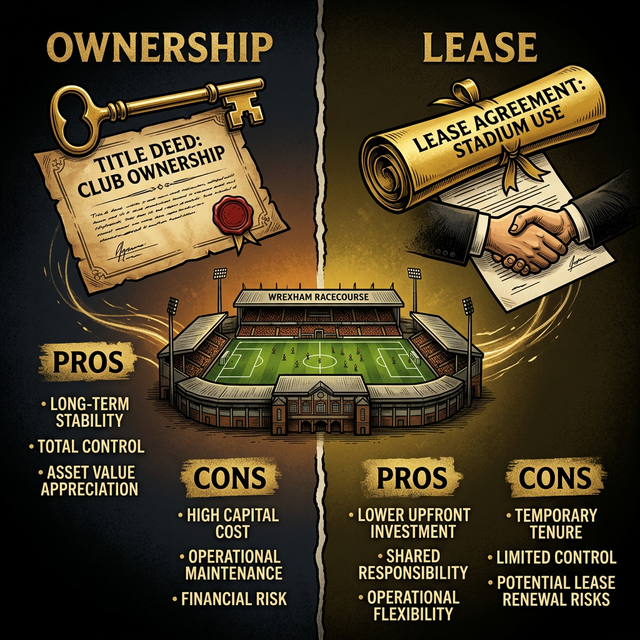
Property tenure is one of the most consequential decisions facing Welsh football clubs and their investors. A club's relationship to its ground shapes everything from daily operations to long-term valuation. In the Cymru Premier — where club revenues range from £0.7M to £3.2M and average attendances sit at 400-600 — the choice between owning and leasing a stadium is not merely a financial calculation. It determines whether a club can invest in ground grading upgrades, secure FAW licensing compliance, and build the commercial infrastructure needed for sustainable growth.
The due diligence guide covers property assessment as part of the pre-acquisition checklist. This analysis examines the financial, operational, and strategic implications of each tenure model.
Financial Comparison: Ownership vs Lease
| Factor | Freehold Ownership | Leasehold/Rental |
|---|---|---|
| Upfront capital | £200K-£1M+ (purchase + renovation) | £0-£50K (deposit + first period) |
| Annual cost | £5K-£20K (maintenance, insurance, rates) | £15K-£40K (rent + contribution to maintenance) |
| Balance sheet impact | Appreciating asset | No asset, recurring liability |
| Borrowing capacity | Ground as collateral for loans | No collateral benefit |
| Upgrade authority | Full control | Landlord approval required |
| Non-matchday revenue | Fully retained | Split with landlord or restricted |
| Exit value | Ground included in sale price | No property value on exit |
| Risk profile | Property market risk, maintenance burden | Lease expiry risk, rent escalation |
Total Cost of Ownership Over 10 Years
| Scenario | Year 0-1 | Annual (Years 2-10) | 10-Year Total | Residual Asset Value |
|---|---|---|---|---|
| Freehold purchase (£400K ground) | £400K + £50K renovation | £15K/yr maintenance | £535K | £400K-£600K |
| Long lease (25 years) | £25K deposit | £25K/yr rent | £250K | £0 |
| Short lease (5 years, rolling) | £10K deposit | £30K/yr rent | £280K | £0 |
Over a 10-year horizon, freehold ownership costs more in absolute terms but creates an asset worth £400K-£600K. Leasing costs less but generates no residual value. For investors with a long-term horizon — which the investment returns analysis suggests is 5-10 years minimum for Welsh football — ownership is typically the superior financial strategy.
The Revenue Case for Ownership
Owning the ground unlocks non-matchday revenue streams that leasing typically restricts or prevents:
| Revenue Stream | Annual Value (Est.) | Ownership Required? |
|---|---|---|
| Community pitch hire (evenings, weekends) | £8K-£20K | Full control needed |
| Facility hire (functions, events) | £5K-£15K | Full control needed |
| Naming rights | £5K-£15K/year | Usually requires ownership |
| Training ground rental to other clubs | £3K-£8K | Full control needed |
| Car boot sales, markets, community events | £2K-£5K | Full control needed |
| Advertising boards (permanent) | £5K-£15K | Full control needed |
| Total non-matchday revenue | £28K-£78K | — |
For a club with annual revenue of £1M, non-matchday facility revenue of £28K-£78K represents a 3-8% revenue uplift — material at this level of the game. The matchday revenue optimisation guide covers how to maximise this potential, and the revenue breakdown analysis shows how facility income fits within overall club finances.
67% of Cymru Premier clubs now play on artificial pitches, which significantly enhances the community hire proposition. A 4G pitch with compliant floodlighting can generate year-round hire income. Haverfordwest County's £500K 4G pitch project is the benchmark — see the Haverfordwest investment profile and the artificial pitch investment guide.
Operational Control and Licensing
FAW and UEFA Licensing
Property status directly affects a club's ability to meet licensing requirements. The FAW licensing framework mandates specific infrastructure standards — seated capacity, floodlighting, safety certification, media facilities — and clubs must demonstrate either:
- Ownership of a compliant ground, or
- A lease of sufficient length (typically 10+ years remaining) with documented landlord agreement for required upgrades
Clubs on short-term leases face licensing risk: if the landlord refuses to authorise an upgrade, or if the lease expires before compliance is achieved, the club's licensing status is jeopardised. For investors, this is a critical due diligence point — a club on a 3-year rolling lease may be unable to invest the £50K-£200K needed for stadium development without security of tenure.
Upgrade Authority
The practical difference between ownership and leasing becomes most apparent when infrastructure investment is needed:
| Upgrade Type | Owner Decision | Leaseholder Decision |
|---|---|---|
| Floodlight installation (£40K-£90K) | Board approval, proceed | Landlord approval required, may be refused |
| Seating installation (£50K-£200K) | Board approval, proceed | Landlord approval, often requires lease modification |
| Pitch replacement (£300K-£600K) | Board approval, proceed | Landlord must agree to alteration of the property |
| Naming rights deal | Club retains 100% | Typically requires landlord consent, revenue may be shared |
| Hospitality suite conversion | Board approval, proceed | Planning and landlord approval, may not be permitted |
The stadium guide provides a ground-by-ground assessment of current facilities and upgrade requirements.
Models in Practice: Welsh Club Case Studies
TNS — Freehold Ownership Model
TNS's Park Hall (2,034 capacity) is owned by the club, giving them full authority over the facility. This has enabled consistent investment in infrastructure — broadcast-grade floodlighting, a 4G pitch, hospitality facilities — that supports their £3.2M revenue and annual European campaigns. The TNS investment profile details the commercial model.
Park Hall's ownership also creates exit value: any future sale of the club includes the ground as an asset, materially increasing the transaction value.
Lease-Based Models
Several Cymru Premier clubs operate from grounds they do not own, typically leased from local authorities or community trusts. These arrangements offer lower capital requirements but create constraints:
- Limited upgrade authority without lengthy negotiation
- No asset appreciation benefiting the club
- Lease renewal risk that can affect long-term planning
- Revenue sharing requirements on commercial hire
Hybrid Models
Some clubs have pursued hybrid arrangements:
- Long lease with purchase option: Secures tenure while preserving capital for squad and operations investment
- Community asset transfer: Local authority transfers ground to a community trust, which leases to the club at favourable terms — increasingly common in Welsh football
- Ground share: Two clubs sharing a venue, splitting costs — relevant for clubs in the same catchment area (see the catchment analysis)
European Ownership Comparisons
The property question is not unique to Wales. Across European football, ownership models vary significantly:
| Country/League | Typical Property Model | Investor Implication |
|---|---|---|
| England (lower leagues) | Mix of freehold and council lease | Freehold valued at premium |
| Scotland (SPFL) | Predominantly freehold | Ground value included in acquisitions |
| Ireland (LOI) | Mixed, many council-owned | Limits infrastructure investment |
| Iceland | Club-owned or municipal | Municipal grounds limit commercial control |
| Wales (Cymru Premier) | Mixed — estimated 50% freehold | Key due diligence variable |
The European ownership models comparison examines broader governance structures, and the small-nation football comparison provides investment return benchmarking across comparable leagues.
Legal Considerations
Investors evaluating property status should assess:
- Title search: Confirm freehold ownership or verify lease terms, rent review mechanisms, and break clauses
- Planning permissions: Check for restrictions on ground use (residential development potential, change of use)
- Environmental liabilities: Older grounds may have contamination or asbestos issues
- Listed building status: Some historic Welsh grounds have heritage designations affecting renovation
- Restrictive covenants: Some ground sales include covenants requiring continued football use
- Community asset listing: Under the Assets of Community Value legislation, grounds listed as community assets give local groups right-to-bid if sold
The Companies House filings analysis provides a starting point for financial due diligence, and the due diligence guide covers the full assessment framework.
Decision Framework for Investors
| Investor Profile | Recommended Approach | Rationale |
|---|---|---|
| Long-term (10+ years), capital available | Acquire freehold | Asset appreciation, full control, licensing security |
| Medium-term (5-7 years), moderate capital | Secure long lease (15+ years) with upgrade rights | Sufficient tenure for investment recovery, lower upfront cost |
| Short-term or exploratory | Lease with option to purchase | Test the investment thesis before committing capital to property |
| Community/trust ownership | Community asset transfer or trust structure | Align with Welsh football culture, access grant funding |
The right choice depends on a club's financial position, competitive ambition, and the investor's time horizon. For clubs targeting European competition — where infrastructure requirements are highest — ownership or a long lease with documented upgrade authority is effectively non-negotiable.
For the broader investment context, see the club investment profiles and the cost to buy a Welsh football club analysis.
Analysis based on Cymru Connect property research, FAW licensing data, Companies House filings, Land Registry records (where available), and industry benchmarking. Cost estimates reflect 2025-26 market conditions. Specific club property arrangements are subject to confidential commercial terms and may differ from estimates presented. Data current as of March 2026.