TL;DR: Eight of 12 current Cymru Premier clubs use 3G/4G artificial pitches and 8 hold UEFA licences. Average capacity sits at 2,500-3,000, but typical attendance is only 400-600 — leaving stadiums at just 15-25% utilisation. With the league expanding to 16 teams in 2026/27, infrastructure investment is no longer optional: it is a prerequisite for competitiveness, European participation, and commercial revenue growth.
Why Stadium Infrastructure Defines Investment Value
In lower-league football, stadium quality is often the single greatest determinant of a club's commercial ceiling. A ground that meets UEFA licensing standards can host European fixtures, generating £50-200K in prize money per campaign. A 3G/4G pitch eliminates weather-related postponements and generates year-round community hire income. Modern hospitality facilities unlock corporate sponsorship packages that are impossible in bare-bones venues.
For investors evaluating Cymru Premier clubs, infrastructure is both a cost and an asset. Unlike player registrations (which depreciate through contract expiry and age) or commercial contracts (which expire and must be renegotiated), facility improvements create permanent value that appreciates as the club grows. This is why our Infrastructure Investment Guide ranks facility development as one of the highest-return capital allocation decisions available in Welsh football.
The Current Stadium Landscape
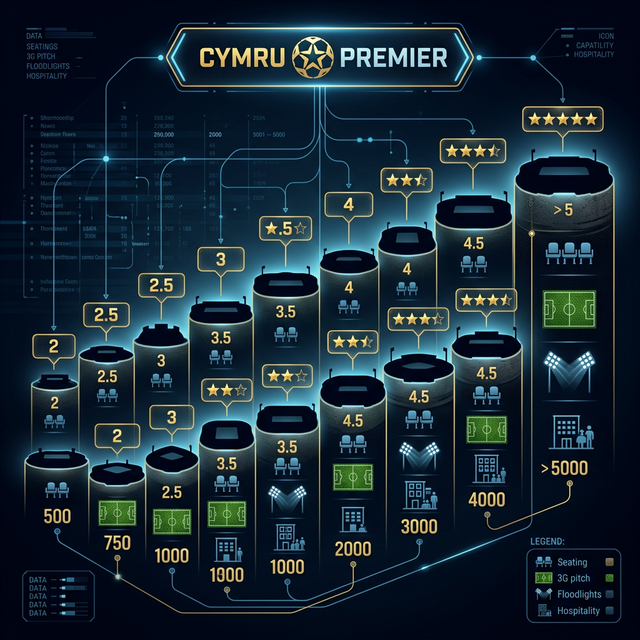
The following table provides a comprehensive overview of every current Cymru Premier ground, including capacity, pitch type, and UEFA licensing status.
| Club | Stadium | Capacity | Pitch Type | UEFA Licence | Google Rating |
|---|---|---|---|---|---|
| TNS | Park Hall | 2,034 | Artificial | Yes | 4.3/5 |
| Connah's Quay | Deeside Stadium | 2,500 | Artificial | Yes | 4.1/5 |
| Penybont | SDM Glass Stadium | 2,500 | Artificial | Yes | 4.4/5 |
| Caernarfon | The Oval | 3,000 | Artificial | Yes | 4.5/5 |
| Barry Town | Jenner Park | 3,000 | Natural | Yes | 4.2/5 |
| Haverfordwest | Ogi Bridge Meadow | 3,000 | 4G | Yes | 4.3/5 |
| Bala Town | Maes Tegid | 3,000 | Artificial | Yes | 4.4/5 |
| Cardiff Met | Cyncoed Campus | 2,000 | Artificial | Yes | 4.0/5 |
| Aberystwyth | Park Avenue | 2,500 | Natural | Partial | 3.8/5 |
| Newtown | Latham Park | 2,500 | Natural | Partial | 4.0/5 |
| Flint Town | Cae-y-Castell | 2,000 | Artificial | Partial | 3.9/5 |
| Briton Ferry | Old Road Athletic Ground | 1,500 | Natural | No | 3.7/5 |
Key Takeaways
- 67% artificial pitch adoption (8 of 12 clubs) — the highest rate of any professional league in the UK
- 8 UEFA licences — enabling two-thirds of the league to host European fixtures
- Average capacity of 2,500 — well above current attendance requirements but below the levels needed for significant matchday revenue growth
- Attendance utilisation of 15-25% — the gap between capacity and attendance represents the league's single largest untapped revenue opportunity
Pitch Technology: The 3G/4G Revolution
The Cymru Premier's widespread adoption of artificial pitches is one of its most distinctive features and a significant competitive advantage over comparable leagues.
Benefits for Clubs
| Benefit | Impact | Annual Value |
|---|---|---|
| Zero Weather Postponements | 100% fixture reliability | £10-20K (avoided lost gate receipts) |
| Community Hire Revenue | Year-round pitch rental | £15-40K |
| Reduced Maintenance Costs | No mowing, re-seeding, or drainage | £8-15K saved |
| Training Use | First-team and academy training on match surface | Competitive advantage |
| Extended Playing Hours | Floodlit sessions in all weather | Revenue + development |
Benefits for Investors
Artificial pitches fundamentally change the business case for stadium investment. A natural grass pitch is a depreciating asset that requires ongoing maintenance expenditure. A 3G/4G pitch is a revenue-generating asset that can be monetised 12 months per year through community hire, coaching programmes, and corporate events. The typical payback period for a 3G/4G installation is 5-7 years — after which the pitch generates net positive cash flow for the remainder of its 8-12 year lifespan.
Our 3G/4G Artificial Pitch Wales analysis provides detailed cost breakdowns and revenue projections for clubs considering the switch. The Artificial Pitch Investment Wales report covers the business case from the investor's perspective.
UEFA Licensing: The Gateway to European Revenue
UEFA licensing is the single most important infrastructure credential in the Cymru Premier. Without a licence, a club cannot host European fixtures — even if it qualifies on sporting merit. This means a club's infrastructure directly determines its ability to access the most valuable revenue stream in Welsh football.
UEFA Licensing Requirements
| Category | Minimum Standard | Current Compliance |
|---|---|---|
| Seated Capacity | 1,500 minimum | 8/12 clubs meet |
| Floodlighting | 500 lux minimum | 8/12 clubs meet |
| Changing Rooms | Separate for home, away, officials | 10/12 clubs meet |
| Media Facilities | Press box, interview area | 8/12 clubs meet |
| Medical Facilities | Treatment room, ambulance access | 10/12 clubs meet |
| Pitch Quality | FIFA Quality Pro or natural (maintained) | 10/12 clubs meet |
The four clubs without full UEFA licences face a clear capital expenditure requirement if they wish to compete for European qualification. For investors, funding the gap between current infrastructure and UEFA compliance can be a high-return proposition — the cost of achieving compliance is typically £100-300K, while the European revenue it unlocks is £50-200K per campaign.
Our UEFA Stadium Licensing guide details the full requirements, while the FAW Licensing Requirements report covers the domestic licensing framework.
Stadium-by-Stadium Investment Analysis
Tier 1: European-Ready Venues
Park Hall (TNS) — The league's most commercially developed ground, with dedicated hospitality areas, media facilities, and a full-time operations team. At 2,034 capacity, it is actually the smallest of the European-ready venues, but TNS's average attendance of 620 means utilisation is among the highest in the league at approximately 30%. The club's investment profile covers the financial context.
Deeside Stadium (Connah's Quay) — A 2,500-capacity venue with modern facilities benefiting from proximity to the A55 corridor and Chester commuter belt. The stadium's location in Deeside gives it strong corporate hospitality potential from the local business parks. See the Connah's Quay Investment Profile.
SDM Glass Stadium (Penybont) — One of the newest grounds in the league, purpose-designed to modern standards. The 2,500 capacity and artificial pitch create a venue that exceeds most clubs' current needs but provides headroom for growth. The Penybont Investment Profile analyses the club's rapid development.
Tier 2: Strong Foundations
The Oval (Caernarfon) — At 3,000 capacity and with the league's highest average attendance (~820), The Oval is arguably the most atmospheric ground in the Cymru Premier. The venue's setting in the shadow of Caernarfon Castle creates a unique matchday experience that has tourism and heritage value beyond football. The Caernarfon Investment Profile covers the opportunity.
Ogi Bridge Meadow (Haverfordwest) — The 4G pitch and 3,000 capacity are complemented by naming rights sponsorship from Ogi — a model of commercial activation that other clubs should study. The Haverfordwest Investment Profile provides full detail.
Jenner Park (Barry Town) — A 3,000-capacity ground with significant heritage value (the club was founded in 1912). The natural grass pitch is one of only four remaining in the league. See the Barry Town Investment Profile.
Maes Tegid (Bala Town) — Situated beside Bala Lake in Gwynedd, Maes Tegid's 3,000 capacity and picturesque setting make it one of the most distinctive venues in Welsh football. The Bala Town Investment Profile covers the club's heritage and commercial position.
Tier 3: Development Required
Cyncoed Campus (Cardiff Met) — Integrated with the university campus, this 2,000-capacity venue benefits from institutional support but lacks the standalone commercial facilities of purpose-built football grounds.
Park Avenue (Aberystwyth) and Latham Park (Newtown) — Both venues require investment in floodlighting and seating to achieve full UEFA compliance.
Matchday Revenue Optimisation
The gap between capacity and attendance is the Cymru Premier's most significant untapped revenue opportunity. With stadiums at 15-25% utilisation, there is enormous headroom for matchday revenue growth without any capital expenditure on capacity expansion.
| Revenue Lever | Current State | Potential | Investment Required |
|---|---|---|---|
| Gate Receipts | £15-30K/season | £25-50K/season | Marketing + pricing strategy |
| Hospitality | £5-10K/season | £15-40K/season | Dedicated hospitality area |
| Food & Beverage | £8-15K/season | £15-30K/season | Improved catering facilities |
| Merchandise | £3-8K/season | £8-20K/season | Club shop/online store |
| Pitch Hire (Artificial) | £15-40K/season | £25-60K/season | Booking system + marketing |
| Events (Non-Football) | £0-5K/season | £10-25K/season | Multi-use facility design |
Our Matchday Revenue Optimisation report provides a practical framework for clubs seeking to close this gap.
Expansion Impact: Four New Venues
The promotion of four clubs from Cymru North and South for 2026/27 will add new venues to the Premier landscape. These grounds must meet FAW ground grading requirements, creating an immediate infrastructure investment opportunity for the promoted clubs and their backers.
Among the leading contenders:
| Contender Club | Stadium Capacity | Pitch Type | Licensing Status |
|---|---|---|---|
| Pontypridd Town | 2,000 | 3G | Met |
| Carmarthen Town | 3,000 | Natural | Met |
| Airbus UK | 1,600 | 3G | Met |
| Prestatyn Town | 2,000 | Natural | Pending |
The Expansion 2027 Guide covers these contenders in detail, including their infrastructure readiness and the capital required to achieve Premier-level compliance.
Stadium Development ROI
For investors considering infrastructure investment, the return profile is attractive relative to other capital allocation options in lower-league football.
| Investment Category | Typical Cost | Annual Revenue Impact | Payback Period |
|---|---|---|---|
| 3G/4G Pitch Installation | £400-800K | £40-80K | 5-10 years |
| Floodlight Upgrade (500 lux) | £80-150K | £15-25K | 4-7 years |
| Hospitality Suite | £50-150K | £15-40K | 2-5 years |
| Seating (to 1,500) | £100-250K | £10-20K | 5-12 years |
| Media Facilities | £30-80K | UEFA licence access | Enabling investment |
Our Stadium Development ROI report models these returns in detail, while the Floodlight Installation Costs guide addresses one of the most common infrastructure gaps.
The Best Stadiums in Wales: Beyond the Cymru Premier
For context on how Cymru Premier grounds compare to the broader Welsh stadium landscape — including Wrexham's Racecourse Ground, Swansea's Swansea.com Stadium, and Cardiff City Stadium — see our Best Football Stadiums in Wales guide.
Conclusion
The Cymru Premier's stadium landscape is defined by two characteristics: surprisingly high infrastructure quality (67% artificial pitches, 8 UEFA licences) and dramatically low utilisation (15-25% of capacity). For investors, this combination creates a clear opportunity — the physical infrastructure exists to support significantly higher matchday revenue, and the capital required to bring the remaining venues up to UEFA standard is modest by any professional football benchmark. Clubs that invest in their facilities now will be best positioned to capture the commercial benefits of the expanded 16-team league.
Stadium data compiled from club websites, FAW licensing reports, Google Maps reviews, and Cymru Connect on-site assessments. Capacity figures represent licensed maximum; some venues may have additional standing areas not included in official figures. Data as of March 2026.