TL;DR: Ground grading is the gatekeeper of the Welsh football pyramid. Clubs need 1,000 seated capacity for Cymru Premier domestic matches and 2,000 for European competition, yet only 8 of 12 current top-flight clubs hold full UEFA licences. With the league expanding to 16 clubs in 2026/27, promoted clubs face infrastructure investment of £200,000-£1.5 million to meet grading requirements — making facility planning as strategically important as squad building.
Why Ground Grading Matters
In Welsh football, you can win promotion on the pitch and be denied it by your ground. The FAW's ground grading system sets minimum standards for stadiums at each level of the pyramid, and clubs that fail to meet them are refused promotion regardless of league position. This is not theoretical — multiple Welsh clubs have been denied advancement due to infrastructure shortfalls in recent seasons.
For investors, ground grading defines the capital expenditure requirements at each tier. A club with ambitions to reach or remain in the Cymru Premier needs to plan its infrastructure investment alongside its sporting programme, because the grading requirements determine the minimum viable facility specification.
This analysis covers the grading criteria at each level, the costs of compliance, and the strategic considerations for clubs and investors navigating the system.
The Welsh Football Pyramid Structure
| Level | Division | Clubs | Ground Grading Required |
|---|---|---|---|
| 1 | Cymru Premier | 12 (expanding to 16) | Tier 1 (domestic) or UEFA (European) |
| 2 | Cymru North / Cymru South | 16 each | Tier 2 |
| 3 | Regional leagues | Various | Tier 3 |
| 4 | Local leagues | Various | Basic |
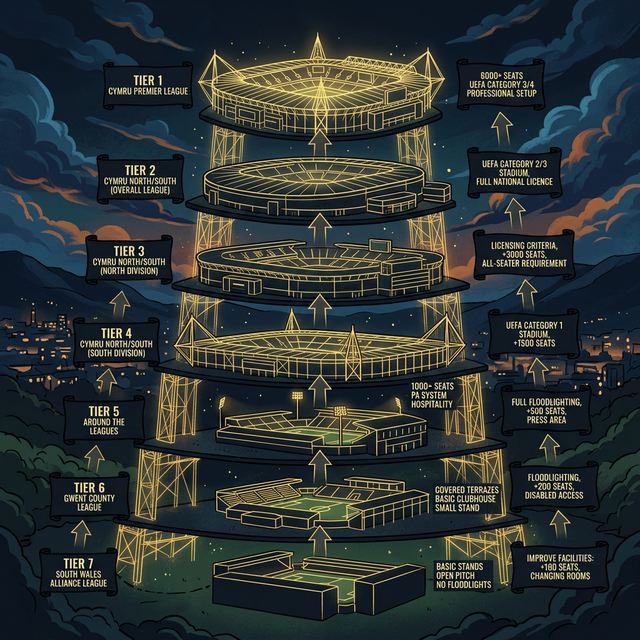
Each tier has specific requirements across multiple categories. The jump from Tier 2 to Tier 1 is the most significant in terms of capital expenditure, and the jump from Tier 1 domestic to UEFA standard represents a further step that only 8 of 12 current Cymru Premier clubs have achieved.
Tier 1 (Cymru Premier) Grading Requirements
Seating Capacity
The headline requirement: 1,000 seated spectators for domestic Cymru Premier matches. This must be permanent, covered seating — temporary structures are accepted only on a transitional basis with FAW approval.
For clubs entering European competition (UEFA Conference League qualifying, Champions League pathway for the league champion), the requirement rises to 2,000 seats. Given that the Cymru Premier champion and typically one or two other clubs qualify for European competition annually, this higher standard is relevant to any club with title ambitions.
| Capacity Requirement | Standard | Typical Cost | Notes |
|---|---|---|---|
| 1,000 seated (domestic) | FAW Tier 1 | £150K-£400K | Covered, permanent seating |
| 2,000 seated (European) | UEFA | £300K-£800K | Higher spec, additional facilities |
| Standing capacity | No minimum (safety-limited) | £20K-£100K | Covered terracing, if provided |
Average attendance in the Cymru Premier sits at 400-600, meaning the 1,000-seat requirement exceeds typical matchday demand. This creates a financial tension: clubs must invest in capacity they may not fill on most matchdays. However, the capacity headroom supports growth and is essential for hosting cup finals, high-profile fixtures, and commercial events.
Pitch Standards
The FAW accepts both natural grass and artificial surfaces for Cymru Premier competition. Currently, 8 of 12 clubs play on 3G or 4G artificial pitches, reflecting the practical reality of Welsh weather and the cost advantages of synthetic surfaces.
| Pitch Type | Installation Cost | Annual Maintenance | Lifespan | Cymru Premier Approved |
|---|---|---|---|---|
| Natural grass (sand-based) | £80K-£150K | £30K-£60K | Continuous (with renovation) | Yes |
| 3G artificial (FIFA Quality) | £400K-£600K | £8K-£15K | 8-10 years | Yes |
| 4G artificial (FIFA Quality Pro) | £500K-£800K | £10K-£20K | 10-12 years | Yes |
| Hybrid (reinforced natural) | £200K-£350K | £25K-£45K | Continuous | Yes |
The artificial pitch option, while more expensive upfront, delivers significant long-term savings and eliminates the weather-related fixture postponements that disrupt schedules and revenue. For a detailed analysis of artificial pitch investment, see the Artificial Pitch Investment Guide.
Floodlighting
All Cymru Premier matches must be playable under floodlights. The minimum standard is 500 lux for domestic matches and 1,200 lux for UEFA competition.
| Standard | Lux Level | Installation Cost | Running Cost (per match) |
|---|---|---|---|
| FAW domestic minimum | 500 lux | £80K-£150K | £50-£100 |
| UEFA minimum | 1,200 lux | £150K-£300K | £100-£200 |
| Broadcast quality | 1,400+ lux | £200K-£400K | £150-£250 |
S4C's Sgorio broadcasts require higher lux levels for camera quality, meaning clubs that host televised fixtures need to exceed the basic FAW minimum. For installation cost details, see the Floodlight Installation Costs guide.
Safety and Ancillary Facilities
| Requirement | Specification | Estimated Cost |
|---|---|---|
| Medical room | Equipped treatment room, stretcher access | £10K-£25K |
| Accessible seating | Wheelchair positions with companion seats, accessible toilets | £15K-£40K |
| Segregation | Visiting supporter separation (where required) | £10K-£30K |
| Public address system | Coverage of all spectator areas | £5K-£15K |
| CCTV | Coverage of turnstiles, spectator areas, pitch perimeter | £8K-£20K |
| Perimeter fencing | Pitch-side barriers meeting safety standards | £10K-£25K |
| Changing rooms | Home, away, and officials' rooms to FAW specification | £20K-£60K |
| Turnstile/entry system | Controlled entry with counting capability | £5K-£15K |
Media and Broadcast Facilities
With S4C Sgorio covering the Cymru Premier, clubs need to accommodate broadcast operations:
| Facility | Specification | Estimated Cost |
|---|---|---|
| Press box | Minimum 6 positions with power and connectivity | £10K-£25K |
| Camera positions | Elevated main camera, pitch-level positions | £5K-£15K |
| Commentary position | Sound-isolated booth or position with broadcast sight lines | £5K-£15K |
| Mixed zone | Post-match interview area with appropriate backdrops | £2K-£5K |
| Broadcast compound area | Hard-standing area for OB vehicles | £5K-£15K |
Tier 2 (Cymru North / Cymru South) Requirements
The step down from Tier 1 to Tier 2 significantly reduces the infrastructure burden:
| Requirement | Tier 1 (Cymru Premier) | Tier 2 (Cymru North/South) |
|---|---|---|
| Seated capacity | 1,000 | 200 |
| Covered standing | Recommended | Not required |
| Floodlighting | 500 lux minimum | 250 lux minimum |
| Pitch | FIFA Quality (artificial) or maintained natural | Maintained to playable standard |
| Changing rooms | 3 rooms to FAW spec | 3 rooms (basic spec) |
| Medical facilities | Equipped treatment room | First aid provision |
| Segregation | Required | Not required |
| CCTV | Required | Recommended |
The cost differential between Tier 2 and Tier 1 compliance is substantial:
| Upgrade Path | Typical Cost Range | Timeline |
|---|---|---|
| Tier 2 compliant ground (from scratch) | £100K-£300K | 6-12 months |
| Tier 2 to Tier 1 upgrade | £200K-£800K | 12-24 months |
| Tier 1 domestic to UEFA standard | £200K-£600K | 6-18 months |
| Full new-build to Tier 1 standard | £1M-£3M | 18-36 months |
The 2026/27 Expansion Challenge
The Cymru Premier's expansion from 12 to 16 clubs in 2026/27 creates an immediate ground grading challenge. Four promoted clubs must achieve Tier 1 compliance, and the transition timeline is tight.
Clubs likely to be in the promotion conversation include those at the top of Cymru North and Cymru South. The FAW grants a transitional period for newly promoted clubs, but the expectation is that Tier 1 standards are met within two seasons. For a detailed analysis of the expansion's implications, see the Cymru Premier Expansion Guide.
Typical Upgrade Requirements for Promoted Clubs
| Component | Likely Existing Standard | Required Standard | Estimated Upgrade Cost |
|---|---|---|---|
| Seating | 200 seats | 1,000 seats | £200K-£500K |
| Floodlighting | 250 lux | 500 lux | £50K-£150K |
| Pitch | Variable | FIFA Quality or equivalent | £0-£600K |
| Changing rooms | Basic | FAW Tier 1 | £20K-£60K |
| Safety and ancillary | Basic | Full compliance | £30K-£80K |
| Media facilities | Minimal | Broadcast-ready | £20K-£50K |
| Total typical upgrade | £300K-£1.5M |
The UEFA Licence Gap
Only 8 of 12 current Cymru Premier clubs hold full UEFA licences, meaning 4 clubs would be unable to compete in European competition even if they qualified on sporting merit. The UEFA licence requires:
- 2,000 seated capacity
- 1,200+ lux floodlighting
- Broadcast-quality facilities
- Additional medical and security provisions
- Financial fair play compliance
This creates a strategic consideration for investors: a club with UEFA-standard infrastructure has an asset that is immediately deployable if sporting results warrant European entry, while a club without it faces a capital expenditure requirement of £200,000-£600,000 before it can compete continentally.
For a detailed examination of UEFA licensing requirements, see the UEFA Stadium Licensing analysis and the FAW Licensing Requirements guide.
Ground Sharing and Alternative Approaches
Some clubs address grading requirements through ground-sharing arrangements or the use of third-party venues:
| Approach | Advantages | Disadvantages | Examples in Welsh Football |
|---|---|---|---|
| Ground share with another club | Shared cost, immediate compliance | Loss of identity, scheduling conflicts | Various lower-league arrangements |
| Use of local authority facility | Lower cost, existing infrastructure | Limited branding, restricted access | Cardiff Met at Cyncoed Campus |
| Partnership with rugby club | Shared stadium costs, dual-use facility | Pitch wear, fixture clashes | Several clubs in south Wales |
| Temporary structures | Lower upfront cost, flexibility | Time-limited FAW approval, aesthetics | Used during transition periods |
The Cardiff Met University Model demonstrates how a club can compete at the highest level using university facilities, though this approach requires a specific institutional relationship.
Investment Planning Checklist
For clubs and investors planning ground grading compliance:
- Audit current status against the target tier requirements (request FAW inspection report)
- Identify the gap between current infrastructure and required standard
- Prioritise by cost and impact: Seating and floodlighting are typically the largest items
- Explore funding sources: Sport Wales grants, FAW facility funding, local authority support, Community Sports Hub funding
- Plan phased delivery: FAW accepts transitional arrangements for newly promoted clubs
- Consider multi-use revenue: Facilities that generate income beyond matchday improve the investment case
- Engage early with FAW: The licensing committee provides guidance before formal inspections
For the broader infrastructure investment context, see the Welsh Football Infrastructure Investment Guide and the Stadium Development ROI analysis. For stadium-specific guides, see the Best Football Stadiums in Wales.
Sources: FAW Ground Grading Regulations (2025-26 edition), FAW Licensing Committee reports, UEFA Club Licensing Regulations (2024 cycle), Cymru Connect infrastructure cost analysis. Cost estimates are based on recent Welsh football facility projects and construction industry benchmarks; actual costs will vary by project specification, location, and market conditions. Data compiled by Cymru Connect Research, March 2026.