TL;DR: The Cymru Premier features extreme financial disparity — TNS generates £3.2M in revenue against a league average of £900K — but benchmarking reveals that the gap between clubs is closing in key areas like academy output, digital presence, and commercial development. For investors, the clubs that benchmark well on growth metrics but poorly on absolute revenue are the undervalued opportunities.
What Benchmarking Reveals
Benchmarking is the process of comparing clubs across standardised metrics to identify relative strengths, weaknesses, and opportunities. In the Cymru Premier, where financial data is patchy and club operations vary enormously, benchmarking provides the analytical framework that enables like-for-like comparison.
The Cymru Premier is a league of extremes. The New Saints operate a full-time professional squad on a £3.2M revenue base. At the other end, clubs run entirely on volunteer labour with revenues below £500K. Between these poles, the majority of clubs operate semi-professionally, with part-time players, limited administrative staff, and revenue in the £700K–£1.2M range.
Understanding where a specific club sits relative to its peers — and where it outperforms or underperforms — is the starting point for any investment thesis.
The Benchmarking Framework
Cymru Connect evaluates Cymru Premier clubs across five dimensions:
1. Financial Performance
| Club | Estimated Revenue | Revenue Rank | Revenue Trend |
|---|---|---|---|
| The New Saints | £3.2M | 1st | Growing (8–12% annually) |
| Connah's Quay Nomads | £1.8M | 2nd | Growing |
| Haverfordwest County | £1.4M | 3rd | Growing |
| Cardiff Met | £1.1M | 4th | Stable |
| Penybont | £950K | 5th | Growing |
| Bala Town | £800K | 6th | Stable |
| Caernarfon Town | £750K | 7th | Growing |
| Barry Town United | £700K | 8th | Growing |
| Newtown AFC | £650K | 9th | Stable |
| Aberystwyth Town | £550K | 10th | Stable |
| Flint Town United | £450K | 11th | Variable |
| Airbus UK Broughton | £400K | 12th | Declining |
Key insight: The top four clubs (TNS, Connah's Quay, Haverfordwest, Cardiff Met) account for approximately 55% of total league revenue. This concentration mirrors patterns seen in other small-nation leagues but is more extreme than the League of Ireland or Icelandic Urvalsdeild, where revenue is more evenly distributed.
Revenue data is drawn from Companies House filings where available and Cymru Connect's proprietary estimates where filings are incomplete. For a detailed breakdown of revenue sources, see our Revenue Breakdown.
2. Squad Valuation
| Club | Estimated Squad Value | Value Rank | Value per Player |
|---|---|---|---|
| The New Saints | £2.5M | 1st | £100K |
| Connah's Quay Nomads | £1.5M | 2nd | £65K |
| Haverfordwest County | £700K | 3rd | £30K |
| Bala Town | £600K | 4th | £25K |
| Penybont | £550K | 5th | £24K |
| Barry Town United | £450K | 6th | £20K |
| Caernarfon Town | £400K | 7th | £18K |
| Newtown AFC | £350K | 8th | £16K |
| Cardiff Met | £400K | 9th | £17K |
| Aberystwyth Town | £300K | 10th | £13K |
| Flint Town United | £250K | 11th | £11K |
| Airbus UK Broughton | £200K | 12th | £9K |
Key insight: TNS's squad value is more than three times the league median. However, Cardiff Met — ranked 9th by squad value — outperforms several higher-valued squads on the pitch, demonstrating that academy output and coaching quality can partially offset recruitment spending.
Squad valuations are sourced from Transfermarkt (March 2026). For a deeper analysis of squad economics, see our Squad Values and Wages report.
3. Academy Output
| Club | Academy Minutes % | Rank | Model |
|---|---|---|---|
| Cardiff Met | 45% | 1st | University |
| Haverfordwest County | 22% | 2nd | Community |
| The New Saints | 15% | 3rd | Professional |
| Connah's Quay Nomads | 12% | 4th | Semi-professional |
| Bala Town | 10% | 5th | Community |
| Penybont | 10% | 5th | Community |
| Newtown AFC | 8% | 7th | Community |
| Caernarfon Town | 7% | 8th | Community |
| Barry Town United | 6% | 9th | Community |
| Aberystwyth Town | 5% | 10th | Community |
| Flint Town United | 4% | 11th | Community |
| Airbus UK Broughton | 3% | 12th | Corporate |
Key insight: Academy output is inversely correlated with revenue in the top three clubs. Cardiff Met (highest academy output, 4th in revenue) and TNS (3rd in academy output, 1st in revenue) represent opposite ends of the development-versus-recruitment spectrum. The optimal model for most clubs lies somewhere between them.
For a detailed comparison of academy models, see our Academy Best Clubs analysis. The Youth International Pathway article explains how academy output feeds into Wales national team selection.
4. Attendance and Community Engagement
| Club | Average Attendance | Attendance Rank | Catchment Population | Attendance/Catchment % |
|---|---|---|---|---|
| Caernarfon Town | 800–1,000 | 1st | ~10,000 | 8–10% |
| The New Saints | 500–800 | 2nd | ~30,000 (Oswestry area) | 1.7–2.7% |
| Connah's Quay Nomads | 500–700 | 3rd | ~35,000 | 1.4–2.0% |
| Penybont | 450–600 | 4th | ~40,000 | 1.1–1.5% |
| Bala Town | 400–550 | 5th | ~5,000 | 8–11% |
| Haverfordwest County | 400–550 | 6th | ~65,000 | 0.6–0.8% |
| Newtown AFC | 350–500 | 7th | ~12,000 | 2.9–4.2% |
| Barry Town United | 350–500 | 8th | ~55,000 | 0.6–0.9% |
| Aberystwyth Town | 300–450 | 9th | ~18,000 | 1.7–2.5% |
| Flint Town United | 250–400 | 10th | ~12,000 | 2.1–3.3% |
| Cardiff Met | 200–350 | 11th | ~365,000 (Cardiff) | <0.1% |
| Airbus UK Broughton | 200–350 | 12th | ~15,000 | 1.3–2.3% |
Key insight: The attendance-to-catchment ratio is the most revealing metric. Caernarfon Town and Bala Town convert 8–11% of their local population into regular attendees — extraordinary figures for any level of football. By contrast, Haverfordwest and Barry Town convert less than 1% of their larger catchments, suggesting significant untapped audience potential. Cardiff Met's position is an outlier — the club competes in a city dominated by Cardiff City, making direct catchment comparison misleading.
For the full attendance analysis, see our Attendance Trends and Attendance History articles. The Catchment Population Analysis examines geographic factors in detail.
5. Digital and Commercial Presence
| Club | Social Media Following (Combined) | Website Quality | Sponsorship Deals | Digital Rank |
|---|---|---|---|---|
| The New Saints | Highest | Professional | Multi-year, national brands | 1st |
| Connah's Quay Nomads | High | Professional | Growing commercial portfolio | 2nd |
| Caernarfon Town | Moderate–High | Good | Local/regional sponsors | 3rd |
| Haverfordwest County | Moderate | Professional | Growing | 4th |
| Barry Town United | Moderate | Good | Historical brand strength | 5th |
| Penybont | Moderate | Good | Growing | 6th |
| Other clubs | Low–Moderate | Variable | Limited | 7th–12th |
Key insight: Digital presence correlates strongly with commercial revenue but is one of the easiest dimensions to improve. A dedicated social media manager (£20K–£30K annually) and a modern website (£5K–£15K one-off) can shift a club from the bottom half of the digital rankings to the top half within a single season.
For the full digital analysis, see our Digital Presence Rankings and Digital Transformation articles.
Composite Benchmarking Score
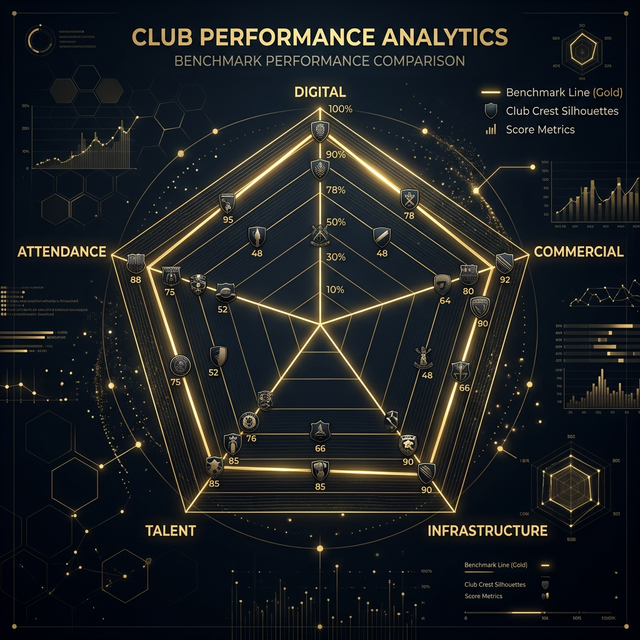
Combining all five dimensions into a composite score reveals the overall competitive position of each club:
| Club | Financial | Squad | Academy | Attendance | Digital | Composite Rank |
|---|---|---|---|---|---|---|
| The New Saints | 10 | 10 | 7 | 7 | 10 | 1st |
| Connah's Quay Nomads | 8 | 8 | 6 | 7 | 8 | 2nd |
| Haverfordwest County | 7 | 6 | 8 | 5 | 6 | 3rd |
| Cardiff Met | 5 | 4 | 10 | 3 | 4 | 4th |
| Caernarfon Town | 4 | 4 | 4 | 10 | 6 | 5th |
| Penybont | 5 | 5 | 5 | 6 | 5 | 6th |
| Bala Town | 4 | 5 | 5 | 6 | 4 | 7th |
| Barry Town United | 3 | 4 | 3 | 5 | 5 | 8th |
| Newtown AFC | 3 | 3 | 4 | 5 | 3 | 9th |
| Aberystwyth Town | 2 | 3 | 3 | 4 | 3 | 10th |
| Flint Town United | 2 | 2 | 2 | 3 | 2 | 11th |
| Airbus UK Broughton | 1 | 1 | 1 | 2 | 2 | 12th |
Scores are relative rankings on a 1–10 scale within the Cymru Premier. They are not absolute measures of quality.
The composite score confirms TNS's overall dominance but also highlights clubs with specific strengths: Cardiff Met on academy output, Caernarfon on attendance, and Haverfordwest on the balance between financial performance and development quality.
Identifying Investment Opportunities Through Benchmarking
The most attractive investment opportunities are clubs that score well on structural metrics (academy, attendance, digital growth) but poorly on financial performance — indicating potential that has not yet been monetised.
High-Potential, Low-Revenue Clubs
| Club | Structural Strength | Revenue Gap | Investment Thesis |
|---|---|---|---|
| Caernarfon Town | Attendance (800–1,000) | Revenue well below league average | Strong community base is under-commercialised |
| Cardiff Met | Academy (45% minutes) | Revenue 4th but could grow with commercial investment | Development model generates value that is not captured |
| Barry Town United | Heritage and brand | Revenue 8th despite historical pedigree | Brand value exceeds current commercial exploitation |
Clubs with Balanced Growth Profiles
| Club | Balance | Investment Thesis |
|---|---|---|
| Haverfordwest County | Strong across financial, academy, and infrastructure | Well-positioned for European qualification; geographic monopoly |
| Penybont | Steady improvement across all dimensions | Young club (founded 2019 as merger) with room to grow |
| Connah's Quay Nomads | Second strongest overall | Closest rival to TNS; competitive for European places |
For individual club assessments, see our Club Investment Profiles series. For valuation methodology, see Club Valuations.
How the Cymru Premier Benchmarks Internationally
Comparing the Cymru Premier with other small-nation leagues provides context for the benchmarking data:
| Metric | Cymru Premier | League of Ireland | Icelandic Urvalsdeild | Scottish League Two |
|---|---|---|---|---|
| Average club revenue | £900K | £1.2M | £900K | £600K |
| Average attendance | 400–600 | 2,000–3,000 | 1,500–2,500 | 500–800 |
| Average squad value | £500K | £800K | £600K | £300K |
| Broadcast deal (per club) | £80K–£120K | £100K–£150K | £50K–£80K | £30K–£50K |
| Academy integration | 10–15% average | 10–12% average | 20–25% average | 8–12% average |
| Artificial pitches | 67% | 30% | 50% | 40% |
The Cymru Premier's closest comparable is the Icelandic Urvalsdeild — similar revenue levels, high artificial pitch usage, and a small-nation context. The League of Ireland represents the aspirational benchmark — similar in structure but with significantly higher attendance and commercial revenue.
For the full international comparison, see our Global Benchmarking and Welsh vs. Icelandic Model analyses.
Using Benchmarking Data for Due Diligence
Investors can use the benchmarking framework for practical due diligence:
Identify the target club's composite position. Where does it rank overall, and where does it rank on each individual dimension?
Identify the largest performance gaps. A club that ranks 8th on financial performance but 3rd on attendance has a clear commercial improvement opportunity.
Estimate the cost to close the gap. For each underperforming dimension, estimate the investment required to move the club from its current position to a target position (e.g., mid-table to top four).
Model the revenue impact. Use the benchmarking data to estimate how much additional revenue each improvement would generate.
Compare with acquisition cost. If the estimated revenue improvement exceeds the acquisition cost within a reasonable payback period (3–5 years), the investment case is worth pursuing.
For the full due diligence process, see our Due Diligence Guide. For financial records, see Companies House Filings.
Limitations of This Analysis
Benchmarking data for the Cymru Premier is inherently limited by:
- Incomplete financial disclosure. Not all clubs file detailed accounts with Companies House. Revenue estimates involve significant assumptions.
- Attendance measurement variability. Clubs count attendance differently — some use turnstile counts, others estimate, and some report only ticket sales (excluding complimentary admissions).
- Squad valuation methodology. Transfermarkt valuations are estimates based on market algorithms and community input, not independent appraisals.
- Dynamic context. The benchmarking data represents a snapshot. Club positions change season to season based on on-pitch performance, management changes, and external factors.
Despite these limitations, the benchmarking framework provides the most comprehensive comparative view of the Cymru Premier available — and a structured basis for investment decision-making.
Source and Methodology
Financial data is sourced from Companies House filings (2023–2025) and Cymru Connect proprietary estimates. Squad valuations are from Transfermarkt (March 2026). Attendance data is from FAW official match reports and club announcements. Academy minutes data is from FAW youth development reports (2024/25). Digital presence data is from Cymru Connect's proprietary social media and website monitoring tools. Composite scores are calculated using equal weighting across dimensions and should be treated as indicative rather than definitive. All figures are in GBP.