TL;DR: Eight Cymru Premier clubs run active academies, with Cardiff Met leading at 45% of squad minutes from graduates. The Cymru Premier is the primary feeder for Wales youth international squads, and clubs that invest in academy infrastructure generate both sporting returns (international call-ups) and financial returns (transfer fees to English clubs).
The Cymru Premier as a Development League
The Cymru Premier occupies a distinctive position in the British football landscape: it is simultaneously a senior competitive league and the primary development pathway for players aspiring to represent Wales at youth and senior international level. This dual function creates a specific value proposition for investors — clubs that excel at player development can monetise that output through transfer fees while simultaneously building the on-pitch competitiveness that drives matchday and commercial revenue.
Understanding how the youth international pathway works, which clubs drive it, and where the investment opportunities lie is essential for anyone evaluating the Welsh football market.
Academy Output Across the League
The clearest measure of a club's development quality is the proportion of first-team minutes played by academy graduates. This metric captures not just the volume of players produced but their readiness for senior competition — a critical factor in international selection.
| Club | Academy Minutes (% of First Team) | Academy Model | UEFA Licence | Key Strength |
|---|---|---|---|---|
| Cardiff Met | 45% | University-integrated | Pending | Academic-football dual pathway |
| Haverfordwest County | 22% | Community-based | Yes | Regional talent identification |
| The New Saints | 15% | Professional infrastructure | Yes | Full-time coaching environment |
| Connah's Quay Nomads | 12% | Semi-professional | Yes | North Wales talent pipeline |
| Bala Town | 10% | Community-based | Yes | Rural talent retention |
| Penybont | 10% | Community-based | Yes | South Wales catchment |
| Newtown AFC | 8% | Community-based | Yes | Mid-Wales presence |
| Caernarfon Town | 7% | Community-based | Yes | Welsh-language cultural identity |
The disparity between Cardiff Met (45%) and the rest of the league is striking. It reflects a fundamentally different model — one that treats player development as the primary objective rather than a secondary benefit of competitive participation. For a deep dive into how this model works, see our Cardiff Met Model case study.
How the Pathway Works
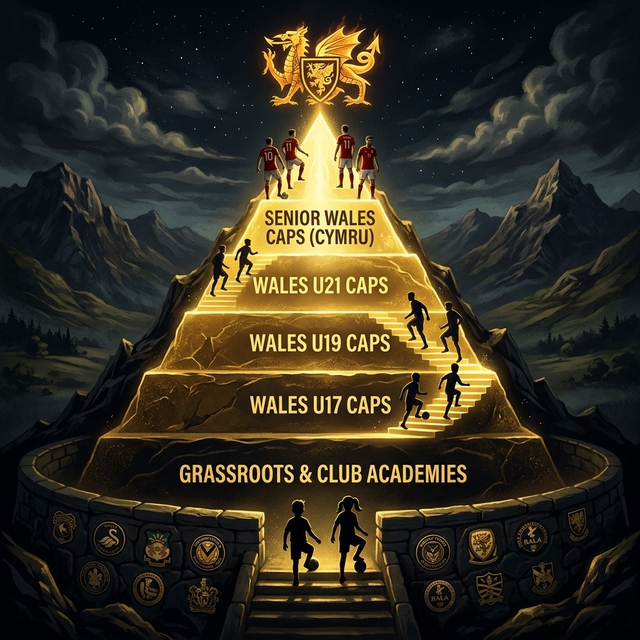
The journey from Cymru Premier academy to Wales youth international typically follows a three-stage process:
Stage 1: Academy Identification and Development (Ages 12–16)
Cymru Premier clubs operate age-group teams from U12 upward, though the quality and resourcing of these programmes varies significantly. The FAW's Elite Player Development Programme (EPDP) provides a framework, but implementation depends on individual club investment.
Key activities at this stage include:
- Technical skills development through structured coaching curricula
- Physical conditioning appropriate to age-group standards
- Competitive fixtures against other Cymru Premier academy teams
- Initial identification by FAW regional talent scouts
The FAW employs regional talent identification officers who attend Cymru Premier youth fixtures and recommend players for national age-group squads. This creates a direct pipeline from club academy to international selection — a pipeline that does not exist in the same form in England, where the academy system is dominated by professional clubs with Category 1 and 2 academies.
Stage 2: First-Team Integration (Ages 17–20)
The critical transition point is from academy to first-team football. Clubs that provide meaningful senior minutes to young players accelerate their development and increase their visibility to both FAW selectors and scouts from English professional clubs.
| Age Group | Typical Cymru Premier Integration | Comparison (English League Two) |
|---|---|---|
| U17 | Occasional squad inclusion, cup appearances | Rare first-team involvement |
| U18 | Regular bench, 5–10 league starts | Academy fixtures only |
| U19 | First-team regular, 20+ starts | Loan to National League |
| U20 | Established first-team player | First-team fringe or loan |
The Cymru Premier's advantage over comparable English tiers is clear: young players get senior competitive minutes earlier and more consistently. This is a direct result of the league's semi-professional economics — clubs cannot afford large squads of experienced professionals, creating opportunities for academy graduates that would not exist in a fully professional environment.
Stage 3: International Selection and Transfer (Ages 18–23)
Players who establish themselves in Cymru Premier first teams become candidates for Wales youth international squads at U17, U19, and U21 level. International appearances then serve as a shop window for English professional clubs, creating a transfer pathway that generates revenue for the selling club.
| Transfer Pathway Step | Typical Timeline | Financial Impact |
|---|---|---|
| Academy to first team | 2–3 years | Cost saving (reduced squad spend) |
| First team to Wales youth squad | 1–2 years after integration | Profile enhancement, no direct revenue |
| International exposure to English club interest | 1–2 years after first cap | Scout visits, trial opportunities |
| Transfer to English professional club | Variable | Transfer fee (£25K–£250K typical range) |
| Solidarity/training compensation | Ongoing | 5% of future transfer fees |
The financial returns from this pathway are modest in absolute terms — Cymru Premier clubs are not generating Premier League-level transfer fees — but they are material relative to club revenues. A single £100K transfer fee represents 10–12% of the average club's annual revenue. For clubs like Cardiff Met, where the academy pipeline is prolific, cumulative transfer income is a meaningful revenue stream.
For more on transfer activity between Welsh and English clubs, see our Players Signed by English Clubs analysis.
The FAW's Role in the Pathway
The Football Association of Wales plays an active role in connecting club academy output to international selection:
Financial Incentives
The FAW provides financial incentives to clubs that meet youth development benchmarks. These include:
- Academy grants tied to coaching staff qualifications (£5K–£15K per club annually)
- Facilities improvement funding for clubs with approved academy programmes
- Contribution to travel costs for clubs whose players are selected for national squads
- Licensing advantages — youth development is a mandatory criterion for UEFA licensing
Talent Identification Network
The FAW operates a network of regional talent scouts who attend Cymru Premier youth and senior fixtures. This network is the primary mechanism through which players are identified for age-group national squads. The network's effectiveness depends on regular attendance at Cymru Premier matches — a further reason why clubs that provide competitive minutes to young players see more international call-ups.
Coach Education
The FAW's coaching pathway (UEFA C, B, A, and Pro licences) is integrated with club academy programmes. Clubs whose coaches hold higher qualifications tend to produce more internationally selected players — a correlation that reflects both coaching quality and the FAW's preference for players developed in well-structured environments.
Investment Implications
For investors evaluating Cymru Premier clubs, the youth development pathway creates several distinct value propositions:
The Academy-First Model (Cardiff Met)
Cardiff Met demonstrates that a club can be competitive while spending minimally on player wages — provided the academy pipeline is strong enough to produce first-team-ready players. The investment thesis is: low operating costs, consistent talent output, and transfer fee upside. The risk is that the model depends on the university partnership and may not be replicable at clubs without an academic institution behind them.
The Hybrid Model (Haverfordwest, Connah's Quay)
Most Cymru Premier clubs operate a hybrid model: a mix of experienced semi-professional players and academy graduates. The investment thesis here is: targeted academy investment (coaching staff, facilities) can increase the proportion of academy minutes, reducing wage costs while maintaining competitiveness. The clubs that shift the balance from 10–12% academy minutes toward 20–25% unlock significant financial efficiency.
The Professional Academy Model (TNS)
TNS operates the league's only full-time professional academy, with dedicated coaching staff and a training environment that mirrors English lower-league standards. The investment thesis is: higher upfront cost, but the quality of output justifies it through larger transfer fees and more consistent international selection. TNS's 15% academy minutes figure is lower than Cardiff Met's because the club also recruits experienced professionals, but the absolute quality of academy graduates is arguably higher.
For a comparative assessment of all three models, see our Academy Best Clubs analysis.
Benchmarking Against Other Small Nations
Wales's youth development pathway can be compared with similar-sized football nations:
| Nation | Population | Youth International Pathway | Academy Club Integration | Transfer Output |
|---|---|---|---|---|
| Wales | 3.1M | Cymru Premier academies to FAW age groups | Strong (8 clubs with active academies) | Moderate (English lower leagues) |
| Iceland | 0.4M | Urvalsdeild academies to KSI age groups | Very strong (all clubs academy-focused) | Strong (Scandinavian and English leagues) |
| Northern Ireland | 1.9M | NIFL Premiership to IFA age groups | Moderate (4–5 active academies) | Moderate (English and Scottish leagues) |
| Republic of Ireland | 5.1M | LOI Premier to FAI age groups | Growing (historically weak) | Strong (English leagues at all levels) |
Iceland's model is the most instructive comparison. A country with one-eighth of Wales's population has built a youth development system that consistently produces players for major European leagues. The key differences are: Iceland invested heavily in indoor facilities (critical for year-round training), mandated coaching qualifications across all levels, and integrated academy programmes into every top-flight club. Wales has the population base and football infrastructure to replicate this — the gap is in execution and investment.
For a detailed comparison, see our Welsh vs. Icelandic Football Model analysis.
The 2027 Expansion and Youth Development
The Cymru Premier's expansion from 12 to 16 teams in 2026/27 has direct implications for the youth development pathway:
- More academy clubs: Four additional top-flight clubs will be expected to operate youth programmes, expanding the talent pool.
- More competitive minutes: A larger league means more fixtures, creating more opportunities for young players to gain senior experience.
- Dilution risk: The quality of academy coaching may be diluted if newly promoted clubs lack the resources to run structured programmes.
- Regional coverage: Expansion clubs from underrepresented areas (South Wales valleys, rural Mid-Wales) may identify talent that the current 12-club structure misses.
For the full implications of expansion, see our 2027 Expansion Guide.
Recommendations for Investors
Prioritise clubs with high academy minutes. Cardiff Met (45%), Haverfordwest (22%), and TNS (15%) demonstrate proven development capability. The investment required to maintain and scale these programmes is modest relative to the returns.
Invest in coaching staff. The single highest-impact investment in youth development is qualified coaching. A UEFA A-licensed academy director costs £30K–£50K annually — a fraction of a first-team player's wages — but can transform a club's development output.
Build relationships with English clubs. Transfer fees are the financial payoff of youth development, but they require a network. Clubs that maintain relationships with English League One, League Two, and National League clubs can facilitate trials and transfers more effectively.
Track FAW selection patterns. The FAW's regional scouts attend Cymru Premier fixtures regularly. Clubs whose players receive international call-ups gain profile, prestige, and — through solidarity payments — long-term financial returns.
Consider the talent pipeline holistically. Youth development is not just about producing international players. It is about building a sustainable operating model where player costs are managed through internal development rather than external recruitment.
Source and Methodology
Academy minutes data is sourced from FAW youth development reports (2024/25 season). Transfer fee ranges are based on publicly reported transactions and Cymru Connect analysis. FAW incentive and grant figures are from published FAW development programme documentation. Comparative data for other nations is drawn from published UEFA and national association reports. Population figures are from the most recent census data. All financial figures are in GBP and represent estimates.