TL;DR: Cymru Premier attendance averages 400–600 per match, with Caernarfon Town drawing 800–1,000. Women's matches have seen 30–50% year-on-year growth. These figures are historically low but improving — and for investors, the gap between current attendance and venue capacity represents one of the clearest revenue growth opportunities in Welsh football.
Attendance as an Investment Signal
Football attendance figures are more than a measure of popularity. They are a leading indicator of commercial health: clubs with growing attendance attract better sponsors, generate more matchday revenue, sell more merchandise, and build stronger community connections. In a league like the Cymru Premier, where broadcast revenue is distributed equally (£80K–£120K per club), matchday income is one of the few areas where individual clubs can differentiate their revenue profile.
Understanding how Welsh football attendance has evolved — and why it sits where it does today — is essential for anyone evaluating the investment potential of a Cymru Premier club.
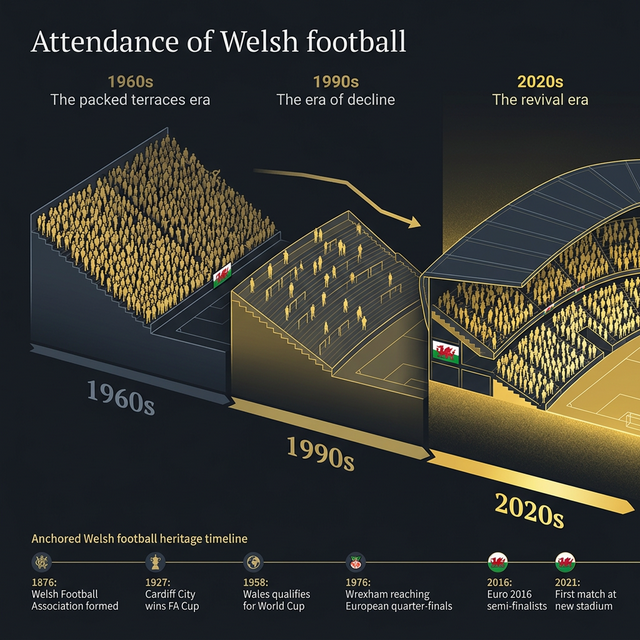
Historical Attendance by Era
The Pre-League Era (Before 1992)
Before the formation of the League of Wales in 1992, Welsh domestic football operated through a patchwork of regional leagues without a single national tier. Attendance data from this period is fragmentary, but the broad picture is clear: Welsh club football was a community activity with modest followings, while the major spectator draws were the Welsh clubs competing in the English league system — Cardiff City, Swansea City, Wrexham, and Newport County.
| Club | Era | Typical Attendance | Context |
|---|---|---|---|
| Cardiff City | 1920s–1960s | 15,000–35,000 | English Division One; 1927 FA Cup winners |
| Wrexham | 1970s–1980s | 5,000–15,000 | English Division Two/Three; European campaigns |
| Swansea City | 1980s | 8,000–20,000 | English Division One (1981–83) |
| Newport County | 1970s–1980s | 3,000–8,000 | English Division Three/Four |
| Welsh domestic clubs | Pre-1992 | 100–500 | Regional league fixtures |
The contrast between English-system Welsh clubs and domestic Welsh clubs was stark. Cardiff City's Ninian Park could host 60,000; the average Welsh league club played on a roped-off pitch in front of a few hundred.
The League of Wales Years (1992–2019)
The formation of the League of Wales in 1992 gave Welsh domestic football a national platform — but it also revealed the scale of the gap. Early seasons attracted modest crowds, and the league struggled for credibility against the perception that "real" Welsh football happened in the English system.
| Period | Average Attendance | Notable Club | Context |
|---|---|---|---|
| 1992–2000 | 200–400 | Barry Town (800–1,200) | New league finding its footing; Barry's dominance |
| 2000–2010 | 250–450 | TNS (400–600) | Barry's decline; TNS rising |
| 2010–2019 | 300–500 | Caernarfon (600–800) | Gradual improvement; new clubs entering |
Several factors suppressed attendance during this period:
- Perception problem: The League of Wales was widely seen as inferior to the English pyramid, discouraging potential supporters.
- Fixture scheduling: Saturday afternoon kick-offs competed with English Premier League television coverage, siphoning off the casual football audience.
- Facility quality: Many grounds lacked basic spectator amenities (covered seating, refreshments, adequate parking), deterring family attendance.
- Geographic spread: Long travel distances for away supporters in a league that stretched from Bangor to Barry reduced combined attendance.
The Cymru Premier Era (2019–Present)
The rebrand from Welsh Premier League to Cymru Premier in 2019 coincided with — and accelerated — a shift in the league's profile and attendance trajectory.
| Season | Estimated Average Attendance | Growth Driver |
|---|---|---|
| 2019/20 | 350–450 | Rebrand; improved broadcast (S4C/Sgorio) |
| 2020/21 | Disrupted (COVID-19) | Limited/no crowds |
| 2021/22 | 400–550 | Post-COVID return; Wrexham effect begins |
| 2022/23 | 450–600 | Wrexham effect in full swing; facility improvements |
| 2023/24 | 500–650 | Continued growth; European campaigns |
| 2024/25 | 500–700 | Stabilisation at higher baseline |
The 30–50% year-on-year growth since 2021 is one of the most striking trends in British football. While the absolute numbers remain modest, the growth rate outpaces every other UK league tier over the same period.
Club-by-Club Attendance (2024/25 Season)
| Club | Average Attendance | Venue Capacity | Utilisation % | Trend |
|---|---|---|---|---|
| Caernarfon Town | 800–1,000 | 3,000 | 27–33% | Stable/growing |
| The New Saints | 500–800 | 2,000 | 25–40% | Stable |
| Connah's Quay Nomads | 500–700 | 2,500 | 20–28% | Growing |
| Penybont | 450–600 | 2,500 | 18–24% | Growing |
| Bala Town | 400–550 | 3,000 | 13–18% | Stable |
| Haverfordwest County | 400–550 | 2,000 | 20–28% | Growing |
| Newtown AFC | 350–500 | 3,000 | 12–17% | Stable |
| Barry Town United | 350–500 | 2,500 | 14–20% | Growing |
| Caernarfon Town | 800–1,000 | 3,000 | 27–33% | Growing |
| Aberystwyth Town | 300–450 | 3,000 | 10–15% | Stable |
| Flint Town United | 250–400 | 1,500 | 17–27% | Variable |
| Cardiff Met | 200–350 | 1,500 | 13–23% | Stable |
| Airbus UK Broughton | 200–350 | 1,500 | 13–23% | Declining |
Two data points stand out. First, Caernarfon Town's 800–1,000 average — nearly double the league median — demonstrates what strong community engagement can achieve. Second, the average utilisation rate across the league is only 15–25%, meaning there is significant capacity headroom for attendance growth without any capital expenditure on stadium expansion.
The Wrexham Effect
The acquisition of Wrexham AFC by Ryan Reynolds and Rob McElhenney in 2020, and the subsequent Welcome to Wrexham documentary series, had a measurable impact on Welsh football attendance beyond Wrexham itself.
| Impact Area | Estimated Effect | Mechanism |
|---|---|---|
| Casual fan interest | 30–50% growth in Cymru Premier attendance | Media exposure raising awareness of Welsh football |
| International media coverage | Significant increase in Welsh football articles | Journalists covering Wrexham expanded to Welsh football generally |
| Investor enquiries | Reported increase in FAW investor contacts | International investors inspired by the Wrexham model |
| Social media engagement | 20–40% growth in Cymru Premier club followings | Wrexham's viral content drawing attention to Welsh football |
The Wrexham effect is real, measurable, and ongoing — but it is important not to overstate its impact on the Cymru Premier specifically. Wrexham competes in the English league system, and many of its new fans are American or international supporters who may not translate into Cymru Premier attendance. The spillover is indirect: increased awareness of Welsh football in general, rather than direct supporter migration.
For the full analysis, see our Wrexham Effect deep dive.
Women's Football Attendance: The Fastest-Growing Segment
Women's football attendance in Wales has seen the sharpest growth of any segment, with 30–50% year-on-year increases across the Adran leagues.
| League | Average Attendance (2024/25) | Growth Rate | Context |
|---|---|---|---|
| Adran Premier | 150–300 | 30–50% YoY | Top women's tier; broadcast coverage growing |
| Adran North | 50–150 | 40–60% YoY | Regional league; community-driven growth |
| Adran South | 50–150 | 40–60% YoY | Regional league; strongest in urban areas |
The growth is driven by broader societal trends (increased visibility of women's sport, post-Euro 2022 interest in women's football) and specific Welsh factors (FAW investment in the Adran league structure, improved facilities, and dual-gender club models where men's and women's teams share venues and supporters).
For investors, women's football attendance represents a high-growth, low-base opportunity. The absolute numbers are small, but the trajectory is steep — and the cost of engaging a women's football audience (through marketing, matchday experience, and community programmes) is a fraction of what it costs to grow a men's attendance base.
See our Women's Football Investment Guide and Women's Football Participation Growth analyses.
What Drives Attendance in Welsh Football
Analysis of club-by-club attendance data reveals several factors that correlate with higher crowds:
Community Identity
Clubs with strong local identity — particularly those in Welsh-speaking communities — draw disproportionate attendance relative to their catchment population. Caernarfon Town is the prime example: a club in a town of 10,000 that draws 800–1,000 per match, driven by cultural identity and community engagement.
Matchday Experience
Clubs that invest in the matchday experience — quality food and drink, family-friendly areas, pre-match entertainment, accessible parking — report higher attendance growth than those that do not. The investment required is modest (£5K–£20K per season for catering improvements, family zones, and matchday programming) but the impact on casual and family attendance is measurable.
Fixture Quality
European qualifiers draw the highest attendances in the Cymru Premier calendar, followed by local derbies and Welsh Cup knockout rounds. Clubs that qualify for European competition see a measurable attendance uplift not just for European fixtures but for subsequent domestic matches, as new supporters attracted by European football return for league games. See our European Competition History for details.
Broadcast Complement
Counterintuitively, broadcast coverage appears to support rather than cannibalise live attendance in the Cymru Premier. S4C/Sgorio's coverage raises the league's profile, and clubs whose matches are televised report increased attendance for subsequent home fixtures. This differs from the English Premier League dynamic, where broadcast saturation suppresses lower-league attendance.
Community Ownership
Clubs with community ownership models report stronger attendance per capita than privately owned clubs. Supporters who have a financial and governance stake in their club attend more frequently and bring more friends and family.
Attendance Growth Projections
Based on current trends and the factors outlined above, Cymru Connect projects the following attendance trajectory for the Cymru Premier:
| Scenario | 2027/28 Projection | Assumptions |
|---|---|---|
| Conservative | 550–700 average | Current growth trends continue; no major structural changes |
| Moderate | 700–900 average | League expansion boosts interest; matchday improvements across clubs |
| Optimistic | 900–1,200 average | Wrexham effect sustained; broadcast deal improvement; significant investor-led growth |
Even the conservative scenario represents a significant improvement from the 400–600 average of recent seasons. The moderate and optimistic scenarios would place the Cymru Premier on par with the League of Ireland (1,500–3,000 average) within 5–7 years — a trajectory that would transform the matchday revenue available to Welsh clubs.
The Revenue Implication
Attendance growth translates directly to matchday revenue. At current Cymru Premier pricing:
| Metric | Current | With 50% Attendance Growth |
|---|---|---|
| Average attendance | 500 | 750 |
| Average ticket price | £8–£12 | £10–£14 (modest price increase) |
| Matchday revenue per match | £4K–£6K | £7.5K–£10.5K |
| Season matchday revenue (16 home matches) | £64K–£96K | £120K–£168K |
| Additional revenue (food, drink, merchandise) | £15K–£25K | £30K–£50K |
| Total annual matchday revenue | £79K–£121K | £150K–£218K |
A 50% attendance increase approximately doubles matchday revenue — from roughly £100K to roughly £185K per season. For a club with average revenue of £850K, this represents a shift from matchday income being a minor contributor to it being a significant pillar of the revenue model.
For a full analysis of revenue streams and how matchday fits alongside broadcast, commercial, and European income, see our Revenue Breakdown and Club Benchmarking analyses.
Recommendations for Clubs and Investors
Invest in matchday experience before stadium capacity. The average utilisation rate is 15–25% — there is no need to build more seats. The priority is making the existing venue more attractive to attend.
Target family attendance. Family groups represent the largest untapped audience for Cymru Premier clubs. Family-friendly pricing, safe standing areas, and children's activities have proven effective in comparable leagues.
Leverage community identity. Clubs in Welsh-speaking communities have a cultural advantage that translates directly to attendance. Bilingual matchday programmes, Welsh-language PA announcements, and community outreach in the local language strengthen this connection.
Coordinate with broadcast coverage. Work with S4C/Sgorio to ensure televised matches are promoted as attendance drivers rather than substitutes. Post-match highlights packages that feature crowd atmosphere encourage future attendance.
Track and publish attendance data. Transparent attendance reporting builds credibility with sponsors and investors. Clubs that can demonstrate consistent growth trends are better positioned for commercial negotiations.
Source and Methodology
Attendance data is sourced from FAW official match reports, club announcements, and Cymru Connect's independent monitoring. Historical data for the League of Wales era is drawn from published league records and media reports. Women's football data is from FAW Adran league reports. Revenue projections are based on current pricing structures and Cymru Connect's modelling of attendance growth scenarios. All figures are in GBP and represent estimates. Attendance figures should be treated as approximations — official counting methodologies vary between clubs.