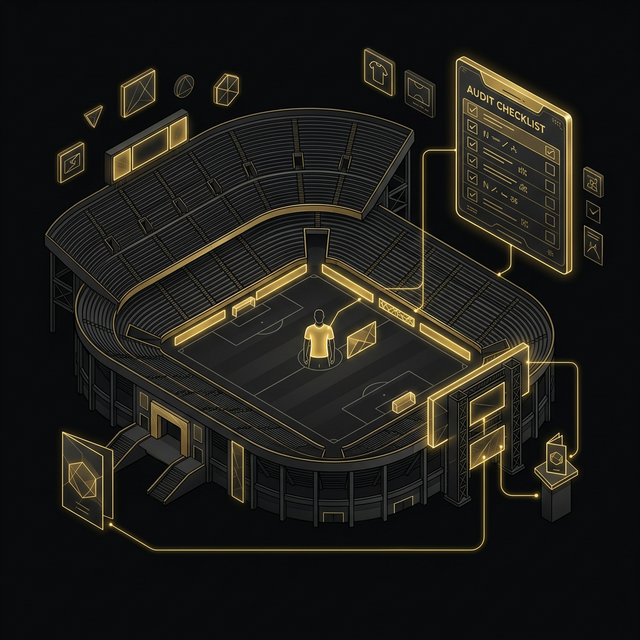
TL;DR: A structured sponsorship inventory audit can lift a Cymru Premier club's commercial revenue by 25-40% by identifying, valuing, and packaging assets that are currently unpriced or unsold. Most clubs activate fewer than 5 of 30 possible sponsorship categories. This template provides the step-by-step framework — from asset identification through valuation to market activation — that clubs, investors, and commercial managers need to close the gap with English non-league benchmarks.
Why Clubs Need a Sponsorship Audit
The central finding of our Sponsorship Gap Analysis is that Cymru Premier clubs activate fewer than 5 of 30 possible sponsorship categories, compared to 12-18 at comparable English National League North clubs. This represents the single largest untapped revenue source in Welsh football.
But knowing the gap exists is not the same as closing it. Clubs need a systematic process to identify what they have, determine what it is worth, and present it to potential sponsors in a professional, commercially credible format. That process is a sponsorship inventory audit.
This template is designed for use by Cymru Premier clubs, Adran Premier clubs, and any Welsh football organisation seeking to professionalise its commercial operations. It draws on English non-league best practice, Companies House financial data, and Cymru Connect's analysis of commercial operations across all 12 Cymru Premier clubs.
Phase 1: Asset Identification
The first step is cataloguing every asset the club can offer to sponsors. Most clubs undercount their assets because they think of sponsorship narrowly — shirt logo, pitch-side boards, and little else. A comprehensive audit covers five asset categories.
1.1 Matchday Physical Assets
These are the tangible, visible assets associated with the stadium and matchday operations.
| Asset | Description | Visibility | Typical Price Range |
|---|---|---|---|
| Shirt front | Primary logo on playing shirts | Highest — every match, broadcast, photos | £5-30K/season |
| Shirt back | Logo on rear of playing shirts | High — visible in match action | £2-10K/season |
| Shirt sleeve | Logo on shirt sleeve | Medium-high — growing category | £1-5K/season |
| Shorts | Logo on playing shorts | Medium — visible in match action | £1-5K/season |
| Training kit | Logo on training/warm-up wear | Medium — pre-match, events, socials | £1-3K/season |
| Stadium naming rights | Ground renamed to include sponsor | High — all communications, broadcast | £8-25K/year |
| Perimeter boards (static) | Fixed advertising boards pitch-side | Medium-high — matchday visibility | £1-5K/season |
| Perimeter boards (LED) | Digital rotating boards pitch-side | High — broadcast-friendly, multiple sponsors | £3-10K/season |
| Dugout/bench branding | Sponsor logo on team dugouts | Medium — broadcast shots | £1-3K/season |
| Entrance/turnstile branding | Sponsor signage at ground entrances | Medium — every fan passes through | £500-2K/season |
| Scoreboard | Sponsor name on scoreboard | Medium — visible to entire ground | £1-3K/season |
| PA announcements | Sponsor messages over PA system | Medium — every matchday | £500-2K/season |
1.2 Broadcast and Media Assets
These assets gain value from S4C/Sgorio coverage and European competition.
| Asset | Description | Visibility | Typical Price Range |
|---|---|---|---|
| Press conference backdrop | Sponsor logos behind manager interviews | High — all broadcast and print media | £2-5K/season |
| Interview board | Sponsor logos behind player interviews | High — all broadcast and social content | £1-3K/season |
| Match ball sponsorship | Sponsor announced as match ball provider | Medium — PA, programme, social media | £500-2K/match |
| Player of the Month | Branded monthly award | Medium — social media, programme | £2-5K/season |
| Man of the Match | Branded per-match award | Medium — PA, social media | £1-3K/season |
| Goal celebration overlay | Sponsor graphic on goal replays | High — broadcast only | £3-8K/season |
| Half-time analysis sponsor | Branded half-time segment | Medium — broadcast only | £2-5K/season |
1.3 Digital Assets
Digital sponsorship is the fastest-growing category in lower-league football and carries high margins because production costs are low.
| Asset | Description | Reach | Typical Price Range |
|---|---|---|---|
| Website header/banner | Sponsor logo on club website | All website visitors | £1-5K/season |
| Email newsletter sponsor | Sponsor branding in email communications | Email list (typically 500-5,000) | £500-3K/season |
| Social media partner | Branded social content, mentions | Social followers (1K-15K) | £1-8K/season |
| Match highlights sponsor | Branded video content | Video viewers (5K-50K) | £2-8K/season |
| Mobile app sponsor | Branding within club app (if exists) | App users | £1-5K/season |
| Fantasy/prediction game | Branded fan engagement tool | Active participants | £1-3K/season |
| Podcast/audio sponsor | Branded club audio content | Listeners | £500-2K/season |
For context on clubs' current digital performance, see our SEO Audit and Digital Presence Rankings.
1.4 Hospitality and Experience Assets
These assets generate direct revenue and create relationship-building opportunities for sponsors.
| Asset | Description | Capacity | Typical Price Range |
|---|---|---|---|
| Corporate box/lounge | Dedicated hospitality area for sponsors | 10-30 guests | £3-10K/season |
| Season ticket block | Reserved seats for sponsor's staff/clients | 10-20 seats | £2-5K/season |
| Matchday sponsorship | Title sponsor of individual matches | 1 per match | £500-3K/match |
| Programme advertising | Full or half page in matchday programme | Programme readers | £200-1K/season |
| Kit launch event | Sponsor involvement in annual kit reveal | Attendees + social reach | £1-5K/event |
| End-of-season awards | Branded awards evening | Attendees | £2-5K/event |
| Player appearance | Player visits to sponsor's premises | Sponsor's audience | £200-500/appearance |
1.5 Community and CSR Assets
Community-linked sponsorship carries the highest brand trust multiplier and is increasingly valued by ESG-conscious businesses.
| Asset | Description | Impact | Typical Price Range |
|---|---|---|---|
| Youth academy partner | Primary sponsor of youth development | Youth players + families | £3-15K/season |
| Community programme | Branded outreach (schools, inclusion) | Community participants | £2-10K/season |
| Women's team sponsor | Support for women's section | Women's team audience | £1-5K/season |
| Disability/inclusion partner | Support for accessible football | Participants + PR value | £1-5K/season |
| Environmental partner | Green initiatives (pitch, facilities) | PR value + community | £1-3K/season |
Phase 2: Valuation
Once all assets are catalogued, each must be assigned a financial value. The valuation process uses three inputs.
2.1 Market Comparables
The most reliable valuation method is benchmarking against comparable deals at similar clubs. Our recommended comparables hierarchy:
- Other Cymru Premier clubs — direct peers, same broadcast deal, same attendance range
- English National League North/South — equivalent competitive level, more developed market
- Scottish League Two / League One — similar audience sizes, separate broadcast environment
- Irish League of Ireland Premier — comparable small-nation league with UEFA access
For pricing data, see our Sponsorship Costs 2026 analysis and Welsh vs Scottish Sponsorship comparison.
2.2 Audience-Based Valuation
Each asset can be valued based on the audience it reaches, using a cost-per-thousand-impressions (CPM) model:
| Audience Channel | Reach per Season | Industry CPM | Implied Asset Value |
|---|---|---|---|
| Matchday attendance (12 home matches x 500 avg) | 6,000 | £15-25 | £90-150 |
| S4C broadcast (10 appearances x 20,000 viewers) | 200,000 | £8-15 | £1,600-3,000 |
| Social media (50 posts x 3,000 reach) | 150,000 | £5-10 | £750-1,500 |
| Website (12 months x 2,500 monthly visitors) | 30,000 | £3-8 | £90-240 |
| Total implied value per visible asset | £2,530-4,890 |
This model suggests that even a modestly visible sponsorship asset at a mid-table Cymru Premier club has a floor value of £2,500-5,000 per season based purely on audience reach. Clubs pricing assets below this level are undervaluing their inventory.
2.3 Scarcity Premium
Assets with limited or zero competition should carry a premium. In the Cymru Premier, five categories have zero activation across the entire league (sleeve, training kit, match ball, player of the month, LED boards). First movers in these categories should expect to pay a premium for exclusivity but can negotiate multi-year terms that protect against future price increases.
Phase 3: Packaging
Raw assets sell for less than packaged assets. A sponsorship package bundles multiple assets into a themed offering that tells a coherent story for the sponsor.
Recommended Package Structure
Tier 1: Title Partner (£20-50K/season)
- Shirt front sponsorship
- Stadium naming rights
- Press conference and interview board branding
- Corporate hospitality (season-long)
- Social media partnership
- Programme full page
- 2 player appearances per season
Tier 2: Official Partner (£8-20K/season)
- Shirt back or sleeve sponsorship
- Perimeter board (premium position)
- Digital package (website + social)
- Matchday hospitality (5 matches)
- Programme half page
- 1 player appearance per season
Tier 3: Match Sponsor (£500-3K/match)
- Title sponsor of individual match
- PA announcements
- Match ball sponsorship
- Social media mention (pre/post match)
- 2 hospitality tickets
Tier 4: Community Partner (£3-10K/season)
- Youth academy branding
- Community programme co-branding
- Social media features (monthly)
- Programme quarter page
- Kit for youth teams
Tier 5: Associate Sponsor (£1-5K/season)
- Perimeter board
- Programme listing
- Website logo
- Social media mention (quarterly)
Pricing Psychology
Packages should be priced at 70-80% of the sum of individual asset values. This gives sponsors a perceived discount while ensuring the club captures more total revenue than selling assets piecemeal. The discount is justified by the operational efficiency of managing fewer, larger relationships.
Phase 4: Market Activation
An audit is only valuable if it leads to sales. The activation phase turns the catalogued, valued, and packaged inventory into signed contracts.
4.1 Build a Sponsorship Prospectus
A professional PDF document (8-12 pages) that includes:
- Club history and community positioning
- Audience data (attendance, broadcast, digital)
- Available packages with pricing
- Case studies or testimonials from existing sponsors
- Contact details and next steps
4.2 Identify Target Sponsors
Map local and regional businesses against sponsorship tiers:
| Business Type | Best Package Tier | Rationale |
|---|---|---|
| Regional employer (50+ staff) | Tier 1-2 | Brand visibility, recruitment, client hospitality |
| Local tradesperson/SME | Tier 3-5 | Community recognition, customer trust |
| National brand (Welsh ops) | Tier 1 | Broadcast visibility, multi-market presence |
| Professional services | Tier 2-3 | Client entertainment, networking |
| Retail/hospitality | Tier 3-5 | Matchday cross-promotion, foot traffic |
4.3 Outreach and Negotiation
- Warm introductions through existing board members and supporters are more effective than cold outreach
- Lead with data — sponsors respond to audience numbers, broadcast figures, and ROI projections
- Offer multi-year terms at 15-25% discounts — this provides both parties with stability and locks in pricing ahead of the 2026/27 expansion
- Be flexible on activation — some sponsors want maximum brand visibility; others want hospitality; others want community association. The same inventory can be packaged differently for different buyers
4.4 Contract and Delivery
Formalise every sponsorship agreement in writing, including:
- Specific deliverables (number of social posts, PA announcements, hospitality tickets)
- Payment schedule (quarterly preferred)
- Duration and renewal terms
- Exclusivity provisions (if applicable)
- Measurement and reporting commitments
Phase 5: Measurement and Reporting
Sponsors who can measure their return renew at higher rates. Clubs that provide measurement data retain 80%+ of sponsors; clubs that do not typically retain only 50-60%.
Recommended Metrics
| Metric | Data Source | Frequency |
|---|---|---|
| Matchday attendance | Gate counts | Per match |
| Broadcast appearances | S4C/Sgorio logs | Monthly |
| Social media impressions | Platform analytics | Monthly |
| Website sponsor page views | Google Analytics | Monthly |
| Sponsor mention in media | Media monitoring | Quarterly |
| Hospitality attendance | Guest lists | Per match |
| Fan brand awareness (survey) | Fan survey | Annual |
Reporting Template
Provide sponsors with a quarterly report including:
- Total impressions across all channels
- Key highlights (broadcast appearances, social viral moments)
- Hospitality usage summary
- Upcoming opportunities (European ties, cup matches, community events)
- Renewal discussion at season midpoint
The Revenue Impact
Based on our analysis, a club that completes this audit process and activates 10-15 sponsorship categories (up from the current average of ~5) can expect:
| Current State | Post-Audit State | Revenue Change |
|---|---|---|
| 5 categories, £30-80K commercial | 10 categories, £60-150K | +£30-70K (+50-90%) |
| 5 categories, £80-200K commercial | 15 categories, £150-350K | +£70-150K (+40-75%) |
| 8 categories, £200-500K commercial | 18 categories, £350-700K | +£150-200K (+30-40%) |
Even at the conservative end, the revenue uplift from a structured audit significantly exceeds the cost of conducting one. For clubs that hire a commercial manager to implement the findings (£25-35K salary), the return on that hire typically exceeds 3:1 within the first season.
Case Study: English Non-League Benchmark
Brackley Town (English National League South, average attendance ~550) provides a useful benchmark. The club activates 16 sponsorship categories, generating an estimated £120-180K in commercial revenue from a supporter base comparable in size to mid-table Cymru Premier clubs. Key elements of their approach:
- Professional sponsorship prospectus updated annually
- Dedicated volunteer commercial coordinator
- Tiered packages from £250 (programme advertising) to £15K (shirt front)
- Quarterly sponsor networking events
- Annual sponsor survey to measure satisfaction and renewal intent
Brackley's model requires no full-time commercial staff — it runs on volunteer effort and a professional template. Any Cymru Premier club could replicate it.
Integration with Other Revenue Streams
A sponsorship audit should not happen in isolation. It connects to:
- Matchday Revenue Optimisation — improved hospitality supports higher sponsorship tier pricing
- Digital Transformation — better digital presence increases the value of digital sponsorship assets
- Stadium Development — improved facilities create new sponsorship inventory (LED boards, corporate boxes)
- Women's Football — clubs with women's sections can offer bundled men's/women's packages
Conclusion
A sponsorship inventory audit is the single highest-ROI activity a Cymru Premier club can undertake. The process — identify assets, value them, package them, sell them, measure them — is straightforward, requires no capital investment, and can lift commercial revenue by 25-40% within one season.
The template above provides the framework. The data from our Sponsorship Gap Analysis confirms the scale of the opportunity. And the Sponsoring Welsh Football Complete Guide gives sponsors the context they need to say yes.
The clubs that conduct this audit — and act on its findings — will be the ones that thrive as the Cymru Premier expands to 16 teams in 2026/27.
Template developed by Cymru Connect Research based on analysis of 12 Cymru Premier clubs, English non-league best practice benchmarks, and FAW commercial data, March 2026. Pricing ranges reflect 2025-26 season data and Welsh market conditions. For club-specific commercial support, see our Club Investment Profiles.