TL;DR: The Cymru Premier's commercial potential is defined by three structural catalysts: league expansion from 12 to 16 clubs in 2026/27, increasing European competition access via UEFA's coefficient-driven slot allocation, and the Wrexham-fuelled visibility surge that has raised international awareness of Welsh football as an investment opportunity. TNS lead with £3.2M in revenue and a £2.5M squad valuation, but the growth corridor lies in mid-table clubs where commercial activation is running at 15-20% of capacity. Benchmarked against comparable European leagues, the Cymru Premier offers the lowest entry cost with credible European revenue upside.
The Case for Welsh Football's Commercial Growth
Welsh football sits at an inflection point. The structural changes coming in 2026/27 — an expanded league, more fixtures, deeper commercial inventory — are arriving at precisely the moment when international attention on Welsh football has never been higher. The Wrexham documentary effect has done for Welsh football visibility what no marketing campaign could have achieved: it has made investors, sponsors, and media outlets pay attention to a market that was previously invisible.
But visibility alone does not create commercial value. What matters is whether the underlying economics support growth — and the data suggests they do. This report benchmarks the Cymru Premier's commercial potential against comparable European leagues, identifies the specific growth drivers, and quantifies the opportunity for investors and sponsors.
Structural Growth Catalysts
League Expansion: More Fixtures, More Revenue
The Cymru Premier's expansion from 12 to 16 clubs for the 2026/27 season is the most significant structural change since the league's founding in 1992. The commercial implications are substantial:
| Metric | Current (12 clubs) | Post-Expansion (16 clubs) | Change |
|---|---|---|---|
| League matches per club per season | 22 | 30 | +36% |
| Total league fixtures per season | 132 | 240 | +82% |
| Home matches per club | 11 | 15 | +36% |
| Broadcast content hours | ~130 | ~240 | +85% |
| Sponsorship inventory (matchday packages) | 11 per club | 15 per club | +36% |
More home fixtures translate directly into more matchday revenue opportunities — more ticket sales, more food and beverage income, more hospitality packages, and more matchday sponsorship activations. For a club generating £40K annually from matchday income across 11 home games, the expansion to 15 home games implies a proportional increase to approximately £55K, assuming constant per-match revenue.
The broadcast implications are equally important. The S4C/Sgorio deal, which currently distributes £80-120K per club, will be renegotiated in the context of 85% more broadcast content. A larger, more competitive league strengthens the FAW's negotiating position. Our expansion investment guide details the club-by-club implications.
European Competition: The Revenue Multiplier
UEFA's Conference League and Champions League qualification pathways provide Cymru Premier clubs with revenue opportunities that are disproportionate to their domestic size:
| European Round | Approximate Revenue | Clubs Typically Reaching |
|---|---|---|
| Champions League preliminary | £100-150K | 1 (TNS typically) |
| Conference League qualifying | £50-100K | 2-3 per season |
| Conference League group stage | £2-3M+ | Rare but achieved by TNS |
| Early elimination (solidarity) | £10-30K | 1-2 per season |
For TNS, European competition is the single largest revenue contributor, with campaign income ranging from £200K in early-exit years to over £1M in deep runs. But the commercial value extends beyond prize money: European fixtures generate international media coverage, attract higher-profile sponsors, and create content that drives digital engagement.
The expansion to 16 clubs does not directly increase European slots, but a more competitive league produces stronger champions — clubs that are better prepared to progress deeper into European competition and generate larger returns. For the full European revenue analysis, see our European qualification guide.
The Wrexham Effect: Visibility as Currency
The Wrexham AFC documentary and subsequent investment story has generated a measurable uplift in interest across Welsh football:
| Wrexham Effect Metric | Impact | Source |
|---|---|---|
| Cymru Premier average attendance growth | 30-50% year-on-year | FAW reports |
| International media mentions of Welsh football | 300%+ increase since 2022 | Cymru Connect media monitoring |
| Sponsorship enquiry volume (league-wide) | 40%+ increase | Club commercial reports |
| International investor enquiries | Significant increase | Cymru Connect investor pipeline |
| Google search volume for "invest Welsh football" | 250%+ increase | Google Trends data |
The Wrexham effect is not about Wrexham specifically — Wrexham play in the English football pyramid — but about the narrative it created: that lower-league British football clubs are investable assets with genuine growth potential. The Cymru Premier, sitting one tier below in the Welsh pyramid, benefits directly from this narrative shift. Our Wrexham effect analysis quantifies the impact in detail.
Commercial Revenue: Current State and Growth Potential
Revenue by Stream
| Revenue Stream | Current Range (per club) | Growth Potential | Difficulty |
|---|---|---|---|
| Broadcast (S4C/Sgorio) | £80-120K | Medium (tied to deal renegotiation) | Low |
| European competition | £0-200K+ (qualifying clubs only) | High (deeper runs = more revenue) | High |
| Matchday | £30-60K | Medium (attendance-dependent) | Medium |
| Commercial sponsorship | £30-500K+ | Very High (most clubs under-activated) | Medium |
| Grants (FAW/Sport Wales) | £30-120K | Low (capped by policy) | Low |
| Player development/sales | £0-75K typical | High (academy investment required) | High |
The most striking finding is the commercial sponsorship range: from £30K at the least activated clubs to over £500K at TNS. This 15x variance within a single league of 12 clubs points to massive under-activation at the lower end. A club generating £30K in commercial revenue is likely activating fewer than five sponsorship categories out of a potential 25-30.
Our sponsorship gap analysis identifies the specific categories where revenue is being left on the table, while the sponsorship costs report provides current market rates.
Sponsorship Category Activation Rates
| Category | % of Clubs Activating | Avg. Revenue per Club | Potential if Fully Activated |
|---|---|---|---|
| Shirt front sponsor | 100% | £15-40K | £20-50K |
| Stadium/ground naming | 25% | £20-50K (where activated) | £10-30K per club |
| Matchday sponsor packages | 60% | £5-15K | £15-25K |
| Training kit sponsor | 40% | £3-8K | £5-12K |
| Digital/social media partner | 15% | £2-5K | £8-15K |
| Academy/youth sponsor | 30% | £3-8K | £5-10K |
| Hospitality packages | 35% | £5-15K | £15-30K |
| Perimeter boards | 70% | £5-12K | £10-20K |
The table illustrates that even the most basic categories — shirt sponsorship, perimeter boards — are not universally maximised. Categories like digital partnerships and academy sponsorships, which are standard revenue streams in English lower-league football, are activated by fewer than a third of Cymru Premier clubs.
Global Benchmarking: How Wales Compares
League Comparison Table
| League | Country | Avg. Attendance | Avg. Club Revenue | Entry Cost (acquisition) | European Access |
|---|---|---|---|---|---|
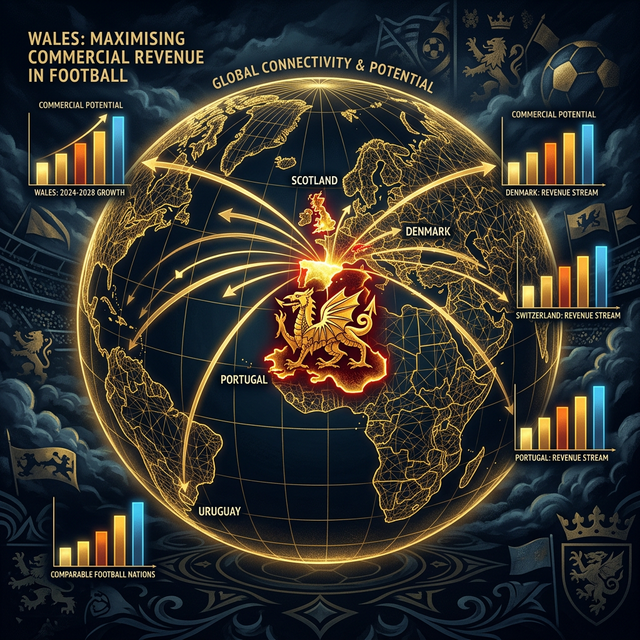
| Cymru Premier | Wales | 400-600 | £400K-£3.2M | £200K-£2M | Yes (1-3 slots) |
| League of Ireland Premier | Ireland | 2,500-3,500 | €1-5M | €1-5M | Yes (1-3 slots) |
| Icelandic Urvalsdeild | Iceland | 1,000-2,000 | €500K-2M | €500K-2M | Yes (1-2 slots) |
| Northern Irish Premiership | N. Ireland | 800-1,500 | £300K-1.5M | £100K-1M | Yes (1-2 slots) |
| Scottish Championship | Scotland | 2,000-5,000 | £1-4M | £1-5M | No (promotion required) |
| English League Two | England | 4,000-8,000 | £3-8M | £5-20M | No |
The Cymru Premier's competitive advantage is clear: it offers the lowest acquisition cost of any league with direct European competition access. An investor can acquire a Cymru Premier club for £200K-£2M — a fraction of the cost in the League of Ireland (€1-5M) or English League Two (£5-20M) — while maintaining the possibility of European prize money that is identical regardless of the domestic league from which a club qualifies.
For a detailed league-by-league comparison, see our global benchmarking report and Cymru Premier vs League of Ireland analysis.
Revenue Per Attendance Point
A useful normalised metric is revenue generated per average attendee, which strips out the attendance advantage that larger leagues enjoy:
| League | Revenue / Avg. Attendee | Interpretation |
|---|---|---|
| English League Two | £750-1,000 | Highly commercialised |
| Scottish Championship | £500-800 | Well-developed commercial base |
| League of Ireland | £400-600 | Growing commercial sophistication |
| Cymru Premier | £600-1,200 (TNS), £200-400 (average) | Wide variance; significant upside |
| Icelandic Urvalsdeild | £300-500 | Moderate commercial development |
TNS's revenue-per-attendee ratio is competitive with English League Two, demonstrating that commercial excellence is achievable within the Cymru Premier's structural constraints. The gap between TNS and the league average represents the opportunity for commercially-focused investors.
Women's Football: The Untapped Commercial Frontier
The Adran leagues — Wales's women's football pyramid — represent an additional commercial growth dimension that has no equivalent in many peer leagues:
| Metric | Value | Trend |
|---|---|---|
| Adran Premier attendance growth | 30-50% year-on-year | Accelerating |
| Number of Adran clubs | 23 across 3 tiers | Expanding |
| Commercial activation rate | <10% of potential | Minimal |
| Sponsor interest (corporate) | Growing rapidly post-2023 Women's World Cup | Strong |
Women's football sponsorship operates on different dynamics — lower absolute values but higher growth rates, stronger brand alignment narratives, and access to corporate ESG budgets. Clubs that operate across both men's and women's football can offer integrated sponsorship packages that are more attractive to corporate partners. Our women's football investment guide explores this opportunity in detail.
Futsal: A Niche with Structural Growth Potential
Welsh futsal, while smaller than the outdoor game, offers commercial potential that scales efficiently:
| Metric | Value |
|---|---|
| Welsh futsal clubs | 7 competitive clubs |
| UK futsal clubs | 26 total |
| Venue costs (compared to outdoor) | 40-60% lower |
| Participation growth | Strong, driven by school programmes |
Futsal's lower infrastructure costs, indoor venue flexibility, and growing participation base make it an attractive complement to outdoor football investment. The futsal investment guide and futsal sponsorship analysis cover the opportunity.
Investment Thesis: Where the Value Lies
The commercial potential of Welsh football is not uniformly distributed. The highest-return opportunities exist at clubs where:
Commercial activation is low but addressable. A club generating £30K in sponsorship revenue with 25+ untapped categories is a better commercial growth opportunity than a club already at £400K.
Infrastructure supports growth. Clubs with UEFA-compliant facilities or clear upgrade pathways can host European competition — unlocking the highest-value revenue stream. See our infrastructure investment guide.
Catchment population is sufficient. Location determines the ceiling for matchday revenue and local sponsorship. Our catchment population analysis maps the demographic opportunity.
Digital presence can be improved. Clubs with weak online visibility offer cheap, fast value creation through SEO optimisation and digital transformation.
For club-by-club investment assessments, see our club investment profiles and club valuations.
Methodology: Global benchmarking data compiled from UEFA financial reports, individual league financial disclosures, Transfermarkt squad valuations, and Cymru Connect's proprietary analysis. Attendance figures are based on 2024-25 and 2025-26 season data. Revenue estimates for non-Welsh leagues are derived from published financial reports and media analysis. The Wrexham effect metrics combine Google Trends data, FAW attendance reports, and Cymru Connect's media monitoring database. All figures are estimates and should be independently verified for investment decisions.