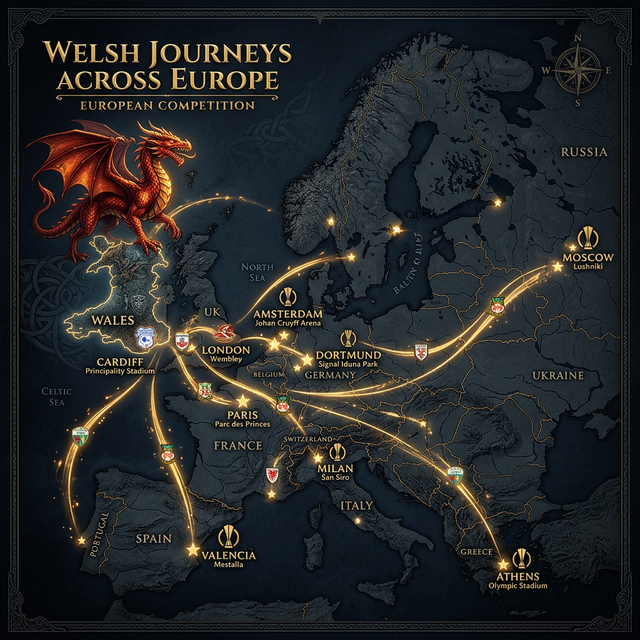
TL;DR: Welsh clubs have accumulated over 150 European matches since the 1960s, with The New Saints leading in modern appearances. European participation delivers an estimated £200K–£500K annual revenue boost per qualifying club — making it the single most important financial differentiator in the Cymru Premier.
A Six-Decade European Journey
Welsh clubs have been competing in European football since Cardiff City first entered the European Cup Winners' Cup in the 1964/65 season. What began as sporadic appearances by clubs from the English and Welsh league systems has evolved into a structured annual pathway: the Cymru Premier champion and Welsh Cup winner now receive guaranteed entry to UEFA qualifying rounds, with additional places occasionally available through coefficient rankings.
Over those six decades, Welsh clubs have accumulated more than 150 European matches, generated millions in prize money and gate receipts, and — critically — used European competition as a platform for domestic growth. The clubs that compete in Europe are the clubs that attract investment, recruit better players, and draw larger crowds. Understanding this history is essential for anyone evaluating the Welsh football market.
The Major Eras of Welsh European Football
The Pioneers: 1960s–1980s
Welsh football's first European chapter was written by clubs that competed primarily in the English league system. Cardiff City, Swansea City, and Wrexham all represented Wales in European competition during this period, drawing on the larger attendances and more established infrastructure of the English pyramid.
| Club | Competition | Season | Notable Result |
|---|---|---|---|
| Cardiff City | European Cup Winners' Cup | 1964/65 | First Welsh club in Europe |
| Cardiff City | European Cup Winners' Cup | 1967/68 | Semi-finalists |
| Wrexham | European Cup Winners' Cup | 1972/73 | Quarter-finalists |
| Wrexham | European Cup Winners' Cup | 1975/76 | Drew 30,000+ to the Racecourse |
| Swansea City | European Cup Winners' Cup | 1982/83 | First-round defeat |
The standout moment of this era was Cardiff City's run to the 1967/68 European Cup Winners' Cup semi-finals — a result that remains the best European performance by any Welsh club. Wrexham's quarter-final appearances in the 1970s drew record crowds to the Racecourse Ground, with the 30,000+ attendance for European fixtures setting a benchmark that no Welsh club has approached since.
For more on the heritage value of these historic clubs, see our guide to the Oldest Welsh Football Clubs.
The Barry Town Era: 1990s–2000s
The formation of the League of Wales in 1992 created a new European pathway — one that ran through the domestic Welsh league rather than the English pyramid. Barry Town United seized this opportunity with remarkable success, winning seven consecutive league titles (1996–2003) and becoming the first League of Wales club to build a sustained European campaign programme.
| Season | Club | Competition | Round Reached |
|---|---|---|---|
| 1996/97 | Barry Town | UEFA Cup | Qualifying round |
| 1997/98 | Barry Town | Champions League | Qualifying round |
| 1998/99 | Barry Town | Champions League | Qualifying round |
| 2001/02 | Barry Town | Champions League | First qualifying round |
| 2000/01 | TNS (Llansantffraid) | UEFA Cup | Qualifying round |
Barry Town's dominance during this period demonstrated that a well-funded Welsh club could sustain European participation — but also exposed the financial risks. The club's subsequent decline and near-extinction served as a cautionary tale about over-reliance on a single revenue stream and inadequate financial controls. For the full story, see our Barry Town Investment Profile.
The TNS Dynasty: 2005–Present
The New Saints have been the dominant Welsh representative in European competition since the mid-2000s, qualifying for UEFA tournaments in virtually every season through their sustained Cymru Premier dominance. TNS have set several records for Welsh clubs in European competition and have established Park Hall as a regular venue for UEFA fixtures.
| Season | Competition | Round Reached | Estimated Revenue |
|---|---|---|---|
| 2019/20 | Champions League Qualifiers | First qualifying round | £200K–£300K |
| 2020/21 | Champions League Qualifiers | First qualifying round | £200K–£300K |
| 2021/22 | Champions League Qualifiers | First qualifying round | £200K–£300K |
| 2022/23 | Conference League Qualifiers | Second qualifying round | £300K–£400K |
| 2023/24 | Champions League Qualifiers | Second qualifying round | £350K–£450K |
| 2024/25 | Champions League Qualifiers | First qualifying round | £250K–£350K |
TNS's consistency in European competition is unmatched by any other current Cymru Premier club. The financial impact is cumulative: each season of European participation funds squad investment that sustains domestic dominance, which generates the next season's European qualification. For the full financial analysis, see our TNS Investment Profile.
Other Modern Campaigners
While TNS dominate the modern European record, several other Cymru Premier clubs have represented Wales in recent seasons:
| Club | European Campaigns (2015–2025) | Best Result | Route |
|---|---|---|---|
| Connah's Quay Nomads | 4 | Conference League second qualifying round | League position / Welsh Cup |
| Bala Town | 3 | First qualifying round | League position |
| Bangor City | 2 | First qualifying round | Welsh Cup |
| Cefn Druids | 1 | First qualifying round | League position |
| Newtown AFC | 2 | First qualifying round | Welsh Cup |
Connah's Quay Nomads have been the most consistent non-TNS European representatives, reaching the second qualifying round of the Conference League and demonstrating that a second Welsh club can sustain competitive European campaigns. Their profile is explored in our Connah's Quay Investment Profile.
The Financial Impact of European Competition
European competition transforms the economics of a Cymru Premier club. The revenue uplift comes from four sources, each of which scales with the round reached.
| Revenue Source | First Qualifying Round | Second Qualifying Round | Third Qualifying Round |
|---|---|---|---|
| UEFA solidarity/prize money | £100K–£150K | £200K–£300K | £400K–£600K |
| Gate receipts (home leg) | £20K–£40K | £30K–£50K | £50K–£80K |
| Broadcast fees | £20K–£30K | £30K–£50K | £50K–£100K |
| Sponsorship uplift | £10K–£20K | £20K–£40K | £40K–£80K |
| Total | £150K–£240K | £280K–£440K | £540K–£860K |
For a Cymru Premier club with average revenue of £850K, even a first qualifying round appearance represents a 15–25% revenue uplift. A second qualifying round adds 30–50%. These figures explain why European qualification is the most important financial objective in Welsh football — and why the clubs that achieve it consistently (primarily TNS) have built an ever-widening financial advantage.
For a broader analysis of how European revenue fits into Welsh club finances, see our Revenue Breakdown.
Qualification Pathways
Welsh clubs reach European competition through two pathways:
Cymru Premier Title
The league champion enters the UEFA Champions League qualifying rounds (first qualifying round). This is the primary pathway and the one that TNS have monopolised in recent years. The champion's European entry is guaranteed regardless of UEFA licence status, though unlicensed clubs may face restrictions on venue usage.
Welsh Cup Winner
The winner of the Welsh Cup enters the UEFA Europa Conference League qualifying rounds. This pathway is significant because it is open to clubs from all tiers of the Welsh pyramid — a Cymru South or Cymru North club that wins the Welsh Cup qualifies for Europe, creating a potential financial windfall for a lower-tier club.
In seasons where the league champion also wins the Welsh Cup, the European place passes to the league runner-up.
UEFA Coefficient Considerations
Wales's UEFA coefficient — determined by the cumulative results of Welsh clubs in European competition — affects the number and quality of European places available. A higher coefficient means more places and later entry points (avoiding early qualifying rounds). TNS's consistent participation has been the primary driver of Wales's coefficient, but the coefficient also benefits from occasional strong results by other clubs.
Infrastructure Requirements for European Matches
Hosting European fixtures requires facilities that meet UEFA's minimum standards. For most Cymru Premier clubs, this means:
| Requirement | UEFA Minimum | Typical Cymru Premier Status |
|---|---|---|
| Seated capacity | 1,000+ (preferably 2,000+) | Most clubs meet 1,000; fewer reach 2,000 |
| Floodlighting | 800 lux minimum | 8 of 12 clubs compliant |
| Pitch surface | Natural grass or FIFA-certified artificial | 67% artificial pitches; certification varies |
| Media facilities | Press room, broadcast positions | Variable — several clubs lack adequate provision |
| Medical facilities | Treatment room with ambulance access | Most clubs compliant |
Clubs that do not meet these standards must either invest in upgrades or arrange to play European home matches at an alternative venue — an arrangement that reduces the home advantage and matchday revenue that European fixtures generate. For the full licensing framework, see our UEFA Licensing Guide.
Lessons for Investors
European competition history offers several lessons for prospective investors in Welsh football:
Lesson 1: European Revenue Is the Key Differentiator
The financial gap between clubs that compete in Europe and those that do not is the single biggest driver of competitive inequality in the Cymru Premier. Investors who can position a club for European qualification — through squad investment, coaching quality, or infrastructure upgrades — unlock a revenue stream that justifies the initial outlay.
Lesson 2: Consistency Matters More Than One-Off Results
TNS's dominance is built on consistent European qualification, not on individual deep runs. The cumulative effect of annual European revenue — even from first qualifying round exits — creates a compounding financial advantage. Investors should target sustainable competitiveness rather than speculative cup runs.
Lesson 3: The Welsh Cup Is an Undervalued Pathway
The Welsh Cup offers a European qualification route that does not require finishing at the top of the Cymru Premier. For mid-table clubs, a focused cup campaign can deliver European revenue at a fraction of the cost of competing for the league title. This pathway is particularly attractive for clubs with limited squad budgets but strong cup-tie mentality.
Lesson 4: Infrastructure Investment Pays for Itself
Clubs that invest in UEFA-compliant facilities can host European matches — generating matchday revenue that partially offsets the infrastructure cost. Clubs that cannot host European matches at their own ground lose both revenue and the competitive advantage of home fixtures. The Infrastructure Investment Guide and Stadium Development ROI analysis explore these dynamics.
Lesson 5: History Matters
Clubs with European heritage — Barry Town, Bangor City, Newtown — carry brand value that transcends their current competitive position. Investors who acquire clubs with European history gain a narrative asset that supports fan engagement, media interest, and commercial partnerships. The History and Heritage Value article explores this further.
The Future of Welsh Clubs in Europe
Several trends suggest that the European landscape for Welsh clubs is improving:
- Expanding UEFA distributions: UEFA has increased prize money and solidarity payments for clubs in early qualifying rounds, directly benefiting Welsh participants.
- Conference League pathway: The creation of the Europa Conference League in 2021 added a third European competition, increasing the number of places available and providing a more accessible pathway for clubs from smaller associations.
- Cymru Premier expansion: The league's growth to 16 teams in 2026/27 may generate additional European places if Wales's UEFA coefficient improves. See our Expansion Guide.
- Rising domestic standards: Improved infrastructure, coaching, and financial controls across the Cymru Premier are raising the baseline quality of Welsh European representatives.
For investors, these trends mean that the financial return from European competition is growing — making the investment case for Welsh football clubs stronger with each passing season.
Source and Methodology
European match data is compiled from UEFA's official competition records and historical archives. Financial estimates are based on UEFA's published prize money distributions, Cymru Connect's analysis of club financial statements, and industry benchmarks for matchday and broadcast revenue at comparable levels of European football. Historical attendance figures are from FAW archives and contemporary media reports. All financial figures are in GBP and represent estimates. Club-by-club European records have been verified against multiple sources but may contain minor discrepancies for pre-digital-era fixtures.