TL;DR: Wales's 12 Cymru Premier grounds range from Llanelli's 3,700-capacity Stebonheath Park to Cardiff Met's 1,500-seat Cyncoed Campus. 67% now feature artificial pitches, and the league's expansion to 16 clubs will add at least four new venues to the circuit by 2027.
A League of Intimate Grounds with Big Character
Welsh football stadiums are not the Emirates or Old Trafford. They are something better for the dedicated football traveller: intimate, accessible, and full of character. You can stand on the terraces, chat with club officials at half-time, and watch the game from distances measured in metres rather than tiers. For investors, these grounds represent both the charm and the constraint of Welsh football — atmospheric venues that create loyal followings but require strategic upgrades to unlock commercial potential.
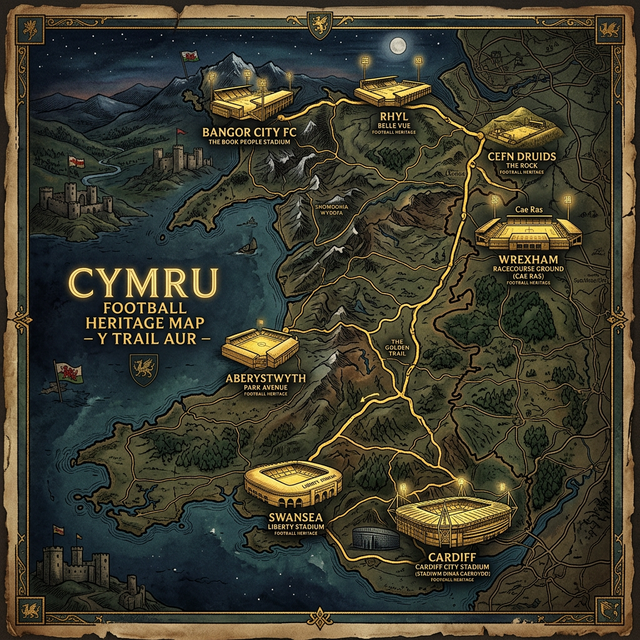
The Cymru Premier's 12 current grounds offer a cross-section of Welsh football infrastructure: modern 3G surfaces alongside century-old natural pitches, purpose-built stands next to converted community facilities. This guide covers every ground in the league, what to expect when visiting, and what each venue tells you about the club behind it.
Stadium Overview: The Full League
| Club | Stadium | Capacity | Pitch | Founded | Location |
|---|---|---|---|---|---|
| The New Saints | Park Hall | 2,034 | 3G | 1959 | Oswestry (border) |
| Connah's Quay Nomads | Deeside Stadium | 2,500 | 3G | — | Deeside (north-east) |
| Penybont | SDM Glass Stadium | 2,500 | 3G | 2019 | Bridgend (south) |
| Haverfordwest County | Ogi Bridge Meadow | 3,000 | 4G | 1899 | Pembrokeshire (west) |
| Cardiff Met | Cyncoed Campus | 1,500 | 3G | — | Cardiff (south-east) |
| Caernarfon Town | The Oval | 3,000 | Natural | 1937 | Caernarfon (north-west) |
| Barry Town United | Jenner Park | 3,000 | Natural | 1912 | Barry (south) |
| Bala Town | Maes Tegid | 3,000 | 3G | 1880 | Bala (north) |
| Colwyn Bay | Llanelian Road | 2,500 | 3G | 1881 | Colwyn Bay (north) |
| Flint Town United | Cae y Castell | 2,000 | Natural | 1886 | Flint (north-east) |
| Briton Ferry Llansawel | Old Road | 2,000 | Natural | 2009 | Neath (south) |
| Llanelli Town | Stebonheath Park | 3,700 | Natural | 2013 | Llanelli (south-west) |
Average stadium capacity across the league is approximately 2,560. Total seated and standing capacity across all 12 grounds is around 30,700.
The Must-Visit Grounds
The Oval, Caernarfon Town — Best Atmosphere
The Oval is where Welsh football atmosphere is at its most intense. Caernarfon's average attendance of 820 — the highest in the Cymru Premier — fills the 3,000-capacity ground with noise that belies the numbers. The natural pitch sits beneath the shadow of Caernarfon Castle (a UNESCO World Heritage Site), giving the venue a setting that no other ground in Welsh football can match. Founded in 1937, the club's deep roots in the Welsh-speaking community of Gwynedd create a matchday experience that feels more like a cultural event than a sporting fixture.
Visitor tip: Arrive early and walk the castle walls before kick-off. The town centre pubs within walking distance are welcoming to visiting supporters.
Jenner Park, Barry Town United — Best Heritage
Jenner Park is a time capsule. Built in the early twentieth century, the ground retains original terracing and pavilion structures that connect visitors directly to Welsh football's past. Barry Town, founded in 1912, were once the dominant force in Welsh club football, and Jenner Park's faded grandeur tells that story without a single word. The 3,000 capacity and natural pitch are more than adequate for current needs, though the ground would benefit from targeted investment in hospitality facilities.
Visitor tip: The clubhouse serves well-priced food and drink, and the town's seaside location makes it an easy day trip from Cardiff.
For more on Barry Town's investment case, see the Barry Town investment profile.
Ogi Bridge Meadow, Haverfordwest County — Best Modern Upgrade
Haverfordwest completed a £500K 4G pitch installation in 2024, making Ogi Bridge Meadow one of the most technically advanced surfaces in the league. The 3,000-capacity ground in Pembrokeshire serves a club founded in 1899, blending western Welsh heritage with forward-looking infrastructure. The 4G surface — a step beyond the 3G standard used elsewhere in the league — eliminates match postponements and generates hire income from community and commercial bookings.
Visitor tip: Pembrokeshire's coastline is among the best in Wales. Make a weekend of it.
For details on artificial pitch economics, see the 3G/4G pitch investment guide.
Park Hall, The New Saints — Best Facilities
Park Hall is the Cymru Premier's most professionally operated ground. The 2,034-capacity stadium features a modern 3G pitch, floodlights that meet UEFA standards, updated hospitality areas, and the infrastructure required for European qualifying rounds. TNS's average attendance of 620 means the ground operates at roughly 30% capacity on a typical matchday — ample room for growth. The stadium's location on the Welsh-English border near Oswestry is geographically unusual but commercially practical, with good road links to both Shrewsbury and Wrexham.
Visitor tip: Park Hall is also home to a zoo and theme park, making it a family-friendly away day.
Maes Tegid, Bala Town — Best Scenery
Maes Tegid sits on the shores of Llyn Tegid (Bala Lake), the largest natural lake in Wales. The 3,000-capacity ground with its 3G pitch offers arguably the most scenic setting in British football. Bala Town, founded in 1880, are one of the oldest clubs in Wales, and the Snowdonia surroundings give visiting supporters a compelling reason to make the journey. Average attendance of 360 leaves significant headroom.
Visitor tip: The narrow-gauge Bala Lake Railway runs along the lakeside — a memorable pre-match activity for families.
The Artificial Pitch Revolution
67% of Cymru Premier pitches are now artificial, a figure that places Wales ahead of most European leagues in surface technology adoption. The shift has been driven by practical necessity: Welsh weather makes natural pitch maintenance expensive and unreliable, leading to frequent postponements that damage matchday revenue.
| Surface Type | Clubs | Percentage |
|---|---|---|
| 3G Artificial | TNS, Connah's Quay, Penybont, Cardiff Met, Bala, Colwyn Bay | 50% |
| 4G Artificial | Haverfordwest | 8% |
| Natural Grass | Caernarfon, Barry, Flint, Briton Ferry, Llanelli | 42% |
The clubs still on natural pitches face a strategic decision. Conversion to 3G or 4G typically costs £400K-£600K but generates returns through eliminated postponements, community hire income, and reduced annual maintenance costs. See the artificial pitch investment analysis for a full cost-benefit breakdown.
Stadium Capacity vs. Actual Attendance
One of the most striking features of Cymru Premier stadiums is the gap between capacity and utilisation. Most grounds operate at 15-25% of capacity on a typical matchday.
| Club | Capacity | Avg. Attendance | Utilisation Rate |
|---|---|---|---|
| Caernarfon Town | 3,000 | 820 | 27% |
| The New Saints | 2,034 | 620 | 30% |
| Connah's Quay | 2,500 | 480 | 19% |
| Haverfordwest | 3,000 | 400 | 13% |
| Barry Town | 3,000 | 380 | 13% |
| Bala Town | 3,000 | 360 | 12% |
| Penybont | 2,500 | 300 | 12% |
| Colwyn Bay | 2,500 | 280 | 11% |
This gap is simultaneously a challenge and an opportunity. Low utilisation depresses matchday revenue but also means that attendance growth requires no capital expenditure on capacity expansion. A club that doubles its attendance from 300 to 600 can do so within existing infrastructure while roughly doubling its matchday income. For more on the revenue implications, see the matchday revenue optimisation guide.
What the Expansion Adds
The expansion to 16 clubs for 2026/27 will bring at least four new grounds into the Cymru Premier circuit. Potential additions from the north include Prestatyn Town, Airbus UK Broughton, Guilsfield, and Ruthin Town. From the south, Pontypridd Town, Carmarthen Town, Afan Lido, and Swansea University are among the contenders.
Each promoted club will need to meet FAW ground grading requirements, which specify minimum standards for capacity, floodlighting, changing facilities, and pitch quality. Some contenders will require stadium upgrades before promotion can be confirmed — a cost that incoming investors should factor into acquisition budgets. See the FAW licensing guide for full requirements.
UEFA Licensing and Stadium Requirements
Eight of the 12 current clubs hold UEFA licences, which impose additional stadium requirements beyond domestic FAW standards. These include minimum seating capacity, media facilities, floodlight intensity (1,200 lux for UEFA competitions versus 500 lux for domestic), and segregation infrastructure. Clubs without UEFA licences face a hard cap on competitive upside — they cannot participate in European qualifying rounds regardless of league position.
For a full breakdown of UEFA versus FAW requirements, see the UEFA stadium licensing guide and the infrastructure investment guide.
Planning Your Stadium Tour
A complete Cymru Premier ground tour is achievable in a long weekend. The north Wales grounds (Caernarfon, Bala, Colwyn Bay, Flint, Connah's Quay) can be covered in two days with overnight stays in Caernarfon or Llandudno. The south Wales grounds (Barry, Cardiff Met, Penybont, Briton Ferry, Llanelli) cluster within a two-hour driving radius. Haverfordwest in the west and TNS on the border require separate trips but reward the journey.
Match fixtures are available through the FAW website, and most clubs offer pay-on-the-gate admission between £8-12 for adults. Hospitality packages, where available, typically run £25-50 and are excellent value compared to English football equivalents.
Sources and Methodology
Stadium capacities and pitch types are sourced from FAW licensing reports (2026) and verified against club-reported data. Attendance figures are from Cymru Connect's proprietary analysis of published gate figures for the 2024/25 and 2025/26 seasons. Infrastructure investment figures (e.g., Haverfordwest's £500K 4G installation) are drawn from club announcements and Companies House filings. All data is current as of March 2026.