TL;DR: Matchday income accounts for 30-60% of revenue at Cymru Premier level, yet most clubs leave significant money on the table. With tickets at £8-12 and average attendance of 400-600 across approximately 15 home matches per season, a club generating £75,000 in gate receipts can realistically lift total matchday revenue to £120,000-£150,000 through pricing optimisation, secondary spend growth, and commercial activation — a 60-100% improvement without building a single new seat.
Why Matchday Revenue Is the Most Controllable Lever
Cymru Premier clubs have three major revenue streams: broadcast income (£80-120K from S4C/Sgorio, largely fixed), commercial partnerships (highly variable), and matchday income. Of these, matchday revenue is the most directly controllable by club management. Broadcast deals are negotiated centrally. Commercial partnerships depend on local economic conditions. But matchday revenue responds directly to operational decisions — pricing, experience quality, merchandise selection, food and drink offerings, and marketing execution.
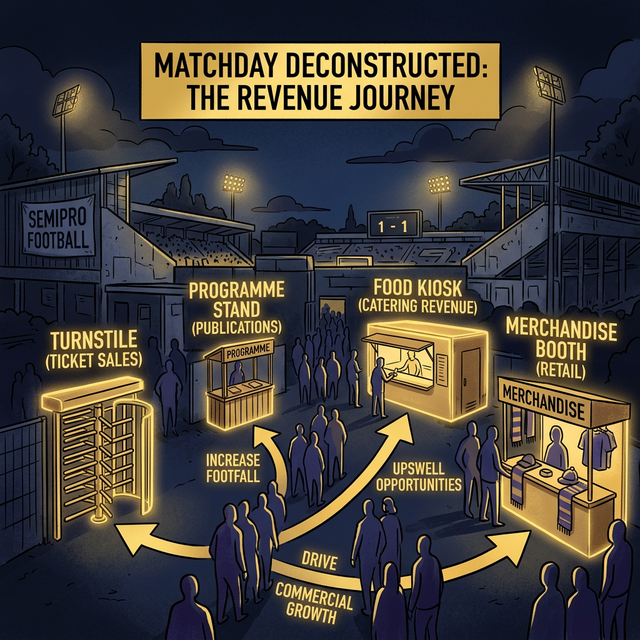
For a club averaging 500 attendance at £10 per ticket across 15 home matches, gate receipts alone are £75,000. But gate receipts are only the starting point. Best-practice matchday operations at semi-professional level generate 1.5-2.5x the gate in total matchday revenue through secondary spend, commercial activations, and ancillary income streams.
Current Matchday Revenue Benchmarks
| Metric | Bottom Quartile | Cymru Premier Average | Top Quartile | Target |
|---|---|---|---|---|
| Average attendance | 250-350 | 400-600 | 700-1,000 | Varies by club |
| Ticket price (adult) | £8 | £10 | £12 | Dynamic pricing |
| Gate receipts per season | £30K-£50K | £60K-£90K | £100K-£150K | +20-30% |
| Secondary spend per head | £2-£3 | £4-£6 | £8-£12 | £8-£10 |
| Total matchday revenue per season | £40K-£70K | £80K-£120K | £150K-£250K | +40-60% |
| Matchday share of total revenue | 25-35% | 35-45% | 45-60% | Balanced portfolio |
The gap between bottom and top quartile is striking — the best-performing clubs generate 3-4x the matchday revenue of the weakest, despite operating in the same league with similar attendance profiles. The difference is almost entirely operational.
The Five Levers of Matchday Revenue
Lever 1: Ticket Pricing Strategy
Most Cymru Premier clubs use a flat pricing model: one adult price, one concession price, applied uniformly across all fixtures. This leaves revenue on the table.
Dynamic pricing adjusts ticket prices based on demand signals:
| Fixture Category | Suggested Pricing | Attendance Impact | Revenue Impact |
|---|---|---|---|
| High-demand (TNS, local derby) | £12-£15 premium | Minimal drop (-5%) | +20-30% per match |
| Standard league fixture | £10 standard | Baseline | Baseline |
| Low-demand (midweek, weak opponent) | £6-£8 promotional | +15-25% uplift | Neutral to positive |
| Family day (designated matches) | £20-£25 family bundle | +30-50% family attendance | +10-15% per match |
Season tickets are the most powerful pricing tool because they convert uncertain attendance into guaranteed revenue. A season ticket priced at 10x the single-match price (£100 for a £10 match) gives fans a "free" five matches and locks in £100 per seat regardless of weather, form, or fixture attractiveness.
| Season Ticket Model | Price | Break-even (for fan) | Club Benefit |
|---|---|---|---|
| Full season (15 home matches) | £100 | 10 matches attended | Guaranteed income, locked-in fan |
| Half season (7-8 matches) | £60 | 6 matches attended | Flexibility for casual fans |
| Family season ticket (2 adults + 2 children) | £200 | 8 matches (vs £40 per match walk-up) | Drives family attendance |
| Under-16 season ticket | £30 | 3 matches attended | Builds next-generation fans |
For clubs exploring how to grow attendance alongside pricing, see the Attendance Trends analysis.
Lever 2: Secondary Spend (Food, Drink, Merchandise)
The gap between Cymru Premier and English lower-league secondary spend is significant. English National League clubs typically achieve £8-£12 per head in secondary spend; most Cymru Premier clubs sit at £4-£6.
Food and drink is the highest-impact area:
| Offering | Typical Setup Cost | Margin | Revenue per Match (500 attendance) |
|---|---|---|---|
| Basic tea bar (hot drinks, confectionery) | £500-£1K | 60-70% | £200-£400 |
| Food van partnership (burgers, chips) | £0 (revenue share) | 20-30% (club share) | £150-£300 |
| Club-operated food offering | £3K-£8K | 50-65% | £400-£800 |
| Licensed bar | £5K-£15K (licence + fit-out) | 55-65% | £500-£1,200 |
| Premium offering (local food, craft beer) | £8K-£20K | 45-60% | £600-£1,500 |
The progression from basic tea bar to premium offering can triple per-head secondary spend. A club that moves from £3 per head to £8 per head across 500 attendees and 15 home matches generates an additional £37,500 per season in food and drink revenue — at 50%+ margins.
Merchandise is underdeveloped at most Cymru Premier clubs:
| Product | Unit Cost | Selling Price | Margin | Annual Units (est.) |
|---|---|---|---|---|
| Replica shirt | £15-£20 | £40-£50 | 60-65% | 100-300 |
| Training top | £10-£15 | £30-£35 | 55-65% | 50-150 |
| Scarf | £4-£6 | £12-£15 | 60-70% | 100-200 |
| Beanie hat | £3-£5 | £10-£12 | 60-70% | 100-200 |
| Pin badge | £1-£2 | £5-£6 | 70-80% | 200-400 |
| Programme (print or digital) | £1-£3 | £3-£5 | 50-70% | 200-500 per match |
A well-managed merchandise operation can generate £15,000-£40,000 annually at Cymru Premier level. Online sales (club website, social media) extend revenue beyond matchday.
Lever 3: Commercial Activations
Matchday provides the platform for sponsor activations that generate revenue beyond passive advertising:
| Activation | Revenue per Match | Annual Revenue (15 matches) | Notes |
|---|---|---|---|
| Match sponsor | £500-£2,000 | £7,500-£30,000 | Named matchday sponsor with announcements |
| Matchball sponsor | £100-£300 | £1,500-£4,500 | Lower-cost entry point for local businesses |
| Hospitality packages | £30-£50 per head | £5,000-£15,000 | Pre-match meal and premium seating |
| Half-time entertainment sponsor | £200-£500 | £3,000-£7,500 | Branded activities, competitions |
| Programme/team sheet sponsor | £100-£300 | £1,500-£4,500 | Branding on printed or digital programmes |
| PA announcement sponsorship | £50-£150 | £750-£2,250 | "Today's match is sponsored by..." |
The key insight is that these activations are stackable — they can all operate simultaneously at a single match. A match with a named sponsor, matchball sponsor, hospitality booking, and programme sponsor can generate £1,500-£3,000 in activation revenue on top of gate receipts and secondary spend.
For a comprehensive view of sponsorship structures and pricing, see the Complete Sponsorship Guide and the Sponsorship ROI Analysis.
Lever 4: Digital and Pre-Match Marketing
Matchday revenue optimisation starts before fans arrive at the ground. Digital marketing drives both attendance and pre-purchase behaviour:
| Digital Channel | Purpose | Cost | Impact |
|---|---|---|---|
| Email newsletter (pre-match) | Drive attendance, promote offers | £0-£50/month | +5-10% attendance on promoted matches |
| Social media (fixture promotion) | Awareness and excitement building | Staff time | +3-5% attendance with consistent posting |
| Online ticket sales | Convenience, data capture, advance revenue | £500-£2K setup | +10-15% advance sales vs cash-on-gate |
| Digital programme | Cost saving vs print, wider reach | £500-£1K setup | 80% cost reduction vs print, larger audience |
| Matchday app | Live updates, ordering, loyalty | £2K-£10K | Long-term engagement tool |
Online ticketing deserves particular attention. Most Cymru Premier clubs still operate primarily on cash-at-the-gate, which means no data capture, no advance revenue, and no ability to market to previous attendees. Moving to online ticketing — even a basic system — transforms the club's ability to understand and grow its audience.
For digital strategy in the context of club operations, see the Digital Transformation and Revenue guide and the Social Media Strategy analysis.
Lever 5: Matchday Experience Design
The final lever is the hardest to quantify but the most important for long-term attendance growth. Clubs that treat matchday as an event — rather than simply a football fixture — build habits that turn occasional visitors into regular attendees.
Pre-match (60-90 minutes before kick-off):
- Open gates early with food and drink available
- Live music, DJ, or entertainment
- Junior skills sessions on the pitch (if timing allows)
- Sponsor activation zone
During the match:
- Professional PA announcements and music
- Half-time entertainment (junior match, skills competition, sponsor activation)
- Live social media updates from club accounts
Post-match (30-60 minutes after final whistle):
- Player meet-and-greet (selected matches)
- Bar and food available post-match
- Supporters' club events
- Post-match entertainment or quiz nights
The clubs that execute this consistently — arriving fans into an atmosphere rather than an empty ground, keeping them engaged beyond the final whistle — report 15-25% higher repeat attendance rates than those that operate on a "gates open at 2:30, kick-off at 3:00, everyone leaves at 4:45" model.
Revenue Optimisation Roadmap: Year-by-Year
For a club starting from a baseline matchday operation, the following phased approach is recommended:
Year 1: Quick Wins (£2,000-£5,000 investment)
| Action | Cost | Expected Revenue Impact |
|---|---|---|
| Introduce season tickets | £500 (marketing and admin) | +£5K-£10K |
| Add matchday and matchball sponsorship | £0 (sales effort) | +£5K-£15K |
| Launch basic online ticketing | £500-£1K | +£3K-£5K (data capture + advance sales) |
| Improve food offering (food van partnership) | £0 (revenue share) | +£3K-£5K |
| Year 1 total investment | £1K-£2K | +£16K-£35K revenue |
Year 2: Infrastructure (£5,000-£15,000 investment)
| Action | Cost | Expected Revenue Impact |
|---|---|---|
| Launch club merchandise range | £3K-£5K (initial stock) | +£10K-£20K |
| Upgrade food and drink to club-operated | £5K-£10K | +£8K-£15K |
| Introduce hospitality packages | £2K-£3K (setup) | +£5K-£12K |
| Implement dynamic pricing for key fixtures | Staff time | +£3K-£8K |
| Year 2 total investment | £10K-£18K | +£26K-£55K revenue |
Year 3: Experience (£10,000-£25,000 investment)
| Action | Cost | Expected Revenue Impact |
|---|---|---|
| Licensed bar (if not already present) | £5K-£15K | +£8K-£15K |
| Matchday experience programme (entertainment, events) | £3K-£5K | +5-10% attendance = £5K-£10K |
| Digital programme and content platform | £1K-£3K | +£2K-£5K |
| Loyalty and membership scheme | £2K-£5K | +£5K-£10K (retention and data) |
| Year 3 total investment | £11K-£28K | +£20K-£40K revenue |
Cumulative Impact
| Metric | Baseline | After Year 3 | Change |
|---|---|---|---|
| Gate receipts | £75K | £90K-£100K | +20-33% |
| Secondary spend (per head) | £4 | £8-£10 | +100-150% |
| Secondary spend (total) | £30K | £65K-£80K | +117-167% |
| Commercial activations | £5K | £25K-£40K | +400-700% |
| Total matchday revenue | £110K | £180K-£220K | +64-100% |
Benchmarking Against English Non-League
Welsh semi-professional clubs can learn from English counterparts at similar levels:
| Metric | Cymru Premier Average | English National League North/South | Gap |
|---|---|---|---|
| Average attendance | 500 | 800 | -38% |
| Adult ticket price | £10 | £14 | -29% |
| Secondary spend per head | £5 | £9 | -44% |
| Matchday revenue per season | £100K | £220K | -55% |
| Merchandise revenue | £10K | £35K | -71% |
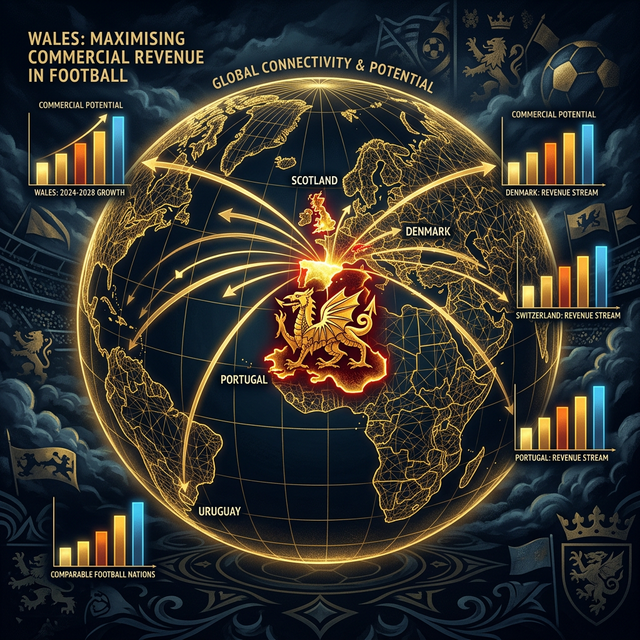
The gap is significant but not insurmountable. English non-league clubs operating in similar-sized communities demonstrate that the revenue potential exists — the difference is primarily operational execution rather than market size. For international comparisons beyond England, see the Global Benchmarking analysis.
The League Expansion Dividend
The Cymru Premier's expansion to 16 clubs in 2026/27 will increase home fixtures from approximately 15 to approximately 17 per season. This 13% increase in home matches directly benefits matchday revenue without requiring any operational improvements:
| Scenario | 15 Matches (Current) | 17 Matches (Expanded) | Change |
|---|---|---|---|
| Gate receipts (500 avg. at £10) | £75,000 | £85,000 | +£10,000 |
| Secondary spend (£5 per head) | £37,500 | £42,500 | +£5,000 |
| Commercial activations (£1K per match) | £15,000 | £17,000 | +£2,000 |
| Total matchday revenue | £127,500 | £144,500 | +£17,000 |
Combined with operational optimisation, the expansion creates a window where matchday revenue can grow by 30-50% within two seasons.
What This Means for Club Owners and Investors
Matchday revenue optimisation is the highest-ROI investment available to Cymru Premier clubs. Unlike squad investment (uncertain return, depreciating asset) or facility upgrades (high capital cost, long payback), matchday operations can be improved with modest investment and deliver returns within a single season.
For clubs and investors evaluating the broader commercial picture, see the Revenue Breakdown analysis, the Small Club Revenue Growth guide, and the Commercial Manager role guide.
Sources: Cymru Connect matchday revenue analysis (March 2026), FAW fixture and attendance data (2025-26 season), English non-league benchmarking data (National League, 2024-25), club financial returns (Companies House). Revenue estimates are illustrative and based on typical Cymru Premier operating conditions; actual results will vary by club, location, and execution quality. Data compiled by Cymru Connect Research, March 2026.