TL;DR: Caernarfon Town converts more of its local population into matchday attendees than any other Cymru Premier club, averaging 820 fans from a relatively small town catchment. Most clubs average 400-600. With the league expanding to 16 teams in 2026/27 and the Wrexham effect driving 30-50% awareness growth, catchment analysis is the single best predictor of which clubs have untapped commercial potential.
Why Catchment Analysis Matters for Investors
A club's catchment area — the population within realistic travelling distance — determines its ceiling for matchday attendance, local sponsorship value, and community engagement depth. For investors evaluating Cymru Premier clubs, catchment demographics are arguably more predictive of long-term commercial potential than current financial performance, because they reveal the gap between existing support and achievable support.
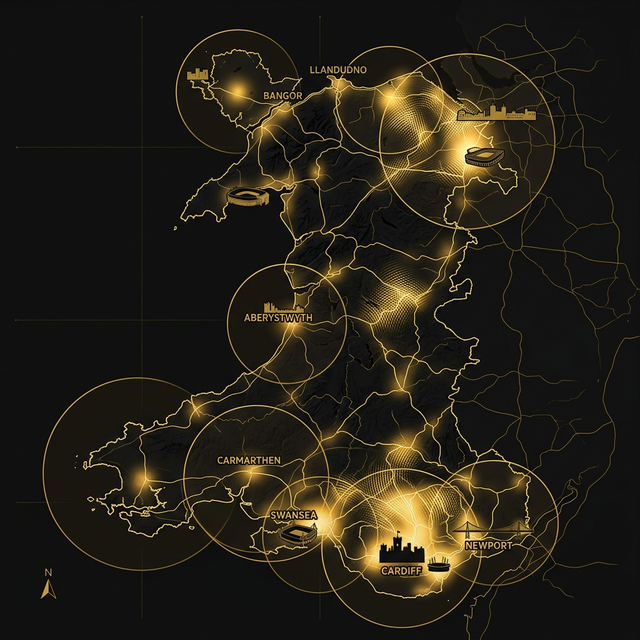
Welsh football operates in a unique demographic context: a national population of 3.1 million spread across a geography that includes dense urban corridors (Cardiff, Swansea, Newport), mid-sized towns (Wrexham, Bangor, Caernarfon), and vast rural areas where the nearest Cymru Premier club may be 30-60 minutes away. This creates highly varied catchment profiles across the league.
With the Cymru Premier expanding from 12 to 16 teams in 2026/27, four new clubs will enter the top division — each bringing their own catchment dynamics. The expansion guide analyses which promoted clubs are best positioned to thrive.
Catchment Demographics Across the Cymru Premier
| Club | Town Population | 30-Min Catchment (Est.) | Average Attendance | Penetration Rate | Matchday Revenue (Est.) |
|---|---|---|---|---|---|
| Caernarfon Town | 9,700 | 45,000 | 820 | 1.8% | £80K-£100K/season |
| TNS (Oswestry) | 18,000 | 55,000 | 550 | 1.0% | £60K-£80K/season |
| Connah's Quay | 35,000 (Deeside area) | 120,000 | 480 | 0.4% | £50K-£70K/season |
| Barry Town | 54,000 | 150,000 | 420 | 0.3% | £45K-£65K/season |
| Haverfordwest | 13,000 | 35,000 | 380 | 1.1% | £40K-£55K/season |
| Bala Town | 1,900 | 15,000 | 350 | 2.3% | £35K-£50K/season |
| Penybont | 40,000 (Bridgend area) | 130,000 | 400 | 0.3% | £40K-£55K/season |
| Cardiff Met | 360,000 (Cardiff) | 450,000 | 250 | 0.06% | £25K-£35K/season |
Several patterns emerge from this data that directly inform investment decisions.
Key Findings
1. Penetration Rate Is More Revealing Than Raw Attendance
Bala Town — founded in 1880 and the oldest club in the league — draws 350 fans from a town of just 1,900 people, representing a 2.3% penetration rate of their broader 30-minute catchment. This is the highest in the league and indicates a club with deeply embedded community support. The Bala Town investment profile examines this heritage-driven model.
Conversely, Cardiff Met sits in the largest urban area in Wales (population 360,000) but attracts just 250 fans — a 0.06% penetration rate. This is not a failure of the club but a reflection of the university model's focus on player development over matchday spectacle. For investors, this represents the league's single largest untapped catchment. The Cardiff Met model analysis explores the trade-offs.
2. Community-Rooted Clubs Outperform on Engagement
Caernarfon Town's average attendance of 820 — the highest in the Cymru Premier — comes from a town of under 10,000 people. This performance reflects decades of community engagement: youth programmes, local partnerships, bilingual (Welsh/English) identity, and a ground (The Oval) that functions as a genuine community hub.
For investors, Caernarfon's model demonstrates that catchment size is less important than catchment conversion. A club that converts 1.5-2% of its 30-minute catchment into regular attendees will outperform a club in a larger urban area converting 0.3%. The Caernarfon investment profile provides the full commercial picture.
3. Urban Catchments Offer the Largest Growth Ceiling
Clubs located in or near larger urban areas — Connah's Quay (Deeside/Chester corridor), Barry Town (Cardiff commuter belt), Penybont (Bridgend/South Wales valleys) — have the largest absolute catchment populations but the lowest penetration rates. This means their growth ceiling is significantly higher than their current attendance suggests.
| Club | Current Attendance | Theoretical Ceiling (1% penetration) | Growth Potential |
|---|---|---|---|
| Connah's Quay | 480 | 1,200 | +150% |
| Barry Town | 420 | 1,500 | +257% |
| Penybont | 400 | 1,300 | +225% |
| Cardiff Met | 250 | 4,500 | +1,700% |
Achieving even a fraction of this potential through improved matchday experience, community programming, and marketing would materially increase club revenues. The attendance trends analysis tracks year-on-year progress across the league.
4. The Wrexham Effect Is Real
The Wrexham AFC story has driven a 30-50% growth in awareness of Welsh football generally. This rising tide benefits all clubs but disproportionately those in catchment areas that overlap with Wrexham's media footprint — primarily North Wales clubs like Caernarfon, Connah's Quay, and Bala. The Wrexham effect analysis quantifies this impact.
Catchment Factors That Drive Attendance
Demographics and Income
The composition of a catchment population matters as much as its size. Key factors:
| Factor | Impact on Attendance | Impact on Revenue Per Head |
|---|---|---|
| Median household income | Moderate (lower incomes reduce discretionary spend) | High (drives hospitality and merchandise spend) |
| Age profile (18-45 proportion) | High (core attendance demographic) | Moderate |
| Welsh language prevalence | Moderate (cultural identity strengthens engagement) | Low direct impact |
| Existing football culture | High (areas with strong football traditions convert more easily) | Moderate |
| Competition from other clubs | High (proximity to Wrexham, Swansea, or Cardiff City reduces catchment) | Variable |
Geographic Accessibility
The distance fans will regularly travel is typically under 30 minutes for Cymru Premier fixtures. This is shorter than for top-tier professional football because:
- Lower perceived value of semi-professional fixtures reduces willingness to travel
- Welsh geography includes mountainous terrain and limited motorway networks, increasing travel time
- Midweek fixtures reduce the catchment further as fans prioritise convenience
Clubs with good road connectivity — such as those near the A55 (North Wales) or M4 (South Wales) corridors — benefit from larger effective catchments.
Community Engagement Programmes
Clubs with active community engagement convert more of their catchment into paying supporters. Effective programmes include:
- Youth football partnerships with local schools and grassroots clubs
- Community events (open days, charity matches, family festivals)
- Local business engagement through commercial partnerships and hospitality
- Social media presence that builds awareness beyond the immediate matchday audience — see the social media strategy guide
Matchday Revenue and Catchment
Matchday revenue in the Cymru Premier typically ranges from £50K to £100K per season, driven primarily by gate receipts and secondary spend (food, drink, merchandise). The relationship between catchment demographics and revenue is direct:
| Revenue Component | Per-Head Value (Est.) | Catchment Dependency |
|---|---|---|
| Gate receipt | £8-£12 | Directly proportional to attendance |
| Food and drink | £3-£5 | Proportional, higher with better facilities |
| Merchandise | £1-£3 | Proportional, higher with strong brand identity |
| Hospitality/VIP | £20-£50 | Dependent on catchment income profile |
| Car parking | £1-£2 | Site-dependent |
| Total per attendee | £13-£22 | — |
For a club averaging 500 attendees over 16 home matches, total matchday revenue ranges from £104K to £176K per season. Increasing average attendance by 200 — achievable through better catchment conversion — adds £42K-£70K annually. This is material for clubs with total revenues under £2M.
The matchday revenue optimisation guide covers strategies for maximising per-head spend, while the revenue breakdown analysis contextualises matchday income within overall club finances.
Implications for the 2026/27 Expansion
The expansion to 16 teams will bring four new clubs into the Cymru Premier, each with distinct catchment profiles. Promoted clubs from the Cymru North and Cymru South will be evaluated on:
- Catchment size and penetration rate — can they sustain top-tier attendance levels?
- Infrastructure readiness — do their grounds meet the higher capacity and licensing requirements?
- Travel logistics — how do they affect away-fan attendance patterns across the league?
- Commercial potential — does their catchment support the sponsorship values expected at Cymru Premier level?
The North vs South comparison examines geographic distribution, and the club benchmarking data provides the comparative framework.
Investment Decision Framework
For investors using catchment analysis to evaluate acquisition targets:
| Catchment Profile | Investment Thesis | Risk Level | Example Clubs |
|---|---|---|---|
| Small town, high penetration | Heritage-driven, community loyalty, limited growth ceiling | Low risk, moderate return | Bala, Caernarfon |
| Urban area, low penetration | Large growth ceiling, requires marketing and matchday investment | Medium risk, high return | Barry, Penybont, Connah's Quay |
| Major city, minimal penetration | Massive theoretical ceiling, significant competition from larger clubs | High risk, potentially transformative | Cardiff Met |
| Rural/cross-border | Niche audience, strong identity, limited scalability | Low-medium risk, modest return | TNS, Haverfordwest |
The club investment profiles provide detailed analysis for each club, and the investment returns study contextualises how catchment growth translates to financial returns.
Analysis based on ONS population data (2021 census, 2025 mid-year estimates), Cymru Connect attendance tracking, FAW reports, and internal catchment modelling. Penetration rates are estimates based on 30-minute travel time catchments and may vary based on road conditions and competition from neighbouring clubs. Data current as of March 2026.