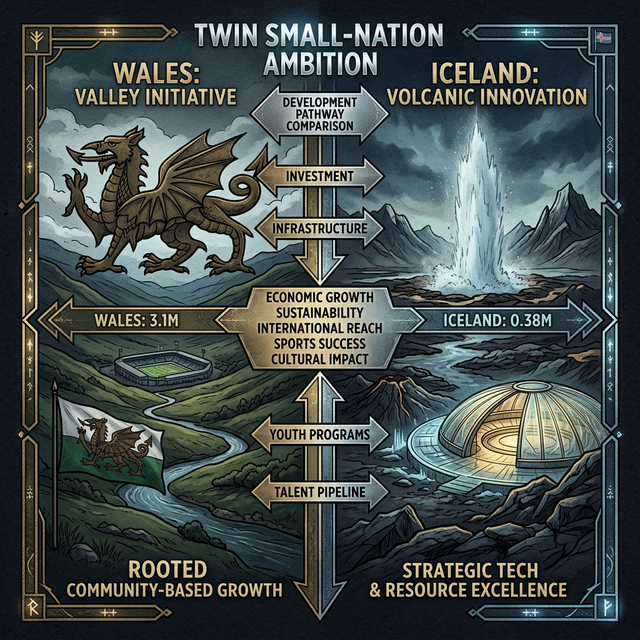
TL;DR: Iceland (population 380K, FIFA rank 39) and Wales (population 3.1M, FIFA rank 50) represent two distinct small-nation football strategies. Iceland prioritised coaching infrastructure and indoor facilities, producing outsized national team results. Wales has focused on professionalising its club pyramid through Cymru Premier expansion, creating a more investable domestic league. Both models have succeeded on their own terms -- but for club-level investors, Wales's structure offers clearer commercial entry points and growth trajectories.
Why This Comparison Matters
Iceland and Wales are the two most instructive case studies in European football development for anyone interested in small-nation strategy. Both have punched above their weight internationally -- Iceland reaching the Euro 2016 quarter-finals and Wales the semi-finals of the same tournament -- but they achieved these results through fundamentally different approaches.
For investors, sponsors, and football administrators evaluating where to deploy capital and attention, understanding the structural differences between these models is essential. The question is not which model is "better" in the abstract, but which approach creates the most favourable conditions for the stakeholder's specific objectives.
Head-to-Head Comparison
| Metric | Wales | Iceland | Source |
|---|---|---|---|
| Population | 3.1 million | 380,000 | National statistics, 2025 |
| FIFA ranking (2026) | 50 | 39 | FIFA Rankings |
| Top division clubs | 12 (expanding to 16) | 12 | FAW / KSI |
| Average top division attendance | 400-600 | 1,000-1,500 | FAW / KSI |
| Top division broadcast deal | £80-120K per club (S4C) | ~€50-100K per club | FAW / KSI reports |
| Indoor football facilities | Limited | Extensive (7 full-size) | National FA reports |
| UEFA coaching licence holders per capita | Moderate | Highest in Europe | UEFA coaching data |
| Club UEFA participation | 1 CL + 1 ECL spot | 1 CL + 1 ECL spot | UEFA |
| National team major tournament appearances (since 2010) | 3 | 2 | FIFA/UEFA |
| Highest club squad value | £2.5M (TNS) | ~€2M (Breidablik/Valur) | Transfermarkt |
| Player salary range (top division) | £15K-£40K | €20K-€60K | Industry estimates |
The Iceland Model: Coaching and Infrastructure First
How Iceland Did It
Iceland's football transformation is one of the most analysed success stories in modern football. The approach was straightforward in concept, even if extraordinary in execution:
Indoor facilities: Between 2000 and 2015, Iceland built seven full-size indoor football halls, ensuring year-round training regardless of the country's extreme climate. For a nation of 380,000 people, this represents one of the highest ratios of covered football facilities per capita in the world.
Coaching education: Iceland embarked on a mass coaching certification programme, producing one of Europe's highest ratios of UEFA A and B licence holders per capita. By 2016, Iceland had approximately 600 UEFA-qualified coaches for a population smaller than Cardiff.
Grassroots integration: Every child in Iceland has access to structured coaching from qualified instructors, in heated indoor facilities, regardless of location or family income. The grassroots pathway is universal.
National team focus: The entire system was oriented towards producing national team players. Club football was the means; international success was the end.
Iceland's Results
The results were remarkable:
| Achievement | Year | Significance |
|---|---|---|
| Euro 2016 qualification | 2016 | Smallest nation ever to qualify |
| Euro 2016 quarter-final | 2016 | Defeated England |
| World Cup 2018 qualification | 2018 | Smallest nation ever at a World Cup |
| Consistent FIFA top-40 ranking | 2015-2026 | Sustained competitive performance |
Iceland's Limitations
The model is not without weaknesses, particularly from an investment perspective:
- Club football underdeveloped: The Icelandic top division (Urvalsdeild) remains semi-professional, with limited commercial infrastructure. Clubs are largely community-funded and volunteer-run.
- Domestic broadcast value limited: Despite national team success, club football broadcast deals remain modest.
- Player export-dependent: The best Icelandic players leave for Scandinavian, British, or continental leagues, meaning the domestic league serves primarily as a development platform rather than a commercially viable product.
- Sustainability questions: The model depends on sustained public investment in facilities and coaching. Any reduction in public funding could undermine the system.
The Wales Model: Club Professionalisation
How Wales Is Building
Wales has pursued a different strategy, one that prioritises the professionalisation and commercialisation of its club pyramid:
League expansion: The Cymru Premier's expansion from 12 to 16 teams increases fixtures, broadens the talent pool, and creates more commercial opportunities. See our expansion guide for the full picture.
Broadcasting development: The S4C/Sgorio partnership provides every Cymru Premier club with broadcast revenue of £80-120K per season -- a meaningful contribution to club budgets that creates a revenue floor. See our S4C/Sgorio analysis.
Club licensing: The FAW has implemented increasingly rigorous licensing standards, raising the minimum professional standards across the league.
European pathway: TNS's regular Champions League participation and other clubs' Conference League campaigns provide European exposure and revenue. See our European competition history.
Commercial activation: Clubs are developing more sophisticated commercial operations, with growing sponsorship revenue and matchday revenue optimisation.
Wales's Results
| Achievement | Year | Significance |
|---|---|---|
| Euro 2016 semi-final | 2016 | Best-ever tournament performance |
| Euro 2020 qualification | 2021 | Back-to-back tournament appearances |
| World Cup 2022 qualification | 2022 | First World Cup since 1958 |
| TNS Champions League regulars | Ongoing | Consistent European representation |
| League expansion to 16 | 2026/27 | Structural professionalisation |
Wales's Limitations
- Facility gap: Wales lacks the indoor facility infrastructure that underpins Iceland's model. Winter training is constrained by weather and limited covered facilities.
- Coaching depth: While improving, Wales does not yet match Iceland's coaches-per-capita ratio.
- Attendance challenge: Cymru Premier attendance (400-600) lags behind the Icelandic league (1,000-1,500) despite Wales having eight times the population. See our attendance trends analysis.
- Competition for attention: Welsh football competes for fans' attention with the English Premier League, a challenge Iceland does not face.
Structural Comparison
Coaching Infrastructure
| Metric | Wales | Iceland |
|---|---|---|
| UEFA A licence holders | ~200 | ~180 |
| UEFA B licence holders | ~800 | ~600 |
| Population per UEFA-qualified coach | ~3,100 | ~630 |
| Coaching ratio (youth football) | 1 per 25-30 children | 1 per 8-12 children |
| FAW/KSI coaching investment | £1M-£2M/year | ~€2M-€3M/year |
Iceland's advantage here is stark: roughly five times as many qualified coaches per capita. This translates directly into higher-quality youth development and broader talent identification.
Facility Infrastructure
| Facility Type | Wales | Iceland |
|---|---|---|
| Full-size indoor football halls | 2-3 | 7 |
| Full-size indoor halls per capita | ~1 per 1M | ~1 per 54K |
| 3G/4G outdoor pitches | ~30-40 | ~20 |
| UEFA-standard stadiums | 4 | 3 |
| Community sports halls (multi-use) | Extensive | Moderate |
Iceland's indoor facility advantage is its most distinctive investment. For Wales to replicate this -- building 7 equivalent halls -- would cost an estimated £35-50M, a substantial but not impossible investment given the population and economic differences.
Financial Comparison
| Financial Metric | Cymru Premier | Icelandic Urvalsdeild |
|---|---|---|
| Average club revenue | £200K-£500K | €150K-€400K |
| Top club revenue | £3.2M (TNS) | ~€1.5M |
| Average sponsorship per club | £80K-£200K | €50K-€150K |
| Broadcast revenue per club | £80-120K | €50-€100K |
| Average player salary | £15K-£40K | €20K-€60K |
| Club ownership model | Mix (private, community) | Predominantly community |
Wales's larger population and economy support higher absolute revenue figures, particularly at the top end (TNS's £3.2M revenue has no Icelandic equivalent). This financial headroom is what makes Welsh club football more investable.
What Each Model Teaches
Lessons from Iceland for Wales
Indoor facilities are transformational. Iceland's investment in covered training spaces eliminated weather as a barrier to year-round development. Wales could replicate this with targeted facility investment. See our infrastructure investment guide.
Coaching density matters. More qualified coaches per child means better development outcomes. The FAW's coaching certification programme could be expanded with targeted funding.
Grassroots universality works. Iceland's model ensures every child has access to quality coaching regardless of location. Wales's more urban-concentrated approach leaves rural areas underserved.
Lessons from Wales for Iceland
Club professionalisation creates investable assets. Wales's approach to club licensing, broadcast deals, and commercial development makes individual clubs viable investment targets -- something Iceland's community ownership model does not readily accommodate.
Broadcasting matters. The S4C/Sgorio deal, modest by UK standards, provides Welsh clubs with a revenue floor that Icelandic clubs lack.
European competition can be leveraged. TNS's regular Champions League participation generates significant revenue and profile. Icelandic clubs compete in Europe but have not leveraged this as effectively commercially.
Implications for Investors
Where to Invest: Wales vs Iceland
For different investor profiles, the two models offer distinct opportunities:
| Investor Type | Wales Opportunity | Iceland Opportunity |
|---|---|---|
| Club ownership | Strong (private ownership common) | Weak (community ownership dominant) |
| Sponsorship | Strong (growing, underleveraged) | Moderate (small market) |
| Facility development | Strong (clear need, funding available) | Limited (largely built) |
| Player development/trading | Strong (salary arbitrage, English market proximity) | Moderate (Scandinavian market) |
| Broadcasting | Moderate (S4C deal established) | Weak (limited broadcast infrastructure) |
| Academy investment | Strong (8 active academies) | Moderate (centralised system) |
The headline conclusion for investors: Wales offers a broader range of investable entry points and a larger addressable market, while Iceland offers a more refined development model that has delivered superior national team results.
The Hybrid Approach
The optimal strategy for Welsh football may be to combine elements of both models:
- Adopt Iceland's coaching density by investing in mass coach education
- Build indoor facilities in strategic locations (Cardiff, Swansea, Wrexham, North Wales coast)
- Maintain Wales's club commercialisation approach to ensure clubs are financially sustainable
- Leverage the English market for player trading, broadcasting, and sponsorship -- an advantage Iceland does not possess
For a broader comparison across multiple small-nation leagues, see our global benchmarking and small nation returns analyses. For the League of Ireland comparison, see our Cymru Premier vs League of Ireland article.
Expert Insight
"Iceland's focus on grassroots football and coaching education has been transformational -- but Wales's club-level professionalisation creates a more structured entry point for private investment. The ideal model would combine Iceland's coaching and facility infrastructure with Wales's commercial ambition and broadcasting partnerships. Neither country has fully achieved this synthesis yet, which represents the opportunity."
-- a European football development consultant
Conclusion
Iceland and Wales demonstrate that small nations can produce world-class football results through sustained, strategic investment -- but the paths they choose have different implications for different stakeholders. Iceland's model is optimised for national team performance; Wales's model is optimised for club-level commercial viability.
For investors evaluating the Welsh football market, the Iceland comparison is instructive rather than prescriptive. Wales's larger population, proximity to the English market, established broadcast deal, and growing club commercialisation create an investment environment that Iceland's model, for all its brilliance, does not replicate. The opportunity is to build on Wales's existing strengths while selectively adopting Iceland's most impactful innovations -- particularly in coaching and indoor facility provision.
Sources: FAW and KSI (Iceland Football Association) annual reports (2025-26), FIFA rankings (2026), UEFA coaching data, Transfermarkt squad valuations, Cymru Connect internal analysis (March 2026). Population and economic data from national statistics offices. Facility counts are based on published reports and may not capture all community-level provision.