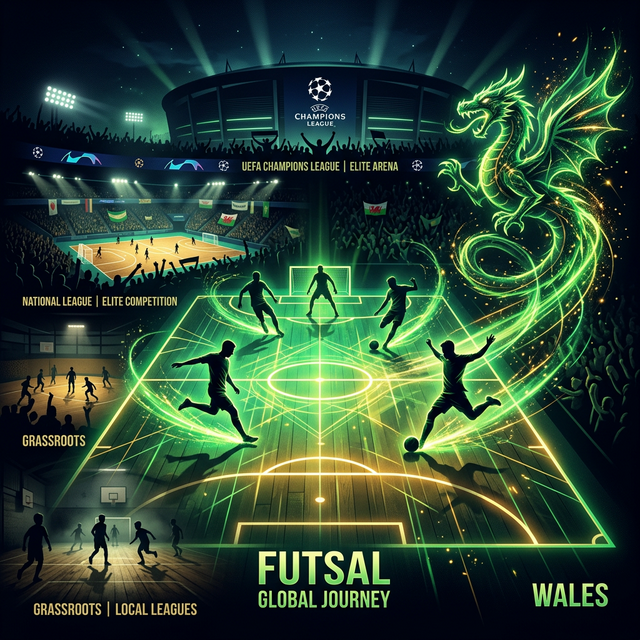
TL;DR: Welsh futsal has evolved from community halls to UEFA competition in under a decade. FC Cardiff competed in the UEFA Futsal Champions League 2025-26, the FAW Futsal League accommodates 7 Welsh clubs alongside 19 UK clubs in connected competitions, and entry costs range from £5K-£50K -- making it the lowest-cost European-pathway sport available to investors. With FIFA futsal ranking ~90 and a national team actively competing, Wales is building a credible small-nation futsal model.
The Rise of Welsh Futsal
Welsh futsal's trajectory over the past decade is one of the most compelling grassroots-to-elite stories in European sport. From informal five-a-side games in community centres to FC Cardiff representing Wales in the UEFA Futsal Champions League, the sport has built a structured pathway that connects local participation to continental competition.
This guide provides the definitive overview of Welsh futsal in 2026: the league structure, the development pathway, the investment landscape, and the strategic opportunity for stakeholders at every level.
Key Statistics
| Metric | Value | Source |
|---|---|---|
| FAW Futsal League established | ~2015 | Welsh Football Historical Data |
| Welsh clubs in FAW Futsal League | 7 | FAW, 2025-26 |
| UK clubs in connected leagues | 19 | FAW, 2025-26 |
| Total clubs across Welsh/UK futsal | 26 | FAW, 2025-26 |
| Wales FIFA futsal ranking | ~90th | FIFA Rankings, 2026 |
| UEFA Champions League participant | FC Cardiff | UEFA, 2025-26 |
| National team head coach | Paul Douglas Jones | FAW |
| National team assistant | Gareth Wallwork | FAW |
| Estimated active futsal players (Wales) | 2,000-3,500 | FAW participation data |
| Entry cost for club involvement | £5K-£50K | Cymru Connect analysis |
League Structure
The FAW Futsal League
The FAW Futsal League is the backbone of Welsh futsal. Established around 2015, it provides a structured competitive framework split into regional sections:
| Section | Number of Clubs | Format | Season |
|---|---|---|---|
| FAW Futsal League North | 3-4 Welsh clubs | Round-robin | October-April |
| FAW Futsal League South | 3-4 Welsh clubs | Round-robin | October-April |
| Connected UK leagues | 19 clubs | Various formats | October-April |
| FAW Futsal Cup | All Welsh clubs | Knockout | January-March |
The league operates a promotion and relegation system within the broader UK futsal pyramid, meaning Welsh clubs compete against English, Scottish, and Northern Irish opposition in upper-tier competitions.
Club Profiles
The 7 Welsh futsal clubs represent a mix of dedicated futsal organisations and football club futsal sections:
| Club | Region | Type | European Experience |
|---|---|---|---|
| FC Cardiff | South Wales | Dedicated futsal club | UEFA Champions League 2025-26 |
| Cardiff University | South Wales | University team | None |
| Wrexham Futsal | North Wales | Dedicated futsal club | None |
| Llandarcy Futsal | South Wales | Community club | None |
| TNS Futsal | Mid Wales | Football club section | None |
| Swansea Futsal | South Wales | Dedicated futsal club | None |
| Newport Futsal | South Wales | Community club | None |
For individual club details and investment profiles, see our futsal investment case.
The Development Pathway
Grassroots Foundation
Welsh futsal's grassroots layer is its greatest strength. The sport's accessibility -- requiring only an indoor sports hall, a futsal ball, and a set of goals -- means participation barriers are minimal compared to outdoor football:
- School programmes: The FAW runs futsal-specific school engagement programmes across Wales, introducing the sport at primary school level. Unlike outdoor football, futsal can be played year-round regardless of weather, making it particularly valuable in Wales's climate.
- Community centres: Local leisure centres and community halls host informal futsal sessions, providing entry points for players of all ages and abilities.
- Coaching pathway: The FAW offers futsal-specific coaching qualifications, building a coaching workforce distinct from the outdoor game. This specialisation is critical -- futsal's tactical and technical demands differ significantly from 11-a-side football.
Youth Development
The pathway from grassroots to competitive futsal follows a structured progression:
| Level | Age Group | Focus | Typical Cost to Family |
|---|---|---|---|
| School futsal | 5-11 | Fun, basic skills | Free (school-based) |
| Community club | 8-14 | Technical development | £50-£150/year |
| Junior league | 12-16 | Competitive play | £100-£300/year |
| FAW Futsal League youth | 14-18 | Advanced competition | £200-£500/year |
| Senior FAW Futsal League | 16+ | Full competitive pathway | £300-£800/year |
National Team Pathway
The Wales national futsal team, coached by Paul Douglas Jones with Gareth Wallwork as assistant, provides the apex of the domestic pathway. The team's FIFA ranking of approximately 90th places Wales in the middle tier of European futsal nations -- a credible position given the sport's relatively recent formalisation in the country.
For a detailed look at the national team programme, see our Wales national futsal team overview.
The FC Cardiff Case Study
FC Cardiff's participation in the UEFA Futsal Champions League 2025-26 is the single most significant event in Welsh futsal history. It demonstrated that the domestic pathway can produce a club competitive at European level and provided a template for future Welsh clubs with continental ambitions.
What FC Cardiff's Run Proved
- The pathway works: A club developed entirely within the Welsh futsal system reached European competition without requiring external investment of the scale associated with outdoor football.
- Exposure multiplied: The Champions League run generated media coverage that the entire Welsh futsal ecosystem benefited from, raising the sport's profile with potential sponsors, participants, and investors.
- Infrastructure gap identified: The run also highlighted the infrastructure limitations Welsh futsal faces -- specifically, the lack of a dedicated futsal venue meeting UEFA standards. This creates a clear investment opportunity.
For the full case study, see our FC Cardiff UEFA case study.
The Investment Landscape
Why Futsal Attracts Investors
Futsal's investment proposition is fundamentally different from outdoor football:
| Factor | Outdoor Football (Cymru Premier) | Futsal (FAW Futsal League) |
|---|---|---|
| Entry cost (club involvement) | £100K-£500K+ | £5K-£50K |
| Annual operating cost | £200K-£1M+ | £15K-£80K |
| Stadium/venue requirement | Dedicated ground (£500K-£5M) | Indoor sports hall (hire or build) |
| Squad size | 22-28 players | 12-16 players |
| Player costs | £15K-£40K average salary | £0-£5K (mostly amateur/semi-pro) |
| European pathway | Champions League/Conference League | UEFA Futsal Champions League |
| Broadcasting | S4C/Sgorio (£80-120K/club) | Minimal (emerging) |
| Sponsorship maturity | Developing | Near-zero (first-mover opportunity) |
The critical insight is that futsal offers a European competition pathway at a tiny fraction of the cost of outdoor football. An investor can fund an entire futsal club operation for less than the annual salary of a single Cymru Premier squad player.
Venue Investment
The most significant infrastructure investment in Welsh futsal is venue development. Currently, most clubs hire existing sports halls on a per-session basis. A dedicated futsal venue would transform the economics:
| Venue Option | Capital Cost | Annual Operating Cost | Revenue Potential |
|---|---|---|---|
| Hire existing sports hall | £0 capital | £10K-£25K hire | Limited |
| Long-term lease (dedicated hours) | £0-£20K fit-out | £15K-£40K lease | Moderate |
| Purpose-built futsal arena (500-1,000 capacity) | £500K-£2M | £30K-£80K | £50K-£150K+ |
| Converted warehouse/industrial unit | £200K-£800K | £20K-£50K | £30K-£100K |
For detailed venue cost analysis, see our futsal venue investment costs guide.
A purpose-built futsal arena in a major Welsh city (Cardiff, Swansea, or Wrexham) would serve as both a competition venue and a community hub, generating revenue from:
- Competitive futsal matches
- Recreational futsal hire
- Corporate five-a-side leagues
- Youth coaching programmes
- Community events
- Ancillary services (cafe, retail)
Sponsorship Opportunity
Welsh futsal's commercial landscape is essentially a blank canvas. Most clubs have no dedicated sponsors, meaning first-movers can secure:
- Category exclusivity: Be the only brand in your sector associated with Welsh futsal.
- Naming rights: Arena or club naming rights at a fraction of outdoor football costs.
- Kit sponsorship: From as little as £1K-£5K per season.
- Digital partnerships: Growing social media audiences with high engagement rates.
For the full sponsorship picture, see our futsal sponsorship opportunities guide.
Starting a Club
For entrepreneurs and community leaders considering founding a futsal club in Wales, the barriers to entry are remarkably low:
| Startup Requirement | Cost | Timeline |
|---|---|---|
| FAW affiliation and registration | £200-£500 | 2-4 weeks |
| Kit and equipment | £1K-£3K | 1-2 weeks |
| Venue hire (first season) | £3K-£8K | Booked in advance |
| Coaching staff | £2K-£5K | Recruitment |
| League entry fees | £500-£1K | Pre-season |
| Insurance | £500-£1K | Annual |
| Total first-year cost | £7K-£19K | -- |
For a step-by-step guide, see our starting a futsal club in Wales article.
Growth Metrics and Participation Data
Welsh futsal participation has grown steadily since the FAW Futsal League's establishment:
| Year | Estimated Active Players | Registered Clubs | Key Development |
|---|---|---|---|
| 2015 | ~500 | 3-4 | FAW Futsal League founded |
| 2018 | ~1,000 | 5-6 | North/South structure established |
| 2020 | ~1,200 | 5-6 | COVID disruption |
| 2022 | ~1,800 | 6-7 | Post-COVID recovery and growth |
| 2024 | ~2,500 | 7 | FC Cardiff UEFA qualification |
| 2026 | ~3,000-3,500 | 7 | Champions League participation |
For detailed participation statistics, see our futsal participation growth data report.
The International Context
How Wales Compares
Welsh futsal's development should be assessed against comparable small nations:
| Nation | Population | FIFA Futsal Ranking | Domestic Clubs | Key Achievement |
|---|---|---|---|---|
| Wales | 3.1M | ~90th | 7 | Champions League participant |
| Iceland | 380K | ~80th | 8-10 | Regular European qualifiers |
| Northern Ireland | 1.9M | ~100th | 5-6 | Developing programme |
| Republic of Ireland | 5.1M | ~85th | 10-12 | Growing domestic league |
| Scotland | 5.5M | ~75th | 12-15 | Established league structure |
Wales's position is creditable given the sport's relatively recent formalisation. The FC Cardiff Champions League run places Welsh futsal ahead of its trajectory -- achieving a milestone that several higher-ranked nations have not.
The Iceland Parallel
The Iceland football model offers instructive parallels for Welsh futsal. Iceland invested heavily in indoor facilities and coaching infrastructure for outdoor football, producing outsized results from a small population. Welsh futsal could follow a similar path, leveraging indoor facility investment to produce disproportionate competitive outcomes.
Challenges and Risks
No investment guide is complete without acknowledging the challenges:
- Broadcasting: Futsal lacks a dedicated broadcast deal in Wales. While this keeps costs low, it also limits commercial revenue and public visibility.
- Professionalisation: The transition from amateur to semi-professional is the next critical step, but it requires sustainable revenue streams that do not yet exist at scale.
- Venue dependency: The reliance on hired sports halls creates scheduling constraints and limits spectator capacity. Purpose-built venues are the solution, but they require capital investment.
- Awareness: Despite FC Cardiff's Champions League run, public awareness of Welsh futsal remains low compared to outdoor football.
Expert Perspective
"Welsh futsal's progression from grassroots to UEFA competition in under a decade shows the pathway is real and the growth is structural. The sport offers everything an investor or sponsor could want: low entry costs, clear growth metrics, European ambitions, and a passionate community. What it needs now is the infrastructure investment -- particularly venue development -- to unlock the next phase of growth."
-- a Welsh futsal development officer
Conclusion
Welsh futsal in 2026 represents a sport at an inflection point. The grassroots foundation is solid, the competitive pathway is proven (up to and including UEFA Champions League participation), and the investment requirements are modest by any standard in European sport. For investors, sponsors, and community leaders, futsal offers a unique combination of low entry costs, clear growth trajectory, and European ambitions.
The strategic priorities for the next phase are clear: venue development, sponsorship activation, and the gradual professionalisation of the playing workforce. The clubs and investors that drive these priorities will shape Welsh futsal's future -- and will do so from a position of remarkable first-mover advantage.
Sources: FAW futsal development reports (2025-26), UEFA competition data, FIFA futsal rankings (2026), Cymru Connect internal analysis (March 2026). Participation estimates are based on FAW registration data and community programme attendance figures. Club financial data is limited due to the amateur/semi-professional nature of most operations.