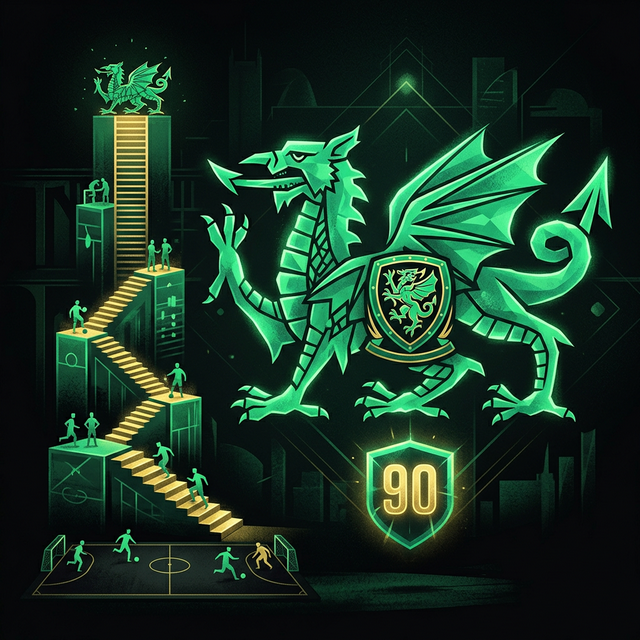
TL;DR: Ranked approximately 90th by FIFA, the Wales national futsal team is building its international profile through a strengthening domestic league, FC Cardiff's European campaigns, and targeted coaching investment. For investors, the national team's trajectory signals a sport on the cusp of professionalisation — with significant upside for those who position early.
Where Wales Stands in Global Futsal
Wales currently sits at approximately 90th in the FIFA futsal world rankings — a position that places it in the lower half of European nations but well above most newcomers to the sport. That ranking understates the momentum. Since the Welsh Futsal League's establishment around 2015, Wales has moved from complete obscurity to regular participation in UEFA qualifying rounds, competitive results against established European nations, and a domestic league structure that is producing internationally capable players.
The trajectory matters more than the current position. Nations that have made rapid futsal progress — Lithuania, Finland, Georgia — followed a similar pattern: domestic league formation, followed by national team investment, followed by a breakout qualifying campaign that accelerated everything. Wales is in the second phase of that progression.
Key Statistics
| Metric | Value | Source |
|---|---|---|
| FIFA futsal ranking | ~90th | FIFA/internal analysis (2026) |
| Welsh Futsal League established | ~2015 | FAW records |
| League structure | North and South divisions | FAW Futsal League |
| Registered futsal clubs (Wales) | 7 domestic + 19 UK-wide | Cymru Connect database |
| FC Cardiff UEFA participation | 2025/26 season | UEFA Futsal Champions League |
| Head coaches | Paul Douglas Jones, Gareth Wallwork | FAW appointment records |
| FAW futsal budget (estimated) | £150K–£250K annually | FAW development reports |
| International matches played (2024/25) | 6–8 | UEFA/FAW match records |
The Domestic Foundation
Welsh Futsal League Structure
The FAW Futsal League operates in two regional divisions — North and South — reflecting the geographic realities of a country where travel distances can be prohibitive for a sport that relies on weeknight training sessions and weekend fixtures. The structure has evolved from a single national competition to the current two-division format, increasing the number of competitive matches and reducing the travel burden on clubs.
| Division | Approximate Clubs | Season Format | Venue Type |
|---|---|---|---|
| North | 3–4 | Round-robin, home and away | Leisure centres, school sports halls |
| South | 4–5 | Round-robin, home and away | University sports halls, leisure centres |
| National finals | Top clubs from each division | Knockout | Neutral venue |
The league's growth has been steady rather than explosive. New clubs form each season, but retention is a challenge — futsal clubs in Wales operate with minimal budgets, limited venue access, and no gate revenue. The FAW has responded by providing subsidised referee appointments, coaching education, and a centralised fixture scheduling system.
For a comprehensive overview of the domestic futsal landscape, see our Welsh Futsal Complete Guide. The FAW Futsal League Structure article details the competition format.
FC Cardiff: The European Standard-Bearer
FC Cardiff's participation in the 2025/26 UEFA Futsal Champions League preliminary round represents a watershed moment for Welsh futsal. As the first Welsh club to compete in UEFA's flagship futsal competition, FC Cardiff provides a benchmark for what domestic excellence can achieve — and a tangible target for other clubs to aim at.
The club's European campaign delivered several benefits beyond the sporting result:
- Player development: Exposure to European-level opponents accelerated the tactical education of players who are also national team candidates.
- Profile: Media coverage of the UEFA campaign raised the visibility of Welsh futsal domestically and internationally.
- Infrastructure insight: Competing in European venues highlighted the facility gap between Welsh futsal and established European programmes, creating a clear investment case.
For the full analysis, see our FC Cardiff UEFA Case Study.
The National Team Programme
Coaching Structure
The Wales national futsal team is led by head coaches Paul Douglas Jones and Gareth Wallwork, who share responsibility for senior and development squads. Both coaches have pursued UEFA futsal coaching qualifications and have studied programmes in Spain, Portugal, and the Balkans — the traditional futsal powerhouses.
The coaching setup reflects the FAW's pragmatic approach to futsal development: rather than appointing a single high-profile (and expensive) foreign coach, the association has invested in homegrown coaches and supported their education through international study visits and UEFA coaching pathway programmes.
Player Pool
Wales draws its national futsal squad from three sources:
- Welsh Futsal League players: The domestic league provides the core of the squad, with FC Cardiff and other leading clubs contributing the majority of selections.
- Football crossover players: Several squad members play 11-a-side football at semi-professional level and transition to futsal for international windows. This crossover is common in developing futsal nations and brings athleticism and tactical awareness, though it can create scheduling conflicts.
- Welsh diaspora: Players of Welsh heritage based in England or elsewhere who play futsal domestically in their resident countries. This pool is small but has contributed individual players with experience in more established futsal leagues.
| Player Source | Approximate % of Squad | Strengths | Challenges |
|---|---|---|---|
| Welsh Futsal League | 60–70% | Futsal-specific skills, tactical familiarity | Limited high-level match experience |
| Football crossover | 20–25% | Athleticism, competitive mentality | Scheduling conflicts, futsal-specific gaps |
| Diaspora | 5–10% | External league experience | Availability, integration |
International Results and Trajectory
Wales's recent international futsal record shows a clear pattern of improvement. While the team is not yet competitive with Europe's top 30 nations, it has recorded increasingly narrow defeats against established programmes and has begun to beat comparable-ranked opponents regularly.
| Period | Typical Results | Notable Matches |
|---|---|---|
| 2015–2018 | Heavy defeats in qualifying | First-ever UEFA qualifying round participation |
| 2019–2022 | Competitive in group matches, occasional draws | Improved goal difference in qualifying groups |
| 2023–2026 | Wins against comparable nations, narrow losses to established sides | FC Cardiff's European debut; improved FIFA ranking |
The pattern mirrors the trajectory of nations like Northern Ireland and Gibraltar, which used consistent qualifying participation to build experience before achieving breakout results. Wales's larger population base and stronger football infrastructure suggest it can progress faster than those comparators.
The Investment Opportunity
Why Futsal Matters for Investors
Futsal investment in Wales operates at a fundamentally different price point from 11-a-side football. Where a Cymru Premier club might cost £250K–£1.5M to acquire, a futsal club can be established or supported for a fraction of that — with the potential for outsized returns if the sport's growth trajectory continues.
| Investment Area | Estimated Cost | Potential Return |
|---|---|---|
| Club establishment/support | £10K–£50K annually | Community engagement, brand association |
| Venue development (dedicated futsal court) | £500K–£1.5M | Rental income, multi-use community asset |
| Sponsorship of national team programme | £25K–£100K annually | National-level brand visibility |
| Youth academy establishment | £15K–£40K annually | Player development pipeline |
The key insight for investors is that futsal in Wales is at the ground floor. The sport's infrastructure is underdeveloped, its commercial potential is untapped, and the national team's improving trajectory creates a rising tide that lifts all domestic boats. For those considering launching a club, see our Starting a Futsal Club in Wales guide. For venue-specific investment cases, see Futsal Venue Investment Costs.
The Venue Gap
The single biggest constraint on Welsh futsal development is venue access. The sport requires a specific playing surface (flat, indoor, minimum dimensions of 38m x 18m) that most Welsh leisure centres and sports halls do not provide. Clubs compete for limited booking slots, often training and playing in facilities that are shared with basketball, badminton, and other indoor sports.
A dedicated futsal venue — or a multi-sport facility with futsal as the anchor tenant — would transform the Welsh futsal landscape. It would provide:
- A permanent home for national team training and matches
- A venue for league finals and showcase events
- Year-round training capacity for development squads
- Revenue through commercial hire, coaching programmes, and events
The FAW has identified venue development as a strategic priority but lacks the capital to fund it independently. This creates a clear opportunity for private investment, potentially in partnership with local authorities or Sport Wales funding. See our Community Sports Hub guide for funding models.
Benchmarking Against Comparable Nations
Wales's futsal development can be benchmarked against nations of similar population size and football infrastructure:
| Nation | FIFA Futsal Ranking | Domestic League Age | Dedicated Venues | National Team Budget |
|---|---|---|---|---|
| Wales | ~90th | ~10 years | 0 | £150K–£250K |
| Northern Ireland | ~85th | ~12 years | 0 | £200K–£300K |
| Scotland | ~75th | ~15 years | 1 | £300K–£400K |
| Lithuania | ~50th | ~20 years | 3 | £500K–£700K |
| Finland | ~40th | ~25 years | 5+ | £800K–£1M |
The pattern is clear: sustained investment in domestic infrastructure and coaching, measured in decades rather than years, drives ranking improvement. Wales is early in this journey but has the advantage of learning from nations that have already walked the path. The Futsal Investment Case article examines the broader growth argument, while Futsal Participation Growth Data tracks the underlying numbers.
What Comes Next
The next five years are critical for Welsh futsal. The FAW's development plan targets the following milestones:
- Top 70 FIFA ranking by 2028: Achievable through continued qualifying participation and results against comparable nations.
- Dedicated national futsal venue by 2029: Dependent on securing capital funding — the most significant single investment need.
- Professional or semi-professional domestic league by 2030: A stretch target that would require sponsorship growth and venue availability.
- UEFA Futsal EURO qualification by 2032: The ultimate goal — reaching the finals of a major tournament.
Each milestone creates commercial opportunities: sponsorship packages become more valuable as the sport's profile grows, venue investment becomes more viable as participation increases, and player development pathways become more attractive as the national team's results improve.
For investors with a five-to-ten-year horizon, Welsh futsal offers a rare combination of low entry cost, clear growth trajectory, and community impact. For sponsorship opportunities specifically, see our dedicated guide.
Source and Methodology
FIFA futsal rankings are based on published data and internal analysis (exact rankings are not always publicly available for nations outside the top 50). Domestic league data is sourced from the FAW's futsal development reports. Budget estimates are based on FAW financial disclosures and Cymru Connect analysis. Comparable nation data is drawn from published UEFA and national association reports. All figures are in GBP and represent estimates. Venue cost estimates are based on Sport Wales facility development guidelines and comparable UK indoor sports projects.