TL;DR: The Cymru Premier is an undervalued talent market where eight clubs run active academies, transfer fees range from free to £300K, and the average squad value sits at a fraction of English and Scottish equivalents. For scouts, agents, and investors, Welsh football offers proven performers at prices that represent exceptional value -- particularly given the league's growing visibility and the "Wrexham effect" driving increased cross-border interest.
The Welsh Talent Landscape
The Cymru Premier occupies a unique position in the British football talent ecosystem. It sits below the English Football League and Scottish Premiership in terms of resources and profile, but above most National League and regional league structures in terms of competitive intensity and player quality. For scouts, this creates an arbitrage opportunity: players performing at a level that would command significant fees in England or Scotland are available at Welsh market prices.
The league's expansion from 12 to 16 teams in 2026/27 will deepen the talent pool further, while the "Wrexham effect" has raised the Cymru Premier's profile among English clubs, agents, and scouts who previously paid little attention to Welsh domestic football.
Key Statistics
| Metric | Value | Source |
|---|---|---|
| Cymru Premier clubs | 12 (expanding to 16) | FAW, 2025-26 |
| Clubs with active academies | 8 | FAW youth development reports |
| Average squad size | 22-28 players | Transfermarkt, March 2026 |
| Highest squad value | £2.5M (TNS) | Transfermarkt, March 2026 |
| Average squad value | £300K-£600K | Transfermarkt, March 2026 |
| Average player salary | £15K-£40K | Cymru Connect analysis |
| Transfer fee range | Free-£300K | Transfermarkt, March 2026 |
| Average Cymru Premier attendance | 400-600 | FAW, 2025-26 |
| Clubs with UEFA licences | 8 | FAW licensing committee, 2026 |
| Women's match attendance growth | 30-50% annually | FAW, 2025-26 |
The Academy System
Eight Cymru Premier clubs operate structured academy programmes that develop players from youth level through to first-team readiness. The quality and scope of these academies vary significantly:
Academy Tiers in Welsh Football
| Academy Tier | Clubs | Annual Budget | Age Groups | Typical Output |
|---|---|---|---|---|
| Tier 1 (FAW Elite) | TNS, Connah's Quay | £100K-£250K | U9-U19 | 2-4 first-team-ready players/year |
| Tier 2 (FAW Development) | Penybont, Caernarfon, Barry Town, Haverfordwest | £30K-£80K | U12-U19 | 1-2 first-team-ready players/year |
| Tier 3 (Club-run) | Bala Town, others | £10K-£30K | U14-U19 | 0-1 first-team-ready players/year |
| No formal academy | 4-6 clubs | Minimal | Varies | Recruitment-based |
For a detailed ranking of which clubs produce the most first-team-ready graduates, see our Best Academy Clubs guide.
The Cardiff Met Model
Cardiff Metropolitan University FC represents a distinctive model within Welsh football. As a university club competing in the Cymru Premier, Cardiff Met combines academic sports science with competitive football, producing players who are both educated and technically proficient. The club operates as a de facto academy for the broader Welsh game, with graduates regularly moving to professional clubs across the UK.
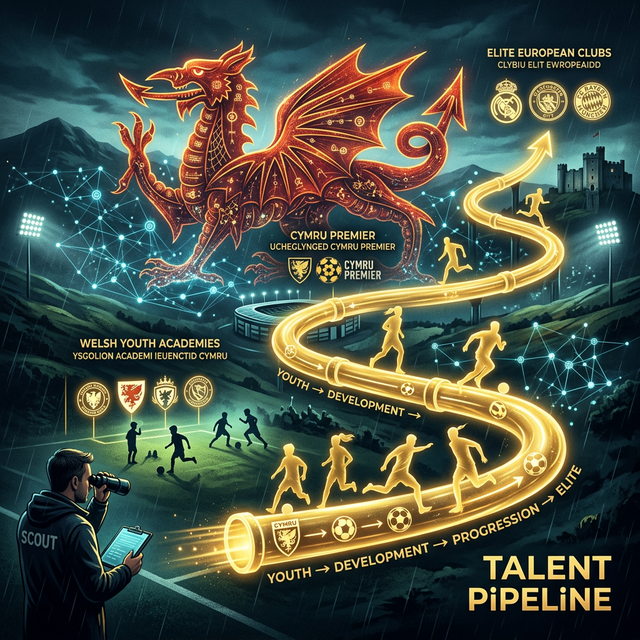
Youth Pathway to Senior Football
The pathway from youth football to senior competition in Wales follows a structured progression:
- Grassroots (ages 5-11): Community clubs and school football, with FAW-affiliated coaching programmes.
- Junior academy (ages 12-15): Club academies providing structured coaching, competitive fixtures, and performance assessment.
- Youth team (ages 16-18): Advanced coaching, physical development, and competitive exposure through FAW youth leagues.
- Development squad (ages 18-21): Bridge between youth and senior football, with loan opportunities and reserve team fixtures.
- First team (ages 18+): Full Cymru Premier registration and matchday involvement.
For the international dimension of this pathway, including how players progress from domestic clubs to Wales age-group squads, see our Youth International Pathway guide.
Scouting the Cymru Premier: What to Look For
Technical Assessment
Scouting in Welsh football requires calibration for the league's specific characteristics. The Cymru Premier is a physical league played on a mix of natural and artificial surfaces, with tactical systems ranging from direct counter-attacking to possession-based approaches. Key technical indicators include:
- First touch quality: On 3G surfaces, a clean first touch separates players who can transition to higher levels from those suited to the domestic game.
- Passing range: The compact nature of many Cymru Premier pitches rewards players with the vision and technique to switch play and find space.
- Set-piece delivery: Set pieces account for a disproportionate share of goals in Welsh football, making quality delivery a premium skill.
- Defensive positioning: The league's physicality means defenders who rely purely on pace are exposed -- tactical intelligence and positional discipline are stronger indicators of potential.
Physical Assessment
| Physical Attribute | Cymru Premier Average | English Championship Standard | Gap |
|---|---|---|---|
| Sprint speed (40m) | 5.2-5.5 seconds | 4.8-5.2 seconds | Modest |
| Aerobic capacity (VO2 max) | 52-58 ml/kg/min | 56-62 ml/kg/min | Moderate |
| Match distance covered | 9-11 km | 10-12 km | Modest |
| High-intensity sprints per match | 30-50 | 50-70 | Significant |
The physical gap between the Cymru Premier and higher leagues is real but not insurmountable. Players with strong technical foundations can bridge the physical gap through professional conditioning programmes -- a factor that makes technically gifted Welsh players attractive to clubs with good sports science infrastructure.
Tactical Awareness
The Cymru Premier's tactical landscape has become more sophisticated in recent seasons, with clubs increasingly employing data-driven approaches to match preparation. Scouts should assess:
- Decision-making speed: How quickly does a player read the game and execute? This translates directly across levels.
- Positional intelligence: Does the player understand space, pressing triggers, and defensive shape?
- Adaptability: Can the player operate in multiple formations? Welsh clubs frequently adjust systems between matches.
- European experience: Eight UEFA-licensed clubs provide European qualifying exposure, which tests players against unfamiliar styles and higher-intensity opposition.
Psychological Resilience
Welsh football presents specific psychological challenges that serve as useful indicators for scouts:
- Part-time demands: Most Cymru Premier players combine football with full-time employment or education. Players who maintain performance levels while managing dual commitments demonstrate exceptional mental organisation and motivation.
- Small-club pressure: In communities where the football club is central to local identity, players face intense scrutiny. Those who thrive under this pressure show the character needed for higher-level football.
- Adverse conditions: Winter fixtures on exposed Welsh grounds in challenging weather test mental toughness in ways that indoor academies cannot replicate.
Player Valuation and Transfer Market
Current Market Values
The Cymru Premier transfer market operates at a fraction of English and Scottish levels:
| Club | Total Squad Value | Average Player Value | Notable Players |
|---|---|---|---|
| The New Saints (TNS) | £2.5M | £80K-£100K | League's highest-valued squad |
| Connah's Quay Nomads | £1.2M-£1.5M | £50K-£70K | Regular European competitors |
| Penybont FC | £500K-£800K | £25K-£35K | Growing academy programme |
| Caernarfon Town | £400K-£600K | £20K-£30K | Strong local identity |
| Haverfordwest County | £350K-£500K | £18K-£25K | Youth development focus |
| League average | £300K-£600K | £15K-£30K | -- |
For detailed valuations, see our player values analysis and squad values and wages breakdown.
Transfer Fee History
Transfer fees for players moving from the Cymru Premier to English or Scottish clubs typically fall within the following ranges:
| Transfer Type | Typical Fee Range | Frequency |
|---|---|---|
| Free transfer / end of contract | £0 | Most common |
| Development compensation | £5K-£20K | Common for academy graduates |
| Negotiated transfer | £20K-£100K | Regular |
| Premium transfer (proven performers) | £100K-£300K | Occasional |
| Record-level transfer | £300K+ | Rare |
For a detailed analysis of cross-border transfer patterns, see our Welsh players signed by English clubs report.
Salary Comparison
The salary differential between the Cymru Premier and higher leagues represents the core value proposition for both scouts and players:
| League | Average Player Salary | Top Player Salary |
|---|---|---|
| Cymru Premier | £15K-£40K | £60K-£80K |
| Scottish Championship | £75K-£150K | £200K-£300K |
| English League Two | £50K-£100K | £150K-£250K |
| English League One | £100K-£200K | £300K-£500K |
| English Championship | £200K-£500K | £1M+ |
This means a player earning £30K in the Cymru Premier could realistically command £100K+ in the Scottish Championship -- a tripling of salary that makes the move attractive to both player and agent.
Scouting Infrastructure
How to Scout Welsh Football
For scouts unfamiliar with the Welsh domestic game, the following practical guidance applies:
- Fixture access: All Cymru Premier matches are accessible. Most grounds charge £8-£15 admission, and there is no accreditation barrier for scouts attending in a personal capacity.
- Broadcast footage: S4C/Sgorio broadcasts 30-40 live matches per season, with highlights available online. This provides an initial screening tool before committing to live attendance.
- Data availability: Performance data is improving but remains less comprehensive than in the EFL. Clubs' own match analysis is increasingly sophisticated, and some share data with prospective buyers.
- Networking: The Welsh football community is small and well-connected. Club managers and directors of football are generally accessible and open to transfer discussions.
Key Scouting Events
| Event | Timing | Opportunity |
|---|---|---|
| Cymru Premier season | August-May | Full league programme |
| FAW Cup rounds | September-April | Cross-tier matchups revealing hidden talent |
| UEFA qualifying rounds | June-August | Players tested against European opposition |
| FAW youth finals | April-May | Emerging academy talent |
| Wales age-group internationals | Throughout season | National-level youth players |
The Women's Talent Pipeline
The Adran Premier represents a parallel talent market with even greater undervaluation. Women's match attendance is growing 30-50% annually, and the three-tier Adran structure provides a development pathway from grassroots to senior competition.
For scouts evaluating women's football in Wales, see our women's investment guide and participation growth analysis.
Investment Implications
For investors rather than scouts, the talent pipeline has direct financial implications:
- Academy investment: Clubs that invest in academy infrastructure produce sellable assets. A £50K annual academy budget that produces one £100K transfer every two years delivers a positive return.
- Player trading model: Clubs that systematically identify, develop, and sell talent can build a self-sustaining financial model. Our investment returns analysis models this trajectory.
- Wage arbitrage: The salary gap between the Cymru Premier and higher leagues means Welsh clubs can attract quality players at affordable wages, compete domestically, and sell at a premium. See our club benchmarking data for how this plays out across the league.
Expert Insight
"The Cymru Premier is not just about today's performance but tomorrow's potential. Scouts who dismiss Welsh football because of its size are missing players who, with the right development environment, can compete at significantly higher levels. The league's expansion and growing professionalism are only going to increase the quality and depth of the talent pool."
-- FAW Talent Development Officer
Conclusion
The Cymru Premier talent pipeline offers scouts, agents, and investors a market where quality players are systematically undervalued relative to their potential. The combination of active academy programmes, competitive league football, European exposure for top clubs, and the broadening visibility driven by the Wrexham effect means the arbitrage opportunity is real -- but it will not last indefinitely as the league's profile continues to rise.
For scouts, the practical recommendation is simple: attend matches, build relationships with club staff, and evaluate players against the technical, physical, and psychological criteria outlined above. For investors, the recommendation is to prioritise clubs with strong academy infrastructure and a track record of player development, as these are the clubs best positioned to generate sustainable transfer revenue.
Sources: FAW youth development reports (2025-26), Transfermarkt squad valuations (March 2026), Cymru Connect internal analysis, club financial disclosures via Companies House, S4C/Sgorio broadcast data. Player valuations and salary estimates are based on publicly available data and industry sources.
Related reading: Youth Pathway | Scouting Report 2026 | Famous Players