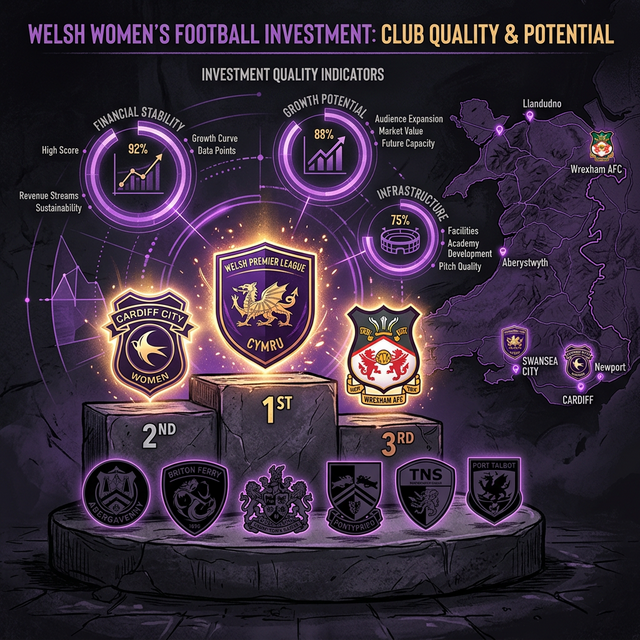
TL;DR: Welsh women's football clubs offer significant growth potential, with attendance increasing 30-50% year on year and most clubs carrying zero dedicated commercial partnerships. Cardiff City Women lead on brand and record (22+ titles), Swansea City Ladies carry second-city commercial potential, Cardiff Met Women offer a unique university-backed model, and Connah's Quay Women benefit from established men's club infrastructure. Valuations range from £50K to £500K — a fraction of comparable English clubs — making this one of Europe's most affordable women's football investment markets.
The Investment Landscape
Welsh women's football is at an inflection point. The Adran Premier, supported by growing FAW investment and expanding S4C/Sgorio broadcast coverage, is experiencing rapid growth across every measurable dimension: attendance, participation, broadcast reach, and commercial interest. The structural conditions that preceded the commercialisation of women's football in England (the WSL's transformation from 2018 onwards) are now present in Wales — but at a fraction of the price.
For investors, this creates a time-limited window. The clubs that professionalise earliest will capture disproportionate value as the market develops. Those that wait will face higher acquisition costs, increased competition, and entrenched incumbents.
This report ranks the most investable women's football clubs in Wales, assessing each on competitive record, commercial potential, growth trajectory, infrastructure, and valuation.
Market Overview
| Metric | Value | Source | Trend |
|---|---|---|---|
| Average attendance growth (per year) | 30-50% | FAW participation reports | Accelerating |
| Female football participation (Wales) | +35% since 2020 | Sport Wales data | Growing |
| Adran Premier broadcast coverage | Expanding | S4C/Sgorio | Growing |
| Number of Adran Premier clubs | 8 | FAW | Stable |
| Cardiff City Women consecutive titles | 5 | Welsh Football Historical Data | Current |
| Broadcast revenue per club | £80-120K | FAW financial statements | Stable |
| European revenue (qualifying clubs) | £50-200K | UEFA prize money data | Growing |
| Average club valuation (Adran Premier) | £100-200K | Cymru Connect analysis | Rising |
| Women's football sponsorship (UK-wide) | £50M+ | Deloitte Football Finance | Growing |
The 30-50% annual attendance growth rate is the headline statistic. While absolute numbers remain modest (most Adran Premier matches draw 100-400 spectators), the growth trajectory implies a market that will look fundamentally different in 3-5 years. Clubs that build commercial infrastructure now will be positioned to monetise that growth.
For the full women's football landscape, see the Women's Football Investment Guide and the Women's Football Investment Opportunity.
The Top Investment Targets
1. Cardiff City Women — The Market Leader
| Metric | Value |
|---|---|
| League titles | 22+ |
| Recent consecutive titles | 5 |
| Est. squad value | £450K |
| Est. total revenue | £250-400K |
| Attendance growth | 30-50% annually |
| European qualification | Regular (Champions League) |
| Commercial development | Underdeveloped |
| Est. valuation | £200-500K |
The Case: Cardiff City Women are the dominant force in Welsh women's football — not just currently, but historically. Twenty-two-plus titles represent a record of sustained excellence that few clubs at any level of the women's game can match. The Cardiff City brand association provides name recognition that extends beyond Wales, and regular Champions League qualifying appearances generate European exposure.
The Opportunity: The gap between brand equity and commercial monetisation is striking. Cardiff City Women's sponsorship revenue is a fraction of what the brand should command. A professional commercial operation could double commercial income within 18 months. The 30-50% attendance growth trajectory means the matchday proposition strengthens each season.
The Risk: The relationship with Cardiff City FC (men's) must be clarified during due diligence. Brand licensing terms, facility access arrangements, and operational independence are critical variables.
For the full profile, see the Cardiff City Women Investment Profile.
2. Swansea City Ladies — Second-City Brand Equity
| Metric | Value |
|---|---|
| League titles | Several |
| Est. squad value | £300K |
| Est. total revenue | £150-250K |
| Attendance growth | 25-40% annually |
| European qualification | Occasional |
| Commercial development | Limited |
| Est. valuation | £150-350K |
The Case: Swansea City Ladies carry the brand equity of Wales's second-largest football city. Swansea's Premier League history (2011-2018) created national and international brand recognition that benefits all teams operating under the Swansea City name. The club's location in South-West Wales gives it a geographic monopoly position in women's football — there is no competing Adran Premier club within 40 miles.
The Opportunity: Swansea's commercial potential is almost entirely untapped. The city's business community, university population (Swansea University has 20,000+ students), and cultural identity as a football city create a substantial sponsorship and audience base. A professional commercial operation, combined with university partnerships, could transform the club's financial profile.
The Risk: Competitive performance has been inconsistent. Unlike Cardiff City Women's dominance, Swansea's on-pitch results have fluctuated, which may complicate the commercial narrative.
3. Cardiff Met Women — The University Model
| Metric | Value |
|---|---|
| Est. squad value | £250K |
| Est. total revenue | £100-200K |
| Attendance | Lower than average |
| Academy/development output | High |
| University infrastructure | Significant subsidy |
| Commercial development | Minimal |
| Est. valuation | £50-150K |
The Case: Cardiff Met Women mirror the men's club's university-based model: student-athletes competing at the top level while pursuing degrees, with university facilities subsidising operations. The model produces a continuous pipeline of players at near-zero acquisition cost.
The Opportunity: For an investor interested in player development rather than competitive dominance, Cardiff Met Women offer the most cost-efficient platform in Welsh women's football. The university partnership reduces facility and coaching costs, while the student-athlete pipeline ensures squad replenishment without transfer spending. Partnership models (rather than outright acquisition) may be the most practical investment structure.
The Risk: The university-owned structure limits conventional acquisition paths. The club's competitive ceiling is constrained by the student-athlete model — dominant performances are unlikely, and key players graduate annually.
4. Connah's Quay Women — Infrastructure Advantage
| Metric | Value |
|---|---|
| Est. squad value | £200K |
| Est. total revenue | £80-150K |
| Men's club infrastructure | Significant (shared) |
| North Wales market position | Strong |
| Commercial development | Minimal |
| Est. valuation | £50-150K |
The Case: Connah's Quay Women benefit from the most developed men's club infrastructure in the Cymru Premier. The Connah's Quay Nomads men's team has invested in facilities, coaching, and commercial operations that the women's team can leverage at marginal cost. The club's location in North-East Wales — close to Chester, Merseyside, and the North-West England economy — provides access to a larger commercial catchment than most Welsh clubs.
The Opportunity: The men's club infrastructure reduces the standalone investment required to professionalise the women's team. Shared facilities, coaching resources, and commercial operations mean that incremental investment in the women's programme delivers disproportionate returns. The North Wales location also offers cross-border sponsorship opportunities.
The Risk: The women's team's identity and commercial strategy are linked to the men's club, which may limit independent decision-making for a women's-team-specific investor.
5. Other Clubs to Monitor
| Club | Est. Valuation | Key Feature | Investment Readiness |
|---|---|---|---|
| Aberystwyth Town Women | £30-80K | University town, community base | Early-stage |
| Wrexham Women | £50-150K | Wrexham brand, potential growth | Emerging |
| Port Talbot Town Women | £20-60K | Industrial community, low cost | Early-stage |
| Briton Ferry Llansawel Women | £20-50K | Neath/Port Talbot catchment | Early-stage |
These clubs represent the lowest-cost entry points in Welsh women's football, suitable for investors willing to build from a lower base. The development work is greater, but the acquisition cost is minimal and the growth ceiling is high if Welsh women's football continues its current trajectory.
What Makes a Club Investable
The strongest investment targets in Welsh women's football share several characteristics. Use this framework to evaluate any club:
The Investability Scorecard
| Factor | Weight | Assessment Criteria |
|---|---|---|
| Brand/name recognition | 20% | Brand equity, media profile, supporter loyalty |
| Competitive record | 15% | Recent results, historical titles, consistency |
| Growth trajectory | 20% | Attendance growth, participation growth trends |
| Infrastructure quality | 15% | Facilities, coaching, administrative capacity |
| Commercial headroom | 20% | Gap between current and potential commercial revenue |
| Valuation reasonableness | 10% | Price relative to assets and growth potential |
Applying the Scorecard
| Club | Brand | Record | Growth | Infra | Commercial | Valuation | Total |
|---|---|---|---|---|---|---|---|
| Cardiff City Women | 9/10 | 10/10 | 8/10 | 7/10 | 9/10 | 7/10 | 8.5 |
| Swansea City Ladies | 8/10 | 6/10 | 7/10 | 6/10 | 9/10 | 8/10 | 7.5 |
| Cardiff Met Women | 5/10 | 5/10 | 5/10 | 8/10 | 6/10 | 9/10 | 6.2 |
| Connah's Quay Women | 6/10 | 6/10 | 6/10 | 8/10 | 7/10 | 8/10 | 6.7 |
The Financial Opportunity
Revenue Growth Projections
Welsh women's football revenue is growing from a low base, but the trajectory is steep:
| Revenue Line | Current (avg. club) | 3-Year Projection | 5-Year Projection |
|---|---|---|---|
| Broadcast (FAW/S4C) | £80-120K | £100-150K | £120-200K |
| Matchday | £10-30K | £20-50K | £40-80K |
| Commercial/Sponsorship | £10-40K | £30-80K | £60-150K |
| Player sales/development | £0-10K | £5-20K | £10-50K |
| Grants | £20-50K | £30-60K | £30-60K |
| Total | £120-250K | £185-360K | £260-540K |
These projections assume continued attendance growth of 20-30% annually (decelerating from the current 30-50%), modest broadcast deal improvements, and progressive commercialisation. They do not assume transformational investment — they represent organic growth with basic professional commercial management.
For investors who actively professionalise the commercial operation and invest in marketing, the revenue trajectory could be significantly steeper. See the guidance on hiring a commercial manager for the practical roadmap.
Valuation Context
Welsh women's football valuations are remarkably low by any standard:
| Comparison | Est. Valuation Range | Notes |
|---|---|---|
| Top Adran Premier club | £200-500K | Cardiff City Women |
| Average Adran Premier club | £100-200K | Mid-table |
| Lower Adran Premier club | £20-80K | Development stage |
| English WSL club (average) | £5-15M | Professional |
| English Championship (women's) | £1-3M | Semi-professional |
| Cymru Premier men's club (average) | £650K | Established market |
For detailed women's football valuation methodology, see the Women's Football Club Valuations analysis.
The Structural Tailwinds
FAW Strategic Commitment
The FAW has committed to growing women's football as a strategic priority. This manifests as:
- Broadcast investment: Expanded S4C/Sgorio coverage of Adran Premier matches
- Facility funding: Grant programmes for pitch and facility improvements
- Coaching development: Subsidised coaching qualifications for women's football coaches
- Competition structure: The Adran North and South structure provides a development pathway below the Premier
The Post-World Cup Effect
The 2023 FIFA Women's World Cup catalysed interest in women's football globally, with participation increases of 20-40% in the 12 months following the tournament. Wales, which narrowly missed qualification, saw heightened domestic interest as the national team's profile rose. This structural tailwind is well-documented — see the Women's Football Growth and Participation Growth analyses.
UK Women's Football Sponsorship Market
The UK women's football sponsorship market has grown from approximately £10M in 2019 to over £50M in 2025. This growth is driven primarily by the WSL, but the rising tide of brand interest in women's football benefits all levels. Welsh women's football offers sponsors:
- Substantially lower costs than WSL or Championship sponsorships
- Authentic community association that resonates with local and national brands
- First-mover branding in an emerging market
- Cross-gender audience appeal (women's football attracts family-oriented, mixed-gender crowds)
For the sponsor's perspective, see the Sponsoring Women's Football ROI analysis.
Due Diligence Considerations
Investors evaluating Welsh women's football clubs should adapt the standard Due Diligence Guide with women's-football-specific considerations:
Ownership Structure
Many Adran Premier clubs are either subsidiaries of men's clubs (Cardiff City Women, Swansea City Ladies) or community-run organisations. The ownership structure directly affects:
- Acquisition pathway: Is the women's team separable from the men's club?
- Brand licensing: Can the women's team use the men's club's brand independently?
- Facility access: What happens to facility-sharing arrangements if ownership changes?
- Financial independence: Are the women's team's finances ring-fenced or commingled?
Player Contracts
Women's football at Adran Premier level involves a mix of professional contracts, semi-professional arrangements, and amateur registrations. An investor must understand the employment status of every player to assess cost commitments and HMRC compliance.
FAW and UEFA Women's Licensing
The Adran Premier champion qualifies for the UEFA Women's Champions League qualifying rounds. FAW licensing requirements for women's clubs are evolving and may become more stringent as the game professionalises. Verify current licensing status and anticipate future requirements.
Investment Strategies
Strategy 1: Acquire and Professionalise (£50-200K)
Acquire an Adran Premier club at current low valuations, hire a commercial manager, build a sponsorship portfolio, and develop the matchday experience. Target: double revenue within 2-3 seasons through commercial activation alone.
Strategy 2: Infrastructure-Led Growth (£200-500K)
Combine acquisition with facility investment — a 4G pitch, improved spectator facilities, or training ground development. This creates non-matchday revenue streams and attracts Sport Wales grant co-funding. See the Community Sports Hub guide for funding opportunities.
Strategy 3: Competitive Investment (£100-300K annual)
Invest in squad quality to dominate the Adran Premier and pursue Champions League qualifying campaigns. European exposure generates broadcast and prize revenue while elevating the club's brand to a national and international level. This is higher-risk but offers the most dramatic growth potential.
Strategy 4: Multi-Club Model
Acquire or partner with both a men's and women's club in the same geographic area, sharing infrastructure, commercial operations, and brand equity. This model — increasingly common in professional football globally — is particularly viable in Wales where men's and women's clubs often operate in proximity. A combined Cymru Premier and Adran Premier operation could achieve significant cost synergies while offering sponsors a dual-gender audience proposition.
Conclusion
Welsh women's football in 2026 resembles English women's football in 2015-2017: a market on the cusp of professionalisation, with structural growth drivers in place but commercial infrastructure absent. The clubs that professionalise first — hiring commercial staff, building sponsor portfolios, improving matchday experiences — will capture disproportionate value as the market develops.
Cardiff City Women are the standout investment target, offering the strongest brand, the best competitive record, and the largest commercial headroom. But Swansea City Ladies' untapped potential, Connah's Quay Women's infrastructure advantage, and Cardiff Met Women's cost-efficient model each offer distinctive investment propositions at price points that make early-stage venture capital look expensive by comparison.
For the full market context, see the Women's Football Investment Guide, the Adran Premier League Guide, and the Due Diligence Guide.
Source & Methodology
This report draws on FAW participation data, S4C/Sgorio broadcast distribution records, Sport Wales funding reports, Transfermarkt player valuations (March 2026), Deloitte's Annual Review of Football Finance (2025), and Cymru Connect's proprietary attendance, revenue, and valuation modelling. Attendance growth rates are based on FAW-reported figures and verified against available matchday data. Club valuations are Cymru Connect estimates informed by transaction comparables, revenue multiples, and asset-based approaches. All figures should be treated as informed estimates. Investors should conduct independent due diligence on any specific club.