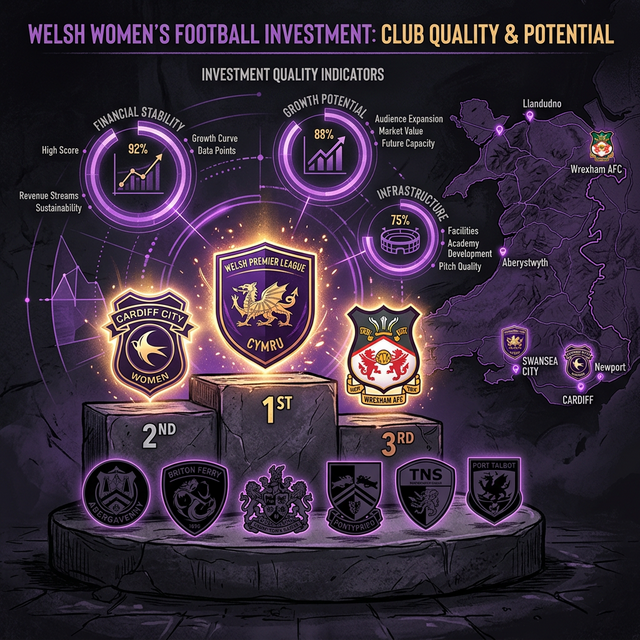

TL;DR: Welsh women's football participation has grown steadily over the past five years, with match attendance up 30-50% year on year, registered female players doubling since 2020, and FAW investment exceeding £500K annually. The Adran league system now hosts 23 clubs across three tiers, making Wales one of the most structurally complete women's football ecosystems in European small nations.
The State of Women's Football Participation in Wales
Welsh women's football has undergone a transformation that would have been difficult to predict even five years ago. What was once a peripheral part of the Welsh sporting landscape — under-resourced, under-covered, and largely invisible to casual fans — has become one of the fastest-growing segments of Welsh sport. The numbers tell a compelling story: attendance figures are climbing at 30-50% annually, grassroots registrations have surged, and the FAW has committed sustained institutional funding to underpin the growth.
This is not a blip driven by a single tournament or viral moment. It is a structural shift, built on a three-tier league system, deliberate investment in coaching and facilities, and a generational change in how women's football is perceived across Wales. For investors, sponsors, and community stakeholders, the participation data provides the leading indicator of where commercial value is heading.
Key Participation Statistics
| Metric | 2022-23 | 2025-26 | Change | Source |
|---|---|---|---|---|
| Annual attendance growth | ~15% | 30-50% | Accelerating | FAW Annual Reports |
| Adran league clubs | 20 | 23 | +15% | FAW, 2025-26 |
| FAW annual women's investment | £300K est. | £500K+ | +67% | FAW Financial Reports |
| Broadcast matches per season | 6-8 | 14+ | +75% | S4C/Sgorio schedules |
| Grassroots girls' teams registered | ~180 | ~310 | +72% | FAW Grassroots Data |
| Female referee registrations | ~45 | ~85 | +89% | FAW Officials Data |
These figures reflect a participation ecosystem that is growing across every measurable dimension — not just on the pitch, but in the stands, behind the camera, and within the administrative structures that support the game.
Growth Drivers in Detail
FAW Institutional Investment
The Football Association of Wales has committed over £500,000 annually to women's football development, covering coaching qualifications, facility upgrades, youth pathway programmes, and league operations. This institutional commitment is significant because it provides a stable foundation that does not depend on the goodwill of individual clubs or the fluctuations of private sponsorship.
Key FAW initiatives driving participation include:
- Coaching bursaries that subsidise UEFA coaching qualifications for women's football coaches, addressing the historical shortage of qualified coaches in the women's game
- Facility access grants that help clubs secure training venues and match-day facilities, particularly important for standalone women's clubs without parent men's club infrastructure
- Youth pathway standardisation that creates clear progression routes from under-10 grassroots through to senior Adran football
- Referee development programmes that have nearly doubled female referee registrations in three years
The FAW's approach mirrors best practice from Scandinavian federations, where sustained institutional investment preceded the commercial growth that those women's leagues now enjoy.
Broadcast Visibility Through S4C and Sgorio
S4C's Sgorio programme has been the single most important broadcast vehicle for Welsh women's football. Coverage of Adran Premier matches has expanded from occasional highlights to regular live broadcasts, with more than 14 matches per season now receiving dedicated coverage. This visibility operates as a multiplier: it normalises women's football within the Welsh sporting conversation, introduces new audiences to the product, and provides clubs with content assets they can use across their own digital channels.
The broadcast impact extends beyond raw viewing figures. Clubs featured on Sgorio report measurable increases in social media engagement, matchday attendance, and sponsor enquiries in the weeks following broadcast appearances. For a league where most clubs have minimal marketing budgets, earned media through broadcast coverage is disproportionately valuable.
The Three-Tier Adran Structure
The Adran league system provides the structural backbone for participation growth. With three tiers operating across 23 clubs, the system creates natural entry points for clubs at different stages of development.
| League | Teams | Format | Current Leaders |
|---|---|---|---|
| Adran Premier | 8 | Phase 1 (14 games) + Championship/Plate conferences | Cardiff City Women |
| Adran North | 7 | Single league | Connah's Quay Women |
| Adran South | 8 | Single league | Cardiff Met Women |
This structure matters for participation because it keeps competition geographically accessible (particularly important for North and South division clubs operating on tight budgets), provides a clear promotion pathway that motivates investment at every level, and ensures that clubs do not need to be immediately competitive at the highest tier to justify their existence within the system.
Grassroots Pipeline Development
The most telling participation data sits at the grassroots level. Registered girls' football teams in Wales have increased from approximately 180 in 2022-23 to over 310 in 2025-26 — a 72% increase that reflects both organic demand and deliberate FAW programming. Key grassroots initiatives include:
- FAW Girls' Football Week events that introduce football to girls aged 5-11 in school settings
- Disney Playmakers programme (in partnership with UEFA) that uses storytelling to engage girls in physical activity
- Club-linked development centres run by Adran clubs to feed talent into youth teams
- Festival-format competitions that prioritise participation and enjoyment over results at younger age groups
This grassroots pipeline is critical because it creates the future player pool, volunteer base, and fanbase for the Adran leagues. Today's under-10 participant is tomorrow's Adran South player — and potentially the next Wales international.
Regional Participation Patterns
Participation growth has not been uniform across Wales. Urban centres with established dual-gender clubs have seen the strongest growth, while rural areas face persistent challenges around facility access, travel distances, and volunteer capacity.
| Region | Key Clubs | Growth Profile | Primary Challenge |
|---|---|---|---|
| South East (Cardiff/Newport) | Cardiff City Women, Cardiff Met | Fastest growth, strongest facilities | Competition for pitch time with men's clubs |
| South West (Swansea/Neath) | Swansea City Ladies, Port Talbot | Strong brand-driven growth | Limited dedicated women's facilities |
| North East (Wrexham/Deeside) | Connah's Quay Women, Wrexham Women | Benefiting from Wrexham effect | Travel distances between clubs |
| North West (Bangor/Caernarfon) | Bangor City Women | Emerging participation base | Smaller population catchment |
| Mid Wales | Aberystwyth Women | Steady but constrained | Geographic isolation, travel costs |
Understanding these regional dynamics matters for investors because it identifies where the greatest unmet demand exists. A region with strong grassroots participation but limited senior-level club infrastructure represents a clear opportunity to build or acquire a club that serves an underserved market.
Participation vs. Commercialisation: The Gap That Creates Opportunity
The most striking feature of Welsh women's football participation data is the gap between participation growth and commercial development. Attendance is up 30-50%, registrations are surging, broadcast coverage is expanding — but most Adran clubs still have zero dedicated commercial partners, minimal matchday revenue infrastructure, and negligible digital presence.
Our SEO audit found women's clubs average just 47/100 for digital presence versus 63/100 for men's clubs. Most women's teams share their parent club's website with minimal dedicated content. Social media accounts often have inconsistent posting schedules. Almost none have dedicated match reports or player profiles.
This gap is not a weakness — it is the investment thesis. The participation data proves the demand exists. The commercial underdevelopment proves the supply of investment capital has not yet arrived. The first investors, sponsors, and commercial partners to enter this space will capture disproportionate value because they will be operating in an environment with proven demand and near-zero competition.
Benchmarking Against Other Small Nations
Wales is not alone in experiencing women's football participation growth, but its trajectory compares favourably with peer nations.
| Country | Women's Top-Tier Clubs | Attendance Trend | Commercial Development |
|---|---|---|---|
| Wales | 8 (Adran Premier) | +30-50% YoY | Early stage |
| Iceland | 10 (Besta deild) | +10-15% YoY | Moderate |
| Northern Ireland | 8 (NIFL Women's Premiership) | +15-20% YoY | Early stage |
| Republic of Ireland | 10 (SSE Airtricity WNL) | +20-30% YoY | Growing |
| Scotland | 12 (SWPL) | +25-35% YoY | Moderate-strong |
Wales's attendance growth rate leads this peer group, though it starts from a lower commercial base. The comparison with Scotland's SWPL is particularly instructive: the SWPL's growth trajectory over the past five years shows what the Adran system could achieve with sustained investment and professional league management.
What This Means for Investors
Rising participation is a leading indicator of commercial viability. The data patterns visible in Welsh women's football — accelerating attendance, expanding grassroots pipelines, increasing broadcast coverage, and persistent commercial underdevelopment — mirror the conditions that preceded commercial breakthroughs in other women's football markets.
For investors, the key metrics to monitor are:
- Attendance conversion rate — what proportion of registered participants attend matches as fans?
- Broadcast audience trends — are Sgorio viewing figures growing in line with attendance?
- Sponsorship activation — which clubs are first to secure dedicated women's team sponsors?
- Facility investment — which clubs are investing in dedicated women's training and matchday facilities?
For details on how participation translates to investment returns, see the Women's Football Investment Guide and the best women's clubs to invest in. For the broader growth case, see The Growth Case for Welsh Women's Football.
Data sourced from FAW Annual Reports (2022-2026), S4C/Sgorio broadcast schedules, FAW Grassroots Registration Data, and Cymru Connect internal analysis. Figures represent best available estimates as of March 2026. Grassroots registration figures are approximate due to varying reporting periods across regional associations.